


Across Kyrgyzstan, local authorities are spending public money on the shooting of free-roaming dogs. Procurement records reveal contracts specifying how many animals are to be killed, how frequently shooting operations should take place and how their bodies must be disposed of.
In one municipality, the target is 185 dogs. In another, shooting is scheduled every 15 days. Elsewhere, a contract calls for weekly operations across 14 villages. These are not unsubstantiated allegations circulating on social media. They are requirements set out in public procurement records issued by local authorities.
Dog Desk Animal Action has examined notices from several regions of Kyrgyzstan, alongside an official statement from the capital, Bishkek, defending the continued shooting of unattended dogs. Together, they reveal a deeply troubling approach to animal population management in which killing is commissioned, budgeted for and administered as an ordinary municipal service.
On 25 September 2026, Dostuk rural municipality in Chüy Region advertised a contract for the shooting, transportation and disposal of 185 stray dogs. The planned expenditure was 110,075 Kyrgyz soms, and procurement records subsequently identified a winning bid of 95,275 soms. Although the record does not establish whether the contract was completed or how many dogs were actually killed, it demonstrates that the municipality intended to purchase the destruction of a specified number of animals.
The figure of 185 raises an immediate question. How was that number determined? Were these dogs individually identified as dangerous, suspected of carrying rabies, or simply living without owners? Nothing in the publicly available description establishes that the animals were to receive individual veterinary assessments before being killed.
In Talas Region, Kara-Buura municipality issued a procurement notice on 6 April requiring stray dogs to be shot throughout its territory every 15 days. The planned budget was 299,700 soms, and the procurement record indicates that contracts were subsequently published. This is particularly disturbing because it describes a recurring programme rather than an intervention directed at an individual animal presenting an immediate danger. The record does not, however, establish how many dogs were killed after the contract was awarded.
A similar approach appears in Batken Region. On 14 July, Iskhak-Polotkhan rural municipality published requirements for weekly shooting operations across 14 villages, targeting stray dogs and those described as rabid. The contract also specified that bodies should be transported to a designated disposal pit in Zhenish village, with written confirmation that the service had been performed. The planned expenditure was 140,000 soms.
The reference to rabies is significant. Rabies is a serious and potentially fatal disease, and governments have an obligation to protect both people and animals from infection. But a dog living without an owner is not necessarily infected, and the distinction between a suspected rabies case and a healthy free-roaming animal must not disappear within a municipal contract. Effective rabies prevention requires sustained vaccination, surveillance and responsible population management, not the repeated removal of dogs.
In Kara-Kul, Jalal-Abad Region, a tender published on 3 April described the shooting of stray dogs in the city and nearby Ketmen-Tobo, followed by the transportation of their bodies to a designated disposal pit. Contractors were expected to possess hunting credentials, firearms permissions and suitable vehicles. The proposed budget was 150,000 soms. This particular procurement was declared unsuccessful after all bids were rejected, so it cannot be treated as evidence that animals were killed under the contract. Nevertheless, the requirements provide a revealing picture of the methods the municipality intended to employ.
The activity has continued into October. On 9 October, Jany-Jer rural administration in Batken Region advertised dog-shooting services for the final quarter of 2026, with a planned expenditure of 139,000 soms. Further tender listings published in mid-October refer to the shooting of stray dogs and cats in Salamalik and in the villages of Zhosholu and Korul. The inclusion of cats is particularly concerning, although the original procurement documents for these latest notices still require verification.
What makes these records so disturbing is not just the use of firearms. It is the apparent normalisation of repeated killing as a municipal responsibility. Budgets are allocated, contractors are invited to submit bids, schedules are established and arrangements are made for the disposal of bodies. The animals themselves appear primarily as quantities to be removed.
The position of Kyrgyzstan’s capital reinforces concerns that this is not an isolated practice. In an official statement addressing the legality of shooting stray dogs, Bishkek City Hall defended the activities of its municipal enterprise, Tazalyk, citing a 1995 city administration resolution and a 2007 Ministry of Health decision. According to the municipality, the latter recommended the continued capture and shooting of stray dogs and cats as a rabies prevention measure.
The city also referred to an average annual volume of operations involving approximately 12,000 unattended animals and expenditure of around 7 million soms. This must not be interpreted as confirmation that 12,000 animals are shot every year. The statement does not provide a sufficiently detailed breakdown of outcomes to establish an annual death toll. It does, however, demonstrate the scale of the municipal activity being discussed and the authorities’ willingness to defend lethal control as part of their approach.
There is a striking contradiction within Bishkek’s own explanation. While defending shooting, the municipality acknowledges the importance of sterilisation, registration, vaccination and responsible pet ownership. It also recognises that constructing shelters alone cannot resolve the problem without a comprehensive population-management programme.
That recognition makes the continued reliance on lethal control particularly difficult to justify. If the authorities understand that prevention is essential, why are municipalities repeatedly commissioning the killing of dogs instead of directing greater effort towards the measures capable of reducing the population humanely over time?
Shooting a dog does not prevent another from being abandoned. It does not stop uncontrolled breeding among owned animals or ensure that the next generation receives rabies vaccinations. Unless the underlying causes are addressed, municipalities risk repeating the same operations indefinitely, with successive generations of animals paying the price.
Public safety cannot be dismissed. Communities must be protected from genuinely dangerous animals, and suspected rabies cases require appropriate veterinary intervention. But there is an enormous difference between responding to an identified threat and treating the presence of an unowned dog as sufficient reason to kill it.
There are also serious welfare questions surrounding the methods used. Shooting an animal does not automatically guarantee an immediate, painless death. The circumstances, competence of the person using the firearm and procedures for dealing with wounded animals are critical. Yet the procurement descriptions examined do not provide enough information to establish what safeguards are in place, how suffering is prevented or whether veterinary personnel supervise the operations.
The records also leave important questions about accountability unanswered. How are dogs selected for shooting? What precautions prevent owned animals from being killed? Are residents warned before operations take place? What documentation is required to demonstrate that contracted work has been completed, and who verifies the numbers reported by contractors?
These questions become even more important when public money is involved. A procurement record can establish that a municipality has commissioned or proposed lethal control, but it cannot tell us how many animals actually died. Establishing the true scale requires contract completion reports, payment records, veterinary documentation and municipal statistics.
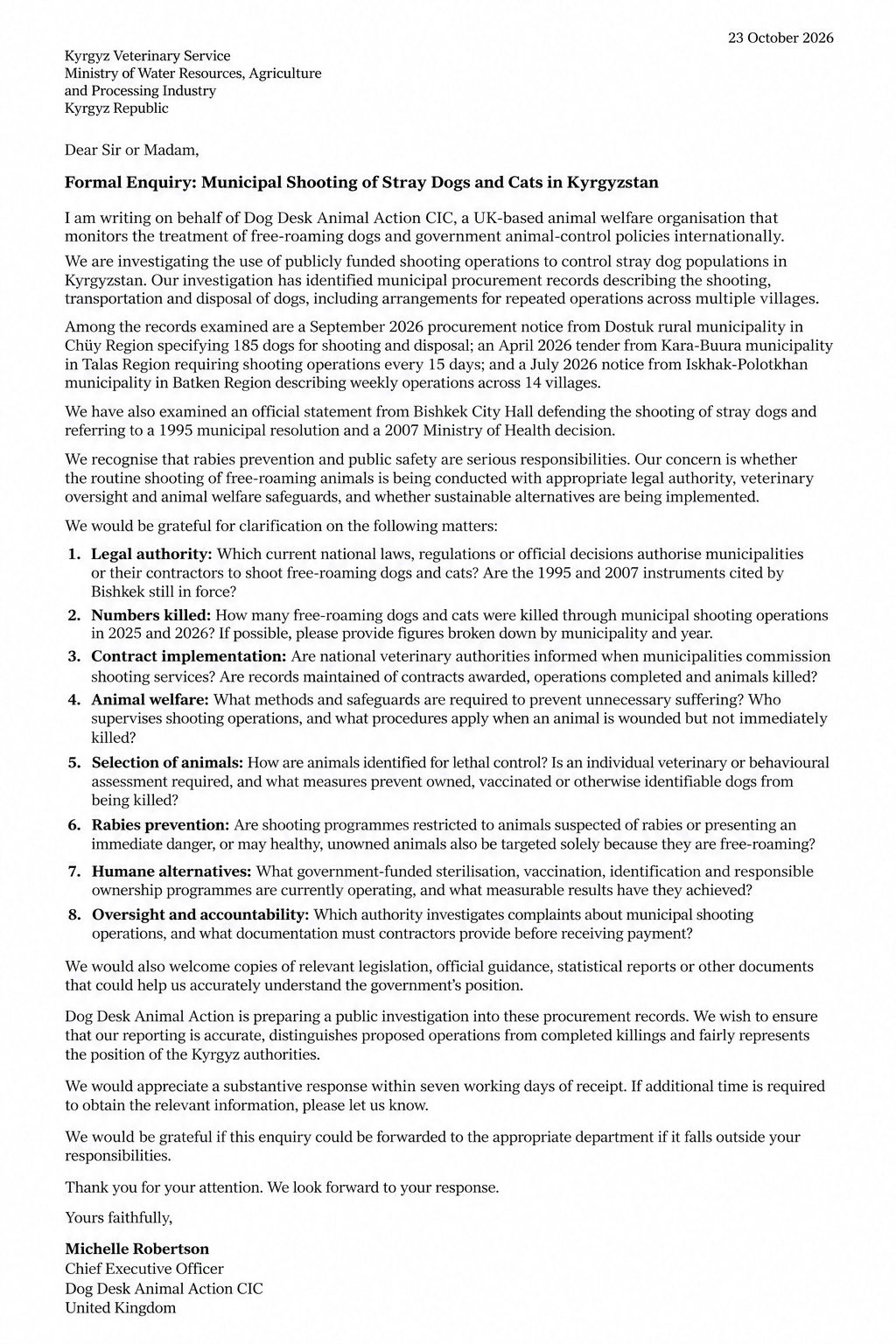
Dog Desk Animal Action has sought clarification from the relevant authorities about the legal basis for these programmes, their implementation and the measures being taken to develop humane alternatives. The original legal instruments cited by Bishkek also warrant examination, particularly to establish their current status and the safeguards they require.
Kyrgyzstan is already classified as CRISIS on our Global Stray Dog Crisis Map, and these findings provide further evidence supporting that classification. They document lethal-control procurement across several municipalities and regions, including arrangements for repeated shooting operations. Although the total number of animals killed remains unverified, the official records leave little doubt that shooting is an established component of local dog-control policy.
Behind every number in these contracts is an individual animal. Some will have spent their lives navigating streets and communities. Others may have been abandoned or born to dogs whose owners never arranged sterilisation. Their circumstances will differ, but none chose the conditions into which they were born.
A government can allocate money to destroy dogs, but doing so does not demonstrate that it has solved the problem that brought those animals onto the streets.
Kyrgyzstan’s street dogs are being counted in contracts for their destruction. They deserve to be counted as lives worth protecting.
Sources
Kyrgyzstan Public Procurement Portal — Kara-Buura municipality, 6 April 2026
Kyrgyzstan Public Procurement Portal — Kara-Kul municipality, 3 April 2026
Kyrgyzstan Public Procurement Portal — Iskhak-Polotkhan municipality, 14 July 2026
Bishkek City Hall — Official statement on the legality of shooting stray dogs