

Malaysia is offering payment to the public for catching dogs. What then happens to them?

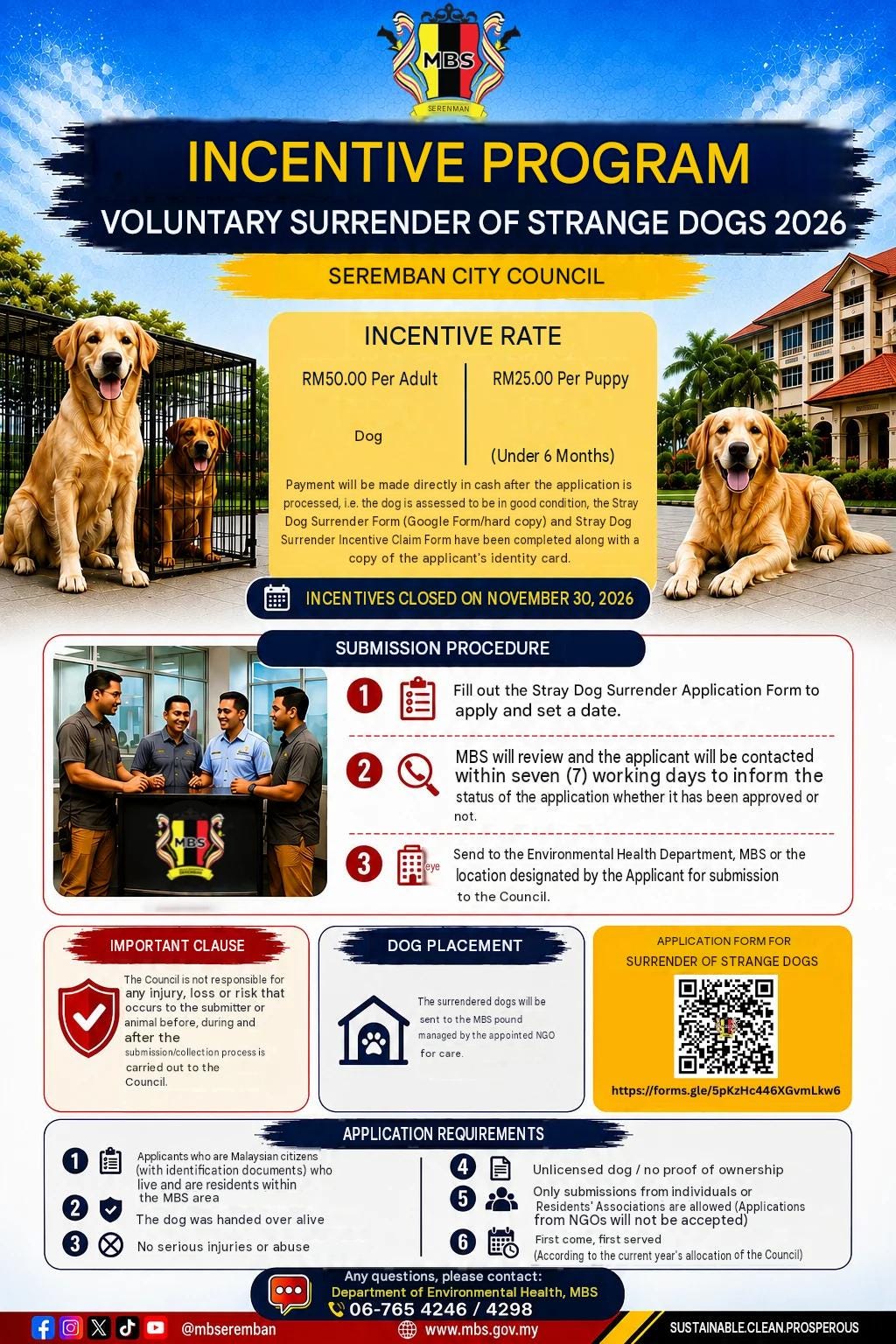
This morning I woke to a most disturbing notification on my phone.
The Seremban City Council in Malaysia is planning on paying people to catch dogs and then hand them over. Yes, you read that right. Ordinary citizens can catch stray dogs for a financial reward. They can scoop them up from the streets & cash them in at the local council.
This is not responsible dog population management!
Who is going to train the people who are going to catch these dogs? Will they even be trained? Has their competence been evaluated? What equipment have they been authorised to use? Have they been given any equipment at all? How is it going to be proven that a dog which has been captured is actually a stray? Will owned pets be taken from their homes & gardens & cashed in? Where are the dogs going to be taken? How many places are there? Who is going to examine them? Will they be injured if bad handling practices are used? For how long are they going to be kept? How can families recover their dogs? How many are going to be adopted, transferred, die or be put down? Will records be kept & published?
The payments have been announced by Seremban, but the accompanying accountability has not been published.
The 2026 Voluntary Stray Dog Surrender Incentive Programme run by the council will take place from 24 August to 30 November. It provides a payment of RM50 for each adult dog and RM25 for each puppy under six months of age which is handed over alive. It is necessary for applicants to live within the council’s area and for the dogs in question to have no proof of ownership.
The expression voluntary surrender is being used. A ridiculous phrase considering what is actually happening to the dogs. Dogs cannot volunteer to be surrendered; someone has to find them, catch them, take them away and hand them over to the council. The phrase being used makes it sound like an owner is voluntarily surrendering their dog but actually none of these dogs have owners. They are strays, many of which will be cared for in their communities by people who love them & look out for them. They certainly won’t be offering the dogs in this terrible scheme.
Catching stray animals is a skilled and dangerous task. If a dog is frightened (which it may well be when a stranger attempts to do something the dog is not expecting) it might run away, bite, hurt itself on inappropriate equipment or experience severe distress. Malaysian animal welfare lawyers have referred to the Veterinary Services Department’s guidelines which regard animal capture as a high risk activity and therefore require trained personnel. They also state that the council’s own Form SA 02 has applicants agreeing to take responsibility for any injuries or risks that occur during the capture. What if an untrained person is mauled during capture due to lack of training in capture techniques by a terrified dog. What if a dog is fatally injured? What happens then?
This is mind boggling stuff. The council knows that capturing the animals could result in injury, why is it paying members of the public to carry out the capture? Where was the risk assessment & who signed off on this as acceptable practice? Asking applicants to take the risk does not make the operation safe. It seems to shift the responsibility away from the authority which designed the programme and onto those people who are attracted by the payment. Do it at your peril & if it goes wrong too bad.
An noteworthy observation is the sum of money involved. The amount is far from trivial. At the exchange rate, RM50 is about £9. The statutory minimum wage in Malaysia is RM1,700 per month, which works out to around RM8.72 per hour. RM50 therefore corresponds to about five and three quarter hours’ worth of work at the minimum wage, most of a typical working day. The equivalent number of hours at the UK minimum wage would have a value of approximately £73. The RM25 given for the puppy is equivalent to nearly three hours of minimum wage work, which amounts to about £36 when expressed in terms of UK wages.
What this shows is the number of hours a worker earning the minimum wage in each country would have to work in order to earn that amount. It demonstrates the effect of the incentive. A single adult dog would be sufficient to earn most of a day’s wages. A number of dogs could earn several days’ income. That is quite an incentive to bring in as many adults & puppies as you can. And I would imagine a nursing mother with a large litter of pups would be seen as hitting the jackpot.
There is a clear danger in this situation, namely that the person giving over the dog has a financial reason to state that the animal is ownerless. How will the council know that this is in fact true? How will they know that the dog hasn’t simply been lifted out of somebody’s garden?
And what of a dog found roaming. A dog which is not licensed need not be a stray; it could be a lost pet, it might have escaped from a garden, it might be a dog that is allowed to roam freely and therefore owned, or it could be a community dog that is fed, looked after and cared for by the residents even though there is no official paperwork. A licence is an administrative record and not evidence that there is no human relationship. Does the council even know how many people haven’t licensed their dogs?
Seremban has never laid down a mandatory procedure for scanning each dog that is handed over for a microchip. And lets be real about this, not everybody chips their dogs even when there is an obligation. It has not explained how it checks against reports of missing animals. It has not committed to having a public photographic record of intakes. It has not said that residents will be informed if a dog which is a familiar member of the community is found. It has not published a clearly defined period during which dogs can be reclaimed or outlined the kind of independent evidence that the council will require before accepting a stranger’s claim that a dog belongs to no one.
How could Seremban prevent lost, wandering or dogs belonging to a community from being turned into cash if there were no such safeguards?
The council states that dogs must be alive and free from serious injuries or signs of abuse. Will the dogs be given a physical assessment by a veterinarian at point of exchange? How is phycological trauma assessed?
The council has not given any reason for having decided on the method of mass collection. In its statement it merely mentions population control, cleanliness, safety, and the well being of the community. We are unable to locate an assessment of the local dog population. Where are the figures regarding owned dogs, stray dogs, community dogs and truly unowned dogs? Where is the information on bites and cases of rabies? What is the level of sterilisation coverage? What are the known sources from which new dogs are entering the streets? What specific measurable result is the council trying to attain, other than the removal of visible animals? Do they have this information & chosen not to publish it or does it not exist?
According to the World Organisation for Animal Health, dog population management should be based on evidence, be sustainable, be monitored and evaluated. Authorities need to have a full understanding of the entire dog population and must deal with its various sources, such as abandonment, uncontrolled breeding, poor identification and irresponsible ownership. Just counting the dogs that can be seen today will not stop more dogs appearing to take their place tomorrow. Knowing what we know streets can be cleared of all dogs & a short time later more will more in to the empty territory. Will the council repeat the bounty?
There is also the most disturbing question of all: what takes place after capture?
A media account states that the mayor said the dogs handed over will be given to local NGOs for relocation and further management. But which organisations? How many dogs has each one agreed to take in? Where are their facilities located? What is the licensed capacity of these organisations? Who is going to pay for the dogs’ food, veterinary treatment, sterilisation and lifelong care? What does relocation involve? Will they be moved on to unfamiliar territories where they will either attempt to return or run the gauntlet with existing populations. Will they know where to access food water & shelter. Will community carers be able to absorb a population which suddenly increases?
The official programme announcement gives no answers to any of these questions that we can find today.
It also fails to state the expected number of animals to be collected, provides no information about the approved kennel capacity, has no intake procedure, no disease control plan, no veterinary assessment standard and makes no commitment to make public the individual outcomes. There is no public explanation of the circumstances under which euthanasia might take place. There is no promise to record and publish the deaths that occur in custody. How do we know that collected dogs will not be euthanised?
At the moment there is no evidence to show that the Seremban City Council has given its approval for animals to be killed as part of this scheme. We will not state anything for which there is no evidence, but we also will not regard silence as sufficient assurance. Since the government sets up a financial incentive to have animals brought into its care, it must be able to give an account of each and every one of them. So far there is no indication that they will.
Disturbingly a dog died while being captured by the Royal Klang City Council in Port Klang on 29 July. An investigation was launched by the police after it was reported that the dog had been tied and dragged during the operation. The council stated that the capture had been in response to complaints from residents and had been carried out in accordance with its local by laws. Even if the final outcome of the investigation is different, the death clearly showed that dog capture involves serious welfare risks. Given this incident it makes the permission given to citizens to capture dogs even more troubling.
Malaysia has been placed on the Dog Desk Animal Action Global Stray Dog Crisis Map Watchlist as a result of two events: a dog dying in a municipal capture operation and then another city paying members of the public to deliver dogs. Prior to this it’s status was stable.
We believe the incentive offered by the Seremban City Council should be suspended before it is launched & have written accordingly. If the Council refuses to do so, it must right away make public the names and positions of all the organisations and facilities that are to receive it; the qualifications needed of anyone who catches dogs; the authorised methods of capturing and transporting them; the procedures regarding microchipping, ownership and lost dogs; the process for reclaiming dogs; the veterinary and sterilisation protocols; the requirements for adoption and transfer; and the policy on euthanasia and deaths that occur in custody.
We believe that it should be required to maintain a traceable intake and outcome record which shows in each case where the dog was found, when it came into custody and whether the dog was recovered, adopted, transferred, stayed in custody, died or was put down. General assurances will not suffice. Each dog must have a record that can be audited. These are living breathing lives that are involved in this programme. There should be traceability & accountability at every step.
The council must also deal with the question which it has so far shied from: why is it paying the public to remove dogs when it could instead use that money to fund trained capture teams, identification, sterilisation, vaccination, enforcement of responsible ownership, and the prevention of abandonment? How much do they anticipate this scheme costing, what id their budget & how much has been spent on spay & neuter to control the population before resorting to this latest scheme.
Just because the government calls a programme systematic does not mean that it becomes responsible. An ill conceived idea doesn’t become humane simply because dogs have to be delivered alive, and sending animals to unnamed third parties does not count as taking responsibility.
The city of Seremban has set a price on each dog that the public can hand over. It now has to make clear who is responsible for protecting those dogs from the moment it is decided that they have value and have to show what becomes of them after the council has taken them over.
The sources include the official programme announcement by the Seremban City Council; The Star’s report on the risks involved in the capture operation and Form SA-02; comments that had been reported regarding the transfers of animals and the process of adoption; the report on the death that occurred during the Port Klang capture and the subsequent police investigation; the dog-population-management standard issued by the World Organisation for Animal Health; and Malaysia’s formal sector wage figures; as well as the minimum wage rates in the UK.