

Two legal challenges have brought Manisa’s dog collection arrangements under scrutiny, raising questions about the authority behind collection operations and the fate of animals transferred into municipal care.
On 19 October 2026, two legal challenges concerning the collection of stray dogs in Türkiye’s Manisa province came before the Second Administrative Court. The proceedings concern decisions made in October and November 2025 that established arrangements for collecting dogs and transferring them into municipal facilities. At the centre of the dispute are questions about the legal authority for these operations, the organisations involved and the facilities receiving the animals.
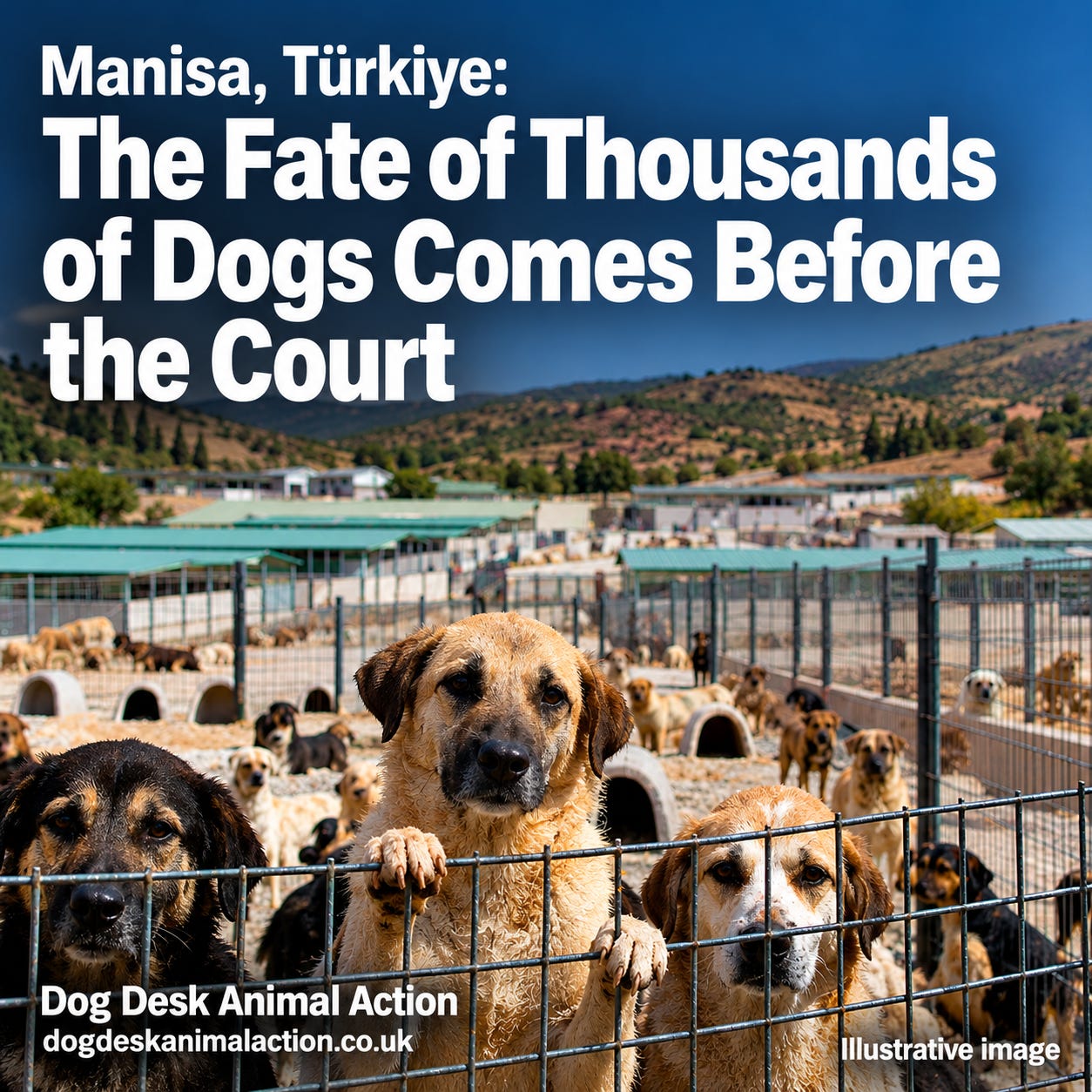
The scale of Manisa’s animal collection system is considerable. On 29 September 2026, Yunusemre Municipality published an account of an official visit to Manisa Animal Life Centre, stating that approximately 4,500 animals were being cared for at the facility. Although this provides an indication of the population under municipal responsibility, it does not distinguish between species or establish how many animals have passed through the centre since collection operations began.
The legal proceedings were brought by animal protection organisation HAKDEM and concern two separate administrative decisions. The first is Provincial Animal Protection Board decision 2025/9, dated 21 October 2025. The second is the Stray Dog Collection Cooperation Protocol, dated 8 November 2025, which established arrangements involving Manisa’s local authorities and other public bodies.
During the hearing, HAKDEM’s lawyer, Asya Erman, reportedly questioned the legal basis of the collection arrangements, including the alleged participation of personnel from Çanakkale Provincial Special Administration in operations taking place in Manisa. Their involvement has not been independently established through publicly available assignment records, leaving questions about whether such participation occurred and, if so, under whose authority. No final judgment was identified in reporting of the 19 October proceedings.
Concerns about the protocol had already emerged within local government. A Şehzadeler Municipality committee report, published among council documents for January 2026, examined the November agreement and raised questions about its legality and the suitability of arrangements at Sarıalan. The report identified a Provincial Public Health Board decision, numbered 2025/3 and dated 7 November 2025, among the decisions underpinning the protocol. This was separate from the Provincial Animal Protection Board decision now being challenged in court, indicating that several administrative decisions contributed to the collection framework.
The number of animals reportedly held in Manisa also raises questions about accommodation capacity. At a provincial meeting reported on 17 September 2026, officials gave a combined capacity of 3,195 animals across 15 shelters, alongside capacity for 24,247 animals in natural living areas across the province’s 17 districts. These figures refer to different categories of accommodation and cannot be directly compared with the approximately 4,500 animals reportedly held at Manisa Animal Life Centre. The centre’s own approved capacity and classification would be needed to establish whether its population falls within authorised limits.
The movement of dogs between municipal facilities adds another dimension to the investigation. In January 2026, reports indicated that 605 dogs had been transferred from Şehzadeler Municipality’s shelter to Yunusemre because the original facility was not fully operational. Separately, on 31 December 2025, Manisa Metropolitan Municipality announced that the Sarıalan animal holding area would close and that its animals would be transferred to Yunusemre Animal Life Centre. The municipality stated that veterinary teams would supervise the process and that the receiving facility would undertake health assessments and rehabilitation. The available reporting does not establish whether these movements involved separate groups of dogs or overlapping transfers.
There is also a financial and administrative dimension. Local reporting in December 2025 described allegations concerning a contract for the collection of 1,500 dogs, reportedly divided equally between Şehzadeler and Yunusemre. The arrangement was said to involve the provincial investment monitoring and coordination authority, YİKOB. These details have not been independently confirmed against the original procurement documents, but they raise relevant questions about who carried out collection operations, how the work was supervised and which authority assumed responsibility for the animals afterwards.
Taken together, the available evidence describes an extensive system involving municipal facilities, inter-authority cooperation, animal transfers and potentially contracted collection services. What remains difficult to establish is the outcome for individual dogs entering that system. A publicly accessible, comprehensive account of admissions, adoptions, subsequent transfers, deaths and euthanasia has not been identified in the material examined.
This does not mean that animals have disappeared or died without explanation. Nor does the reported population at Manisa Animal Life Centre establish overcrowding. Such conclusions would require evidence that is not currently available. The concern is that the scale of collection and confinement cannot be properly assessed through population figures and administrative announcements alone.
The legal challenges may eventually clarify important questions about the authority under which Manisa’s collection operations have been conducted. Their significance also extends beyond the courtroom, because responsibility for an animal does not end when it is delivered to a municipal facility. Dogs removed from their communities depend on the institutions receiving them for their safety, veterinary care and long-term welfare.
Manisa’s authorities have acknowledged thousands of animals in municipal care. The question now is whether the public record can establish what has happened to the dogs collected and transferred into that system.
Dog Desk Animal Action will continue examining publicly available municipal documents, court developments and Turkish-language reporting as further information emerges.
Sources and further reading
Şehzadeler Municipality — January 2026 council committee reports, including discussion of the November 2025 collection protocol.
Yunusemre Municipality — 29 September 2026 Official announcement: Manisa Animal Life Centre and approximately 4,500 animals
T.C. Yunusemre Belediyesi
Manisa Kulis Haber — 19 October 2026 HAKDEM’s legal challenges concerning the collection protocol and the fate of Manisa’s dogs
Son Dakika Manisa HaberManisa Meydan Gazetesi — 18 September 2026 Provincial figures: capacity for 3,195 animals in shelters and 24,247 in natural living areas