


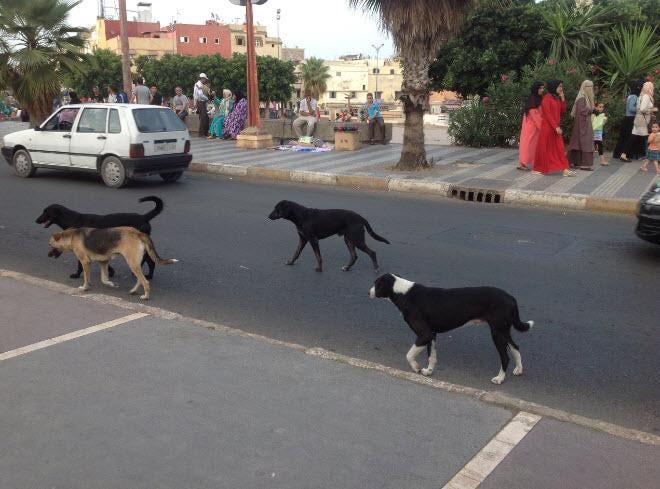
There is a difference between a country having stray dogs and a country entering an animal welfare crisis.
Across the world, many countries live alongside free-roaming dog populations. Some are stable community dog environments. Some are under strain. Some are slowly improving through sterilisation and vaccination programmes. Others are struggling under economic pressure, abandonment, weak infrastructure or political conflict.
But a flashpoint emerges when governments begin facing pressure to rapidly remove visible dog populations faster than humane systems can realistically absorb them.
That is why Morocco is now drawing ever growing international concern.
The issue is no longer simply about whether Morocco has stray dogs. The concern is what may now be happening to those dogs as international visibility intensifies ahead of the 2030 FIFA World Cup.
Animal welfare organisations, campaign groups and rescuers have raised allegations of large-scale removals, poisonings, shootings and culling operations linked to efforts to reduce the visible street dog population. Moroccan authorities and associated reporting have defended interventions as public safety and rabies control measures while also discussing newer legal frameworks intended to formalise stray animal management.
But this is where the global rescue community becomes deeply uneasy. Because history shows that when governments attempt to rapidly clean visible dog populations from streets, tourist areas or future event zones, humane infrastructure often struggles to keep pace.
Sterilisation takes time, vaccination takes time, community education takes time. Building shelters, staffing veterinary systems and implementing transparent management structures takes time.
Rapid removal campaigns do not. That is the point where a stray dog issue can become a welfare emergency.
Morocco now sits at the intersection of tourism, international image management, rabies control and animal welfare politics. That combination is volatile. Once international sporting attention arrives, pressure intensifies to create orderly public spaces. Dogs become highly visible symbols of disorder, poverty or risk, regardless of whether they are aggressive, vaccinated or community managed.
And when visibility becomes politically uncomfortable, animals can disappear very quickly. This is one of the reasons rescuers across multiple countries are increasingly using the term flashpoint when discussing Morocco. Not because every allegation has been individually proven beyond dispute, but because the overall pattern itself is familiar.
The global rescue community has seen similar warning signs before, rapid collection campaigns, sudden disappearances, conflicting official narratives, unclear shelter destinations and mounting reports from activists on the ground who say dogs are vanishing from areas faster than humane systems can account for them.
Once that begins happening at scale, fear spreads rapidly among rescuers because outcomes inside overwhelmed systems can become difficult to monitor.
Overcrowding increases disease, stress escalates aggression, injuries go untreated, mortality rises & transparency weakens. And the public often sees only the empty street afterwards, not what happened or is happening behind closed gates.
This is why many rescuers argue the conversation about Morocco should not be reduced to simplistic arguments about whether street dogs should exist. The real question is whether population management is being approached through sustainable long-term infrastructure or through rapid visible reduction under international pressure. Those are not the same thing.
One attempts to gradually stabilise populations over years through sterilisation, vaccination, veterinary access and abandonment prevention. The other prioritises making dogs disappear quickly.
And globally, animal welfare history shows that when speed becomes the primary political objective, dogs often pay the price.
Morocco’s situation matters beyond Morocco itself because it reflects a growing international tension that rescuers are increasingly confronting worldwide, what happens when governments face pressure to remove visible dog populations before humane systems are ready?
That question is no longer theoretical. It is already shaping the future of street dogs in multiple countries. And for many animal welfare groups watching Morocco now, the fear is not simply that dogs are at risk. It is that the world may already be witnessing the early stages of another large-scale animal welfare crisis unfolding in real time.