Something happening in Mumbai has caught our attention. The Brihanmumbai Municipal Corporation (BMC) is drawing up plans to deal with street dogs who must be removed from specified institutional premises following directions from India’s Supreme Court. These include places such as schools, colleges, hospitals, railway stations and bus depots. Dogs removed from these locations are not sterilised, vaccinated and returned to the same area, which creates an obvious problem. Where are they going to go?
BMC is now reportedly looking for land outside Mumbai where shelters could be established. It is also considering using agencies to house and care for the dogs, with those agencies potentially being paid for the lifetime of each dog while the animal remains in their care. That concerns us because once we start talking about removing large numbers of free living dogs and paying organisations to keep them for the remainder of their lives, we are no longer talking about temporary animal management. We are potentially creating a system of mass, long-term confinement.
Mumbai has an estimated street dog population of around 90,000 and does not currently have anything approaching the shelter capacity required to accommodate that number. We need to be very clear that this does not mean all 90,000 dogs are destined for shelters. The Supreme Court directions we are discussing concern dogs removed from specified institutional premises and Animal Birth Control remains central to the wider management of India’s street dog population. Indeed, only days ago the Bombay High Court told Maharashtra to implement its ABC programme aggressively, with the emphasis firmly on sterilisation rather than simply catching dogs.
We welcome that approach, but Mumbai still needs somewhere for the dogs who cannot be returned to institutional premises, and that is where we believe questions need answering before large-scale removal begins. How many dogs does BMC expect to place into lifetime care? How much capacity will actually exist before collection begins? Where will these facilities be located and what standards will they have to meet? Who will inspect them and will inspections be unannounced? Most importantly, will BMC be able to account for every individual dog placed into the system?
There is also the question of how the proposed funding model will work. If an organisation is paid for the lifetime care of an individual dog for as long as that animal remains in its custody, there needs to be very clear safeguards around that arrangement. Dogs who can be responsibly adopted should not spend their lives in shelters, and the funding system must not inadvertently create a financial incentive to retain animals who could otherwise be rehomed. That is not an allegation against any organisation that may eventually participate. It is a basic governance question that should be addressed before public money begins following dogs into long-term private or third-party care.
Traceability will be equally important. Every dog entering lifetime care should be individually identifiable and there should be a record of where that dog was collected, where they were taken and what happened afterwards. Transfers should be recorded. Adoptions should be recorded. Deaths should be recorded. If a dog is moved from one organisation to another, that movement should be visible. If public money is paying for the lifetime care of an individual animal, the authority funding that care should be able to demonstrate that the dog remains alive, where they are and that appropriate care is being provided.
There is a reason we are particularly sensitive to this. We have spent considerable time monitoring what has happened to street dogs in Türkiye. The circumstances are different and we are not suggesting that Mumbai is Türkiye, but Türkiye provides an important warning about what can happen when getting dogs off the streets becomes the priority while questions about capacity, destinations and outcomes follow behind.
The Turkish government now says that almost all of the country’s unowned street animals have been collected. We have repeatedly asked a very simple question: where are they? Collection percentages tell us how many animals authorities say have disappeared from the streets. They do not tell us whether those dogs are alive, where they are being held, what conditions they are living in or what ultimately happened to them. Without transparent outcome data, the public is being asked to accept a collection figure without being able to follow the dogs behind it.
That is precisely why Mumbai has an opportunity to get this right before the system grows. Shelter capacity cannot be an afterthought and neither can veterinary provision, staffing, funding, inspection or traceability. A dog entering a facility at three years old could remain there for another ten years or more. Multiply that by thousands of dogs and lifetime care becomes an enormous welfare, logistical and financial commitment.
Those dogs will need appropriate accommodation, food, veterinary treatment, vaccination, parasite control, exercise, behavioural support, disease management, cleaning, staffing and emergency care every single day. Somebody will need to make sure those standards are maintained not just when a new facility opens and everybody is watching, but five or ten years later when the dogs are older and the political attention has moved elsewhere.
There is also a wider policy issue that needs watching. Maharashtra is being told to increase sterilisation while Mumbai is simultaneously having to develop permanent accommodation for dogs removed from institutional premises. Those approaches need to work together. Effective ABC addresses future population growth while lifetime confinement deals with dogs already living on the streets. The danger comes if permanent sheltering gradually becomes an easier substitute for effective population management, vaccination, responsible ownership and prevention.
We have seen elsewhere how quickly the conversation can move from managing street dog populations to removing street dogs. Once that happens, capacity becomes everything. If collection moves faster than safe, properly funded and transparent accommodation, the dogs carry the consequences.
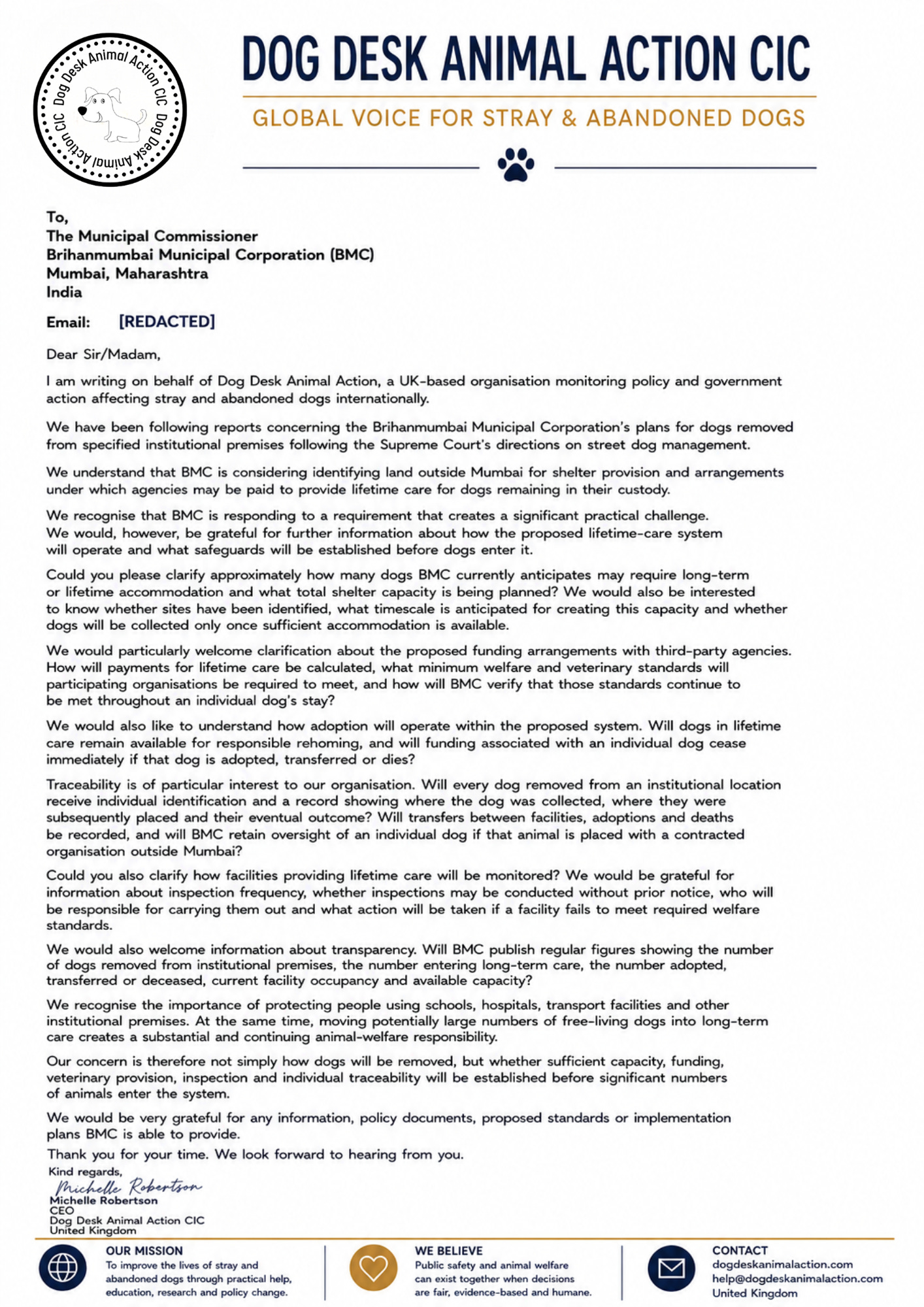
Dog Desk Animal Action has contacted BMC to ask how many dogs it expects to place into lifetime care, what capacity will be created, how the funding model will operate, what inspection and welfare safeguards will apply and how every individual dog will remain traceable throughout the system.
We hope the answers provide reassurance because there is a very simple lesson governments can take from what we have been documenting elsewhere.
Don’t collect thousands of dogs and then work out where you are going to put them. Work that out first.