
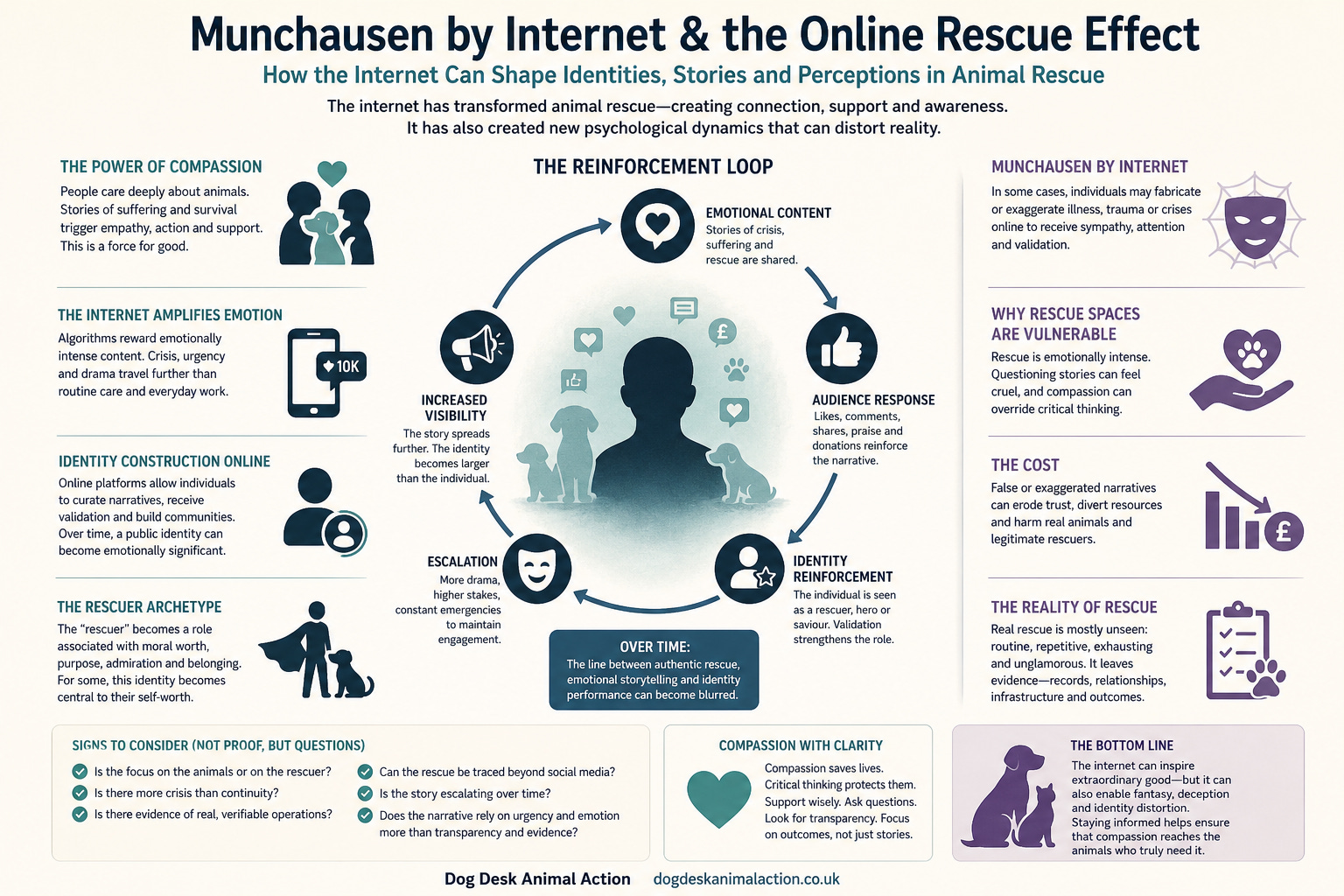
In 2000, psychiatrist Dr. Marc Feldman introduced the term Munchausen by Internet to describe a growing phenomenon: individuals fabricating illness, trauma, or personal crises online in order to receive emotional support, validation, sympathy, or social significance.
At the time, most documented cases involved:
fake cancer diagnoses,
fabricated bereavements,
invented medical emergencies,
or false personal tragedies.
The internet had created a new psychological environment in which identity could be constructed through storytelling, emotional response, and community reinforcement.
Twenty-five years later, online culture has evolved dramatically, but many of the same psychological mechanisms remain highly relevant including within animal rescue spaces.
This is not an accusation aimed at rescuers generally. Most rescue work is genuine, difficult, and often psychologically exhausting. However, the structure of social media itself may unintentionally create conditions in which identity, emotional validation, and rescue culture become unusually intertwined.
The Psychology of Online Reinforcement
Human behaviour is strongly shaped by reinforcement. On social media, reinforcement arrives instantly:
likes,
comments,
praise,
emotional responses,
shares,
donations,
and follower growth.
Research into online behaviour has repeatedly shown that emotionally charged content receives disproportionately high engagement. Content involving:
suffering,
moral conflict,
hope,
redemption,
or crisis
travels further and generates stronger reactions than ordinary daily activity.
Animal rescue naturally contains many of these elements. As a result, rescue content often performs extremely well algorithmically, particularly when framed around:
emergency intervention,
dramatic recovery,
severe neglect,
imminent death,
or personal sacrifice.
Over time, this creates a feedback system between audience response and personal identity.
Identity Construction Online
Psychologists have increasingly studied the internet not simply as a communication tool, but as an environment for identity formation. Online platforms allow individuals to:
curate narratives,
selectively present aspects of themselves,
receive continuous social feedback,
and build emotionally meaningful communities around shared values.
In many cases this is positive. Communities built around illness, grief, activism, or rescue can provide genuine support and purpose.
However, the same systems can also encourage what researchers sometimes describe as identity amplification:
a gradual expansion of a public role or persona through repeated reinforcement.
In rescue spaces, this can manifest as the development of a highly symbolic rescuer identity, particularly when compassion-based content becomes central to a person’s online presence and social validation.
The Emergence of the Rescuer Archetype
Historically, rescue work was largely invisible outside local communities.
Social media changed this. Rescuers are now public-facing figures with large audiences, emotionally engaged followers, and highly visible narratives.
This visibility can create what sociologists sometimes call a moral identity role:
a socially reinforced perception of oneself as a compassionate protector, saviour, or advocate.
Again, this is not inherently unhealthy. Many people involved in animal welfare derive genuine meaning and resilience from their work. However, problems can emerge when:
public identity becomes heavily dependent on emotional engagement,
audience validation becomes psychologically important,
or the symbolic role of rescuer begins overshadowing operational reality.
In these situations, social media can unintentionally reward emotional presentation more strongly than routine care work itself.
Identification, Admiration, and the Desire to Become the Rescuer
Another aspect of online rescue culture that receives little discussion is the role of identification and aspirational identity formation.
Highly visible rescuers often become symbolic figures online. They represent:
compassion,
purpose,
redemption,
resilience,
and moral certainty in a chaotic world.
Followers may form strong emotional attachments not only to the animals, but to the rescuer identity itself.
Psychological research into parasocial interaction shows that people can develop meaningful emotional identification with public figures despite never meeting them directly. In emotionally charged spaces such as rescue, this effect may become particularly strong.
For some individuals, especially those experiencing loneliness, instability, or a lack of personal direction, the rescuer role can appear psychologically transformative:
a way to become significant, admired, needed, or morally valuable.
Social media platforms intensify this process because they provide continuous reinforcement:
praise,
gratitude,
emotional intimacy,
community belonging,
and public recognition.
Over time, this may contribute to what psychologists sometimes describe as identity fusion where admiration gradually shifts into attempts to psychologically embody the admired role itself.
In online rescue culture, this can create an environment in which:
symbolic language expands,
ordinary acts become heavily narrativised,
emotional storytelling intensifies,
and the distinction between authentic rescue work and performed rescue identity becomes increasingly blurred.
Importantly, this does not necessarily begin with malicious intent. In some cases, the online identity may evolve progressively through emotional reinforcement and audience response rather than deliberate deception from the outset.
Why Crisis Narratives Spread So Easily
One important aspect of online rescue culture is that dramatic narratives consistently outperform ordinary operational content. Routine but essential work:
feeding,
cleaning,
behavioural management,
sterilisation,
administration,
transport logistics
rarely generates the same engagement as:
emergency surgeries,
catastrophic events,
collapsing facilities,
rescue deadlines,
or dramatic personal sacrifice.
This is partly an algorithmic issue rather than an individual moral failing. Platforms are designed to maximise engagement, and emotionally intense content is highly engaging.
The result is a structural tendency toward visibility of crisis over visibility of routine care. Over long periods, this can distort public understanding of what rescue work actually consists of.
Munchausen by Internet and Rescue Culture
Dr. Feldman’s original work on Munchausen by Internet focused on fabricated illness narratives, but the broader psychological principle is relevant here:
online environments can reinforce identities built around sympathy, moral significance, and emotional response.
In some cases, individuals may gradually move from:
admiring rescue culture,
to participating in rescue discourse,
to psychologically identifying with the role of rescuer itself.
For psychologically vulnerable individuals, the distinction between:
supporting rescue,
andembodying the rescuer identity
may become increasingly blurred.
Importantly, this does not necessarily begin as deliberate fraud. In some online behavioural patterns, exaggeration and identity performance appear to evolve progressively through reinforcement and audience response.
Parasocial Communities and Emotional Centrality
Modern social media also encourages parasocial attachment, one-sided emotional relationships between audiences and public figures.
Rescue accounts often develop highly emotionally bonded communities. Followers may feel:
personally connected,
morally invested,
protective,
or emotionally dependent on the rescuer narrative.
Language within these spaces frequently becomes collective and symbolic:
journey
hope
family
community
souls
together.
Again, none of this is inherently manipulative. It reflects genuine emotional investment. But it also increases the psychological importance of maintaining the public identity around which the community is organised.
The Importance of Operational Reality
One consistent observation from experienced rescue workers is that legitimate rescue operations produce substantial visible operational evidence over time, sometimes all or some of the below
veterinary partnerships,
foster systems,
transport logistics,
adoption records,
sterilisation work,
routine updates,
local community involvement,
and long-term continuity of care.
These elements rarely attract viral attention, but they are the structural foundation of real rescue work.
As online rescue culture continues to grow, maintaining attention on operational transparency rather than purely emotional storytelling may become increasingly important both for public trust and for animal welfare itself.
Conclusion
The internet has fundamentally altered not only how animal rescue is seen, but how rescue identity itself is formed and reinforced.
Most people involved in rescue spaces are acting in good faith. Many are carrying extraordinary emotional and financial burdens in order to help animals survive.
However, social media platforms are not psychologically neutral environments.
They reward emotional intensity. They amplify symbolic narratives. They reinforce identity performance.
And they can blur the boundary between authentic work, emotional storytelling, and public persona.
Understanding these dynamics does not weaken compassion. If anything, it may help protect it.


