


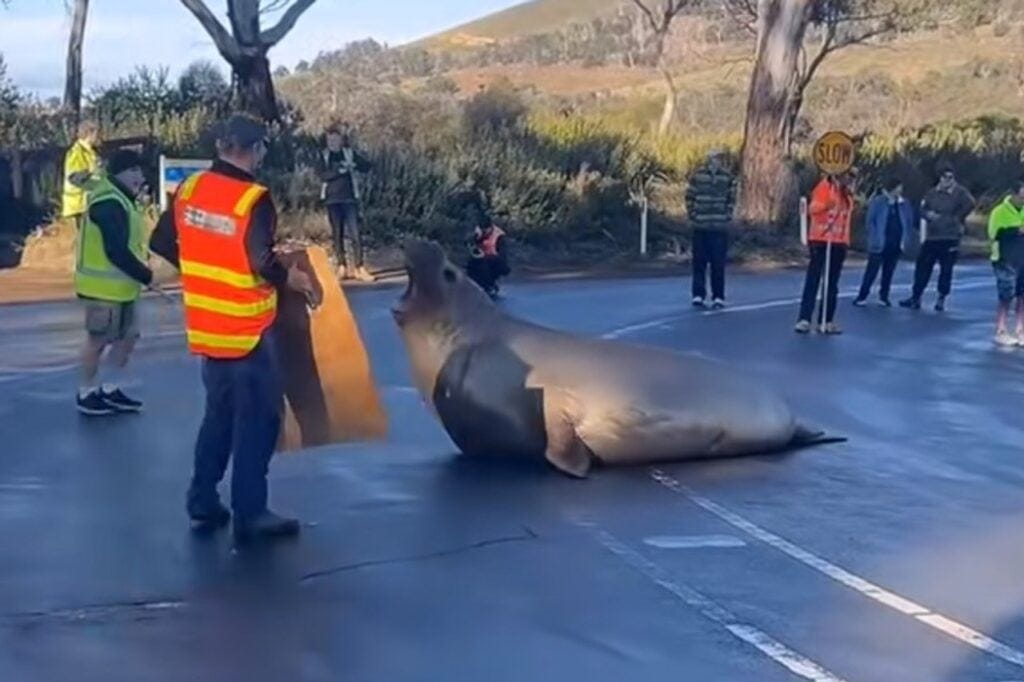
There are few wild animals that capture people’s hearts quite like Neil.
Over the past few years, this young Southern elephant seal has become something of a celebrity in Tasmania. Every time he appears, thousands of people stop what they’re doing to follow his latest adventure. His gentle nature and unmistakable character have introduced countless people to a species they may never otherwise have thought about.
We love Neil, which is exactly why we’re becoming increasingly concerned for his safety. As Neil grows, so does the risk.
What may once have seemed like an amusing wander through a neighbourhood is now a one tonne wild animal moving through roads, traffic, fences, gardens and crowds of people. It only takes one mistake for curiosity to become tragedy.
Roads are dangerous & people can be unpredictable.
Not everyone respects wildlife, and while most people simply want a photograph, it only takes one person making a poor decision to put Neil at risk. Equally, if Neil feels threatened or cornered, someone could be seriously injured. None of us want either outcome.
Recent footage of Neil being guided back towards the beach has prompted strong reactions around the world. Many people found it upsetting to watch. Others pointed out that moving such a large wild animal is never going to be straightforward.
But perhaps the discussion has become focused on the wrong question.
Instead of asking how Neil should be moved once he reaches a residential street, perhaps we should be asking why we keep reaching that point at all.
Neil is no longer an unexpected visitor. His movements are well known. His behaviour is well documented. We know he likes to haul out in certain areas and we know he has a habit of exploring beyond the shoreline.
That raises an important question. Is it time for Neil to have a long-term management plan?
Could a designated haul-out area be created on a beach he already favours?
Could temporary exclusion zones help reduce disturbance while he rests?
Could volunteers help educate visitors and encourage people to admire Neil from a respectful distance?
Could roads be managed earlier if he begins moving inland?
Could intervention become calmer and more structured because everyone already knows the plan?
Perhaps none of these ideas would prevent Neil from wandering. He is a wild elephant seal, and that is exactly as it should be. But if there is an opportunity to reduce the number of times he ends up on busy roads, surely it is worth exploring.
Wildlife management should not simply be about responding to the latest incident. It should also be about learning from patterns and adapting as circumstances change.
Neil has become part of Tasmania’s story. He inspires children, attracts visitors and reminds us that remarkable wildlife still shares our world. That makes him far more than the subject of another viral video. It also gives us an opportunity to think differently about how we coexist with animals that choose to live alongside us.
He deserves more than another trip back to the beach.
He deserves a plan that keeps him safe, allows him to remain wild and helps ensure that the next generation can fall in love with him too.