
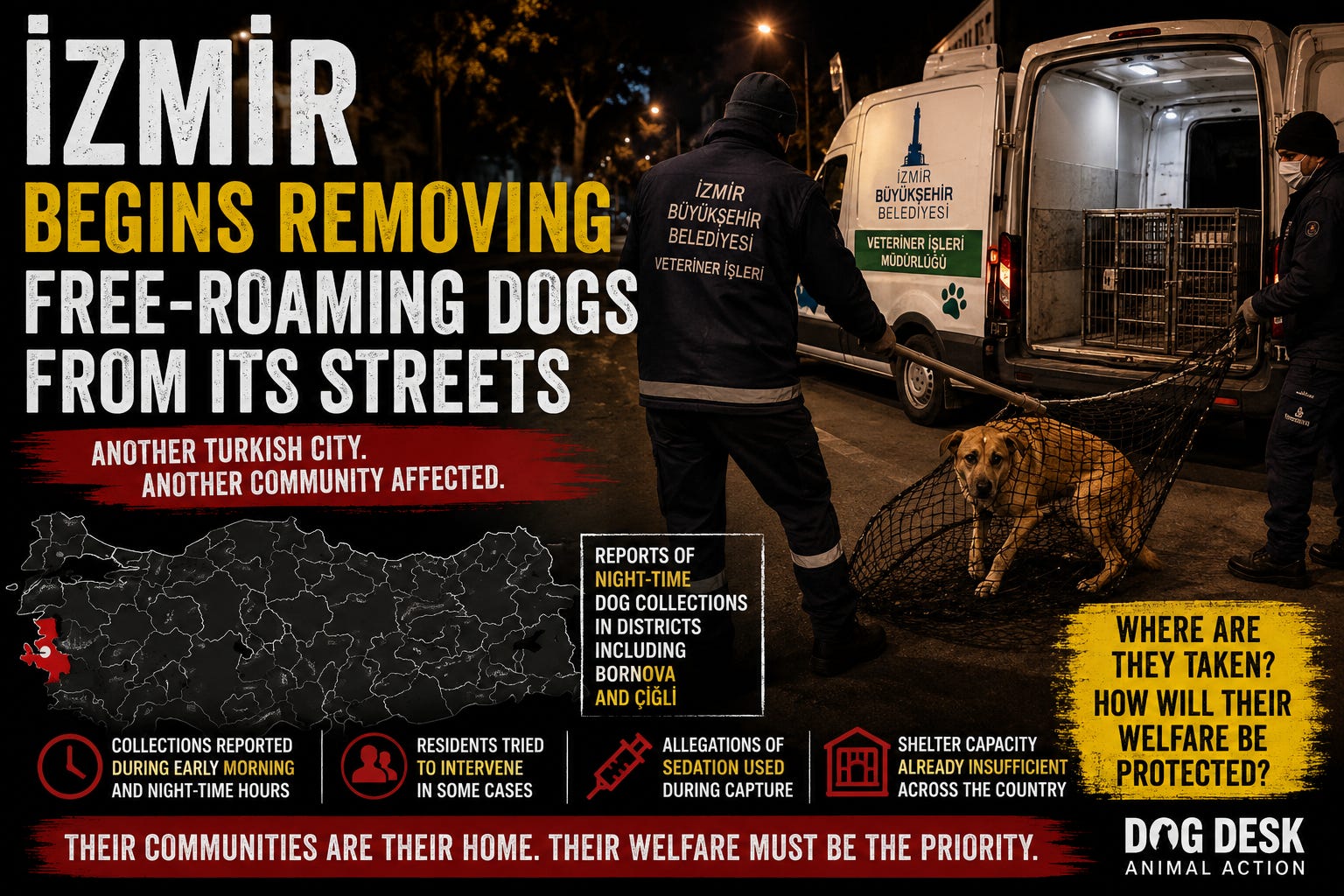
The removal of free roaming dogs from Turkey’s streets is no longer confined to a handful of provinces. Reports from İzmir suggest the programme is continuing to spread, with dogs now being collected from another of the country’s major cities as pressure grows on municipalities to comply with government expectations.
According to local reporting, municipal teams have been carrying out dog collection operations in districts including Bornova and Çiğli. Residents have shared videos online showing dogs being removed during the early hours of the morning and at night, prompting concern among local animal advocates who say the collections are becoming increasingly difficult for the public to witness or challenge.
Representatives animal welfre organisations in İzmir claim municipalities are acting under instructions passed through the Governor’s Office following calls for free roaming dogs to be removed from the streets before the end of the year. While those claims have not been independently verified, they reflect concerns that have been voiced repeatedly across Turkey over recent months as the country’s new approach to free roaming dogs continues to unfold.
Perhaps the most pressing question is not whether municipalities are collecting dogs, but where those dogs are supposed to go.
Across Turkey, local authorities have repeatedly acknowledged that shelter capacity is limited. New facilities take time to build, existing shelters are already under pressure and many municipalities simply do not have the space required to accommodate large numbers of healthy free roaming dogs. Every announcement of another collection programme therefore raises the same concern. If thousands of dogs are removed from their communities, where will they all be housed, who will care for them and what happens when the available space runs out?
Those are not theoretical questions. They are questions that should have been answered before large scale removals began.
Videos from İzmir show dogs being tranquillised before they are removed from their communities. The scenes have intensified concern among animal welfare organisations and local residents, who fear not only the methods being used to capture free roaming dogs but also the conditions awaiting them once they enter municipal shelters. For Dog Desk Animal Action, the overriding concern is that no dog should be removed from its community only to face poorer welfare in overcrowded, under resourced facilities.
For years, Turkey’s free roaming dogs have been part of the country’s towns and cities. They have been cared for by residents, monitored by volunteers and, in many areas, managed through sterilisation and vaccination programmes. The current policy marks a profound change in that relationship, replacing community based management with widespread removal.
İzmir now joins a growing list of cities where free roaming dogs are reportedly being taken from the streets. Ankara, Afyonkarahisar and other provinces have already featured in our reporting as collections accelerated following the implementation of the new law. Each new city reinforces the sense that this is not a series of isolated municipal decisions but part of a broader national programme.
Dog Desk Animal Action’s primary concern is the welfare of every dog that is removed from its community. Collecting dogs without suitable accommodation, sufficient veterinary provision, trained staff and long term welfare plans risks replacing life on the street with life in overcrowded facilities where welfare may be significantly compromised.
Every municipality carrying out collections should be able to answer some straightforward questions. How many dogs can its facilities accommodate? How many are already there? What standards of care are being maintained? What veterinary support is available? And how will each dog’s welfare be protected for however long it remains in municipal care?
Removing a dog from its community should never result in poorer welfare. If collection is to take place, it must be supported by transparency, adequate resources and facilities capable of providing a good quality of life. Without those safeguards, there is a real risk that dogs are moved into conditions that leave them worse off than before.
As more reports emerge from across Turkey, the same questions will continue to follow every collection vehicle. How many dogs are being removed? Where are they being taken? What capacity exists to care for them? And what does their future look like once the gates close behind them? Until those questions can be answered openly and transparently, concern will continue to grow with every new city added to the list.


