

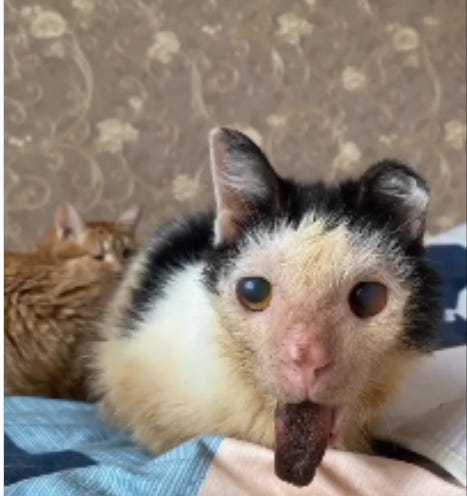
His name is Phoenix, affectionately known as Fenya. For years, his life has been documented on the Instagram account @cheeryl_home, where photographs and videos show a distinctive black and white cat living alongside other animals, being cared for at home and receiving veterinary treatment when he needs it.
But elsewhere on social media, Phoenix has been given another identity. They call him Pluto.
Over the past year, we have watched images and videos of the same cat appear on apparently unrelated social media accounts accompanied by emotional stories and urgent requests for money. The accounts change, the locations they claim or appear to represent change and the amount of money supposedly needed changes, but the cat at the centre of the appeals remains the same.
Dog Desk Animal Action first became directly involved in 2025, when we were tagged in a fundraising appeal from an account presenting itself as an animal rescue group in Istanbul. The cat featured in the appeal was called Pluto, and the account posted updates claiming that tests and X rays had been carried out and that he had serious medical problems requiring treatment. In one appeal, the person behind the account referred to him as “my beloved Pluto” while asking the public for help.
We believed there was a seriously ill cat in Istanbul who needed veterinary care, so we did what we would do for any animal we were in a position to help.
We offered to help him.
We didn’t offer to send money. Instead, we offered to provide exactly what the fundraising appeal said Pluto desperately needed. We had a driver in Istanbul who could collect him and take him directly to an animal hospital. Our veterinary team was ready to receive him, and Dog Desk Animal Action would cover the cost of his treatment.
If a sick cat was waiting in Istanbul for desperately needed medical care, we could remove the financial barrier and get him into treatment.
But that didn’t happen.
Despite the apparent urgency surrounding Pluto’s condition, our attempts to arrange his collection went nowhere. We had transport available, veterinary care waiting and the treatment costs covered, yet we were never able to get access to the cat.
Eventually, the account blocked us. It was subsequently suspended by X.
At the time, we knew something about the situation didn’t make sense. What we didn’t fully understand was that the cat we had been trying to collect in Istanbul appeared to have an entirely different identity and an established life documented elsewhere.
As we looked more closely, we found Phoenix.
Posts published by @cheeryl_home show the same distinctive cat long before the Istanbul fundraising appeals appeared. We found content dating back to at least 2023 showing Fenya at home alongside other cats, establishing a history that predates the appeals we encountered by years.
We also found posts showing him receiving veterinary care, accompanied by detailed information about his health, treatment and test results. In one veterinary update, information was provided for supporters wishing to contribute towards his care, including a means of making a payment through the veterinary clinic.
The further we looked, the clearer the picture became. This was not a cat who had suddenly appeared as a rescue case in Istanbul. Phoenix, also known as Fenya, already had a documented history.
Then we found a public warning about the very same cat. The warning identified him as Phoenix and Fenya and told people that accounts asking for donations for a cat called “Pluto” were fake. Anyone genuinely wanting to follow or support the cat was directed to @cheeryl_home.
That discovery cast our own experience in an entirely different light.
We had spent time trying to arrange the collection of a cat we had been led to believe was in Istanbul. Our driver was available. Veterinary treatment was waiting. We were prepared to pay.
But if the account asking for money did not actually have the cat in its possession, there was no “Pluto” in Istanbul for us to collect.
We cannot know the identity or intentions of every person operating every account without access to information held by social media platforms and payment providers, and we will not make claims about individuals that we cannot substantiate. What we can do is document what happened to us and show what we have subsequently discovered.
Unfortunately, the disappearance of the Istanbul account did not mark the end of Pluto. We have since found Phoenix’s distinctive face appearing in further fundraising appeals.
One account presented as Paws Welfare used what appeared to be footage of Phoenix while telling followers that only $350 had been raised and another $5,600 was still needed for his treatment.
More recently, another rescue themed account posted an urgent appeal claiming that “Pluto’s life is in danger” and that only $5 had been received from one donor. Followers were told that without surgery to remove a tumour, Pluto would suffer a painful death.
We have seen his image appearing in yet another rescue themed account, again accompanied by an emotional appeal asking people to help a cat called Pluto.
The accounts change. The stories change. The supposed emergencies change. The sums of money change. The cat does not.
There is something particularly disturbing about seeing the same animal repeatedly presented in this way. Phoenix is visually distinctive and his appearance immediately attracts attention. People see his face, read that he is suffering and want to help him. That instinctive compassion is exactly what genuine animal rescue depends upon, but it can also make people vulnerable to exploitation.
A photograph can be copied in seconds. A video can travel thousands of miles while the animal in it never moves. Genuine footage of an animal receiving veterinary treatment can be removed from its original context and attached to an entirely different story.
An animal living in one country can suddenly appear to be awaiting rescue somewhere else. His name can be changed, his medical history rewritten and a new emergency created around him. Meanwhile, the people being asked to donate may have no idea that the person receiving their money has no apparent connection to the animal on their screen.
The animal cannot correct the story. Phoenix cannot tell potential donors where he lives or who cares for him. He cannot explain that he is also known as Fenya rather than Pluto, and he cannot tell someone reaching for their bank card whether the person asking for money has ever even met him.
That is why what happened when Dog Desk Animal Action became involved matters.
We effectively removed money from the equation.
We were told that a cat desperately needed veterinary treatment, so we offered veterinary treatment. We had transport, an animal hospital, a veterinary team and the money to cover his care.
All that was needed was access to the cat. We never got it. And we were blocked.
There can be legitimate reasons why a genuine rescuer might be cautious about allowing another person or organisation to collect an animal, and responsible rescuers should always make appropriate checks. But someone raising significant sums of money for an animal should be able to demonstrate that the animal exists, that they are responsible for its care and that the treatment for which they are fundraising is genuine.
If an animal supposedly needs thousands of pounds or dollars for urgent surgery, donors have every right to ask which veterinary clinic is treating them. They have every right to ask for evidence of the costs involved and whether payment can be made directly to the clinic. They also have every right to look through an account’s history and ask what happened to the animals featured in previous fundraising appeals.
Phoenix’s story matters far beyond one cat because we have no reason to believe he is the only animal whose photographs and videos are being used in this way.
Every day, social media users encounter images of sick puppies, injured street dogs, disabled cats and animals supposedly hours away from death. Many of those appeals are completely genuine. Behind them are rescuers working in extraordinarily difficult circumstances who rely on the kindness of strangers to pay veterinary bills, buy food and keep vulnerable animals alive.
Those genuine rescuers are victims too when people’s compassion is exploited.
Every questionable appeal chips away at public trust. Every donor who discovers that the story behind an animal may not have been what they were led to believe becomes a little more reluctant to donate the next time.
And the next animal they scroll past may genuinely be waiting in a veterinary clinic for someone to help.
We are not telling people to stop donating. We are asking people to verify before they do.
Take a few minutes to look through an unfamiliar account’s history. Search for the animal elsewhere. Check whether the same photographs and videos appear on older accounts or under another name. Ask where the animal is receiving treatment and whether veterinary documentation exists. Where possible, ask whether you can contribute directly towards the veterinary bill.
Urgency should never be used to prevent reasonable questions. If anything, the greater the amount of money being requested and the more serious the claimed emergency, the more important transparency becomes.
Genuine animal rescue depends on trust, and when the images of real animals are taken and used to tell stories that do not belong to them, the damage reaches far beyond the people who may lose their money. It damages the rescuers doing genuine work and, ultimately, the animals who depend on public generosity to survive.
That is why we are telling Phoenix’s story. We first met him as Pluto, a supposedly desperately ill cat in Istanbul. We tried to help him. We arranged transport, had veterinary care waiting and offered to cover his treatment. Instead of being able to reach the animal at the centre of the appeal, we were eventually blocked.
More than a year later, we are still seeing his face. New accounts appear. New emergencies are described. New appeals for money are made.
But now we recognise him.
Phoenix is a real cat. His life is real, his medical needs are real and the people who genuinely care for him have spent years documenting his story.
His image is not a fundraising prop to be passed from account to account. His medical history is not material for strangers to rewrite, and his identity is not something to be changed whenever a new appeal for money is needed.
The people using his face may call him Pluto. But Phoenix’s story is not theirs to sell.
And this story is not over.
Today, Phoenix is being used again.
An account whose details indicate that it is based in Uganda is currently using his images, calling him “Pluto” and telling people that his life is in danger. The account claims he needs surgery to remove a tumour and is appealing to animal lovers around the world for donations.
People are responding to that appeal. People are donating because they believe the cat on their screen belongs to the people asking for their money.
That is perhaps the most disturbing part of Phoenix’s story. An account can disappear or be suspended, but the photographs and videos remain. They can be downloaded, reposted and handed to another audience with another story attached. The location can change, the medical emergency can change and the person receiving the donations can change, while the animal at the centre of it all remains the same.
Phoenix is a real cat. His life is real, and the people who genuinely care for him have spent years documenting his story.
But somewhere on social media today, he is “Pluto” again.
And people are still being asked to pay to save him.
We've seen "Pluto" on so many social media platforms. It's heartbreaking when animals are used simply for stealing money from genuine, perhaps a little naive animal lovers worldwide. In the case of Phoenix "Pluto" we are safe in the knowledge that he is well and cared for, it is kind hearted people who are being lied to, hoodwinked into sending donations and genuine rescues will ultimately pay the price.
However, the rise in "Fake Animal Rescue" over a number of years now where young, vulnerable animals are put into dangerous situations to allow a "set up Rescue" simply to generate "rescue for clicks" is quite different.
These are using and abusing Animals, often the same animals over and over resulting in horrific injuries and ultimately, death. All for monetary gain, every click, every time a video is watched they make money.
People are very naive with this type of content, often they will refuse to believe these "Angels" could be hurting animals and it's extremely difficult to change that opinion.
Social media sites have to be more effective. There is so much Animal Abuse online it is fuelling the rise in AA worldwide. Viewing desensitizes, particularly the young more impressionable minds.
Government's worldwide are asleep at the wheel. They aren't taking enough notice of this rise in Animal Cruelty. Animal Abuse rarely happens in isolation, there are well documented links of AA to human, domestic violence, CSA etc ....
Sorry I've went a bit off original topic and had a little rant 🙏