
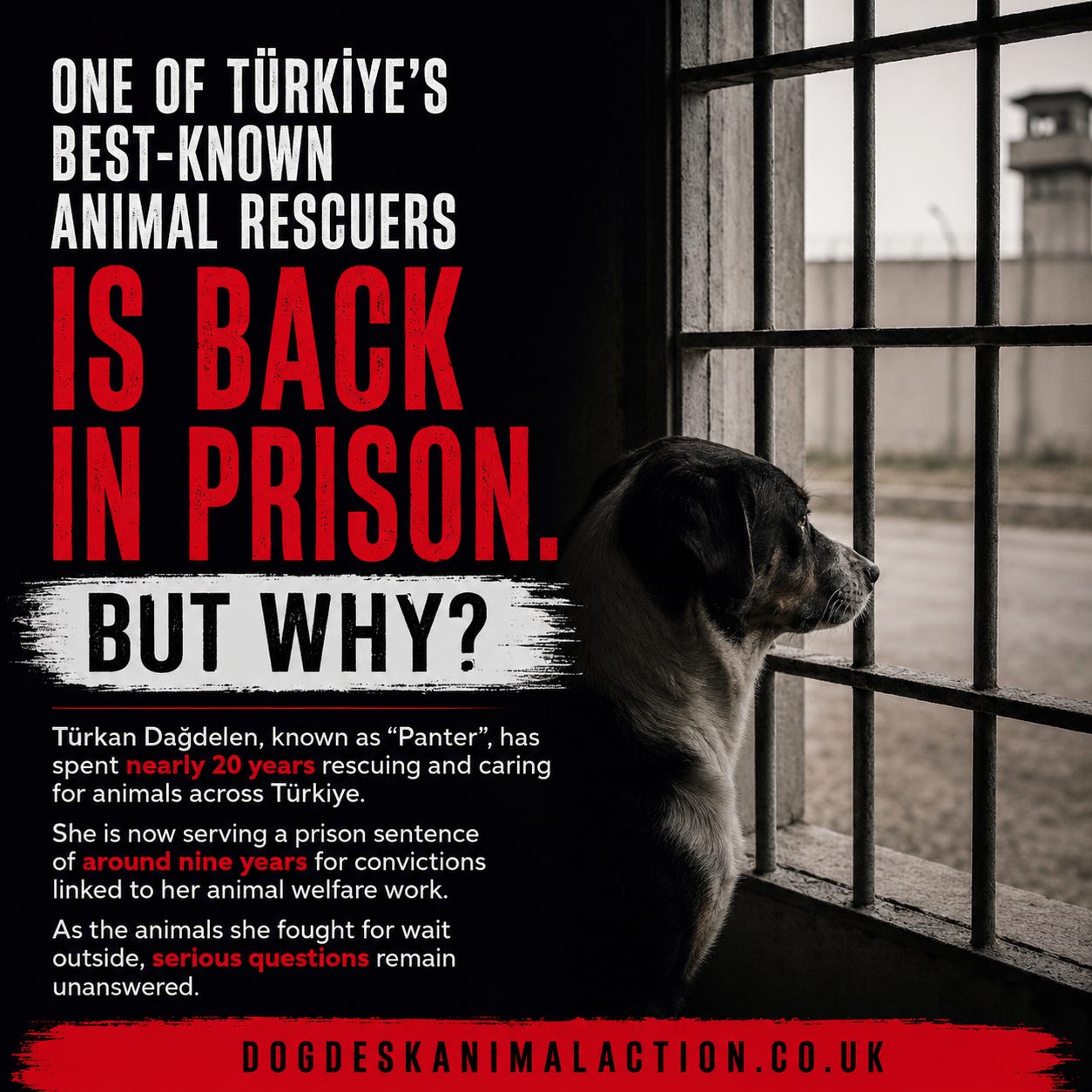
For almost two decades, Türkan Dağdelen has been a familiar name in Türkiye’s animal welfare movement. As the founder of HAYDOS (Friends of Animals Association), she has spent years rescuing injured dogs, feeding free roaming animals and speaking out against cruelty. To many supporters she is simply Panter, a woman who has dedicated her life to animals that few others would help.
Today she is back in prison.
It is a story that has attracted surprisingly little attention outside Türkiye, despite raising uncomfortable questions about the relationship between animal protection and the criminal justice system.
Recent posts from HAYDOS confirm that Türkan is currently serving a prison sentence after being returned to custody earlier this year. According to the organisation, she believed she had completed the custodial element of her sentence following an earlier release, only to discover that further time remained to be served. She is now being held in an open prison in Dalaman and is occasionally permitted short periods of leave while continuing to worry about the hundreds of animals that relied on her.
The obvious question is: what happened?
The publicly available information is remarkably sparse. Turkish media consistently report that the convictions relate to offences described as unlawfully obtaining or disseminating personal data and simple assault. Reports also state that these convictions combined to produce a final prison sentence of around nine years.
It is impossible not to notice the contrast with another case we have followed closely.
Last year, Ankara doctor Muhammet Mustafa Duman was sentenced to 9 years 9 months after being convicted of killing, sexually abusing and mutilating puppies. At the time it appeared to mark a turning point in how Türkiye dealt with extreme animal cruelty.
But that sentence did not stand. The conviction was overturned on appeal, a retrial was ordered and, following that retrial, the sentence was reduced to 4 years 4 months.
Türkan Dağdelen’s reported cumulative prison sentence is now around nine years.
That comparison is not intended to suggest the two cases are legally equivalent. They are not. One concerns convictions arising from disputes connected with animal-rights activism. The other concerns convictions arising from the torture and killing of animals.
But it inevitably raises a question that many people will ask:
How can one of Türkiye’s best-known animal rescuers be serving a sentence of around nine years while a man originally sentenced to 9 years 9 months for killing and sexually abusing puppies ultimately received 4 years 4 months after retrial?
HAYDOS has always maintained that the criminal cases arose during Türkan’s work protecting animals. In a statement issued when she was first imprisoned in 2023, the organisation said she had been jailed following disputes that developed while defending animal rights. It described her not as a dangerous criminal, but as someone whose attempts to protect animals repeatedly brought her into conflict with others.
That statement does not deny that convictions were handed down. Rather, it argues that the legal cases cannot be understood without recognising the circumstances in which they arose.
Our own research suggests at least one of those disputes centred on allegations that a local man had abused a dog. According to reports from the time, Türkan published information on social media identifying the alleged suspect after witnesses contacted her. The man denied the allegation and complained that he and his family had been exposed to harassment after the publication.
Under Turkish law, offences involving personal data are broader than many people realise. They can include unlawfully obtaining, publishing or disseminating information that identifies another person. Whether that particular incident ultimately formed part of Türkan’s conviction remains unclear because the detailed court judgments have not been made publicly available.
That lack of transparency is frustrating.
A sentence approaching nine years is significant in any legal system. It is therefore reasonable to ask what combination of cases and convictions resulted in such a lengthy custodial term. At present, neither the court documents nor comprehensive legal analysis appear to be publicly accessible.
The case also arrives at a time when many animal welfare campaigners in Türkiye continue to express concern about accountability for cruelty against animals. There have been numerous high profile investigations, appeals and acquittals in recent years that have left campaigners questioning whether justice is being delivered consistently. Those concerns form the backdrop against which Türkan’s imprisonment is now being viewed by supporters.
None of this means the courts were wrong. Equally, it does not mean that every criticism made by supporters is correct. Facts are important, and there are still important pieces of this story missing.
What can be said with confidence is that one of Türkiye’s longest serving and best known animal rescuers is once again behind bars, while the animals she spent years caring for now depend on others to continue that work.
For Dog Desk Animal Action, this story is not about taking sides in a criminal case. It is about asking questions.
How did years of animal welfare disputes accumulate into a prison sentence of this length? What were the precise facts behind each conviction? And what does it mean for the future of animal protection when experienced rescuers find themselves removed from the very work that defined their lives?
Until those questions are answered with greater transparency, the story of Türkan Dağdelen remains incomplete.


