


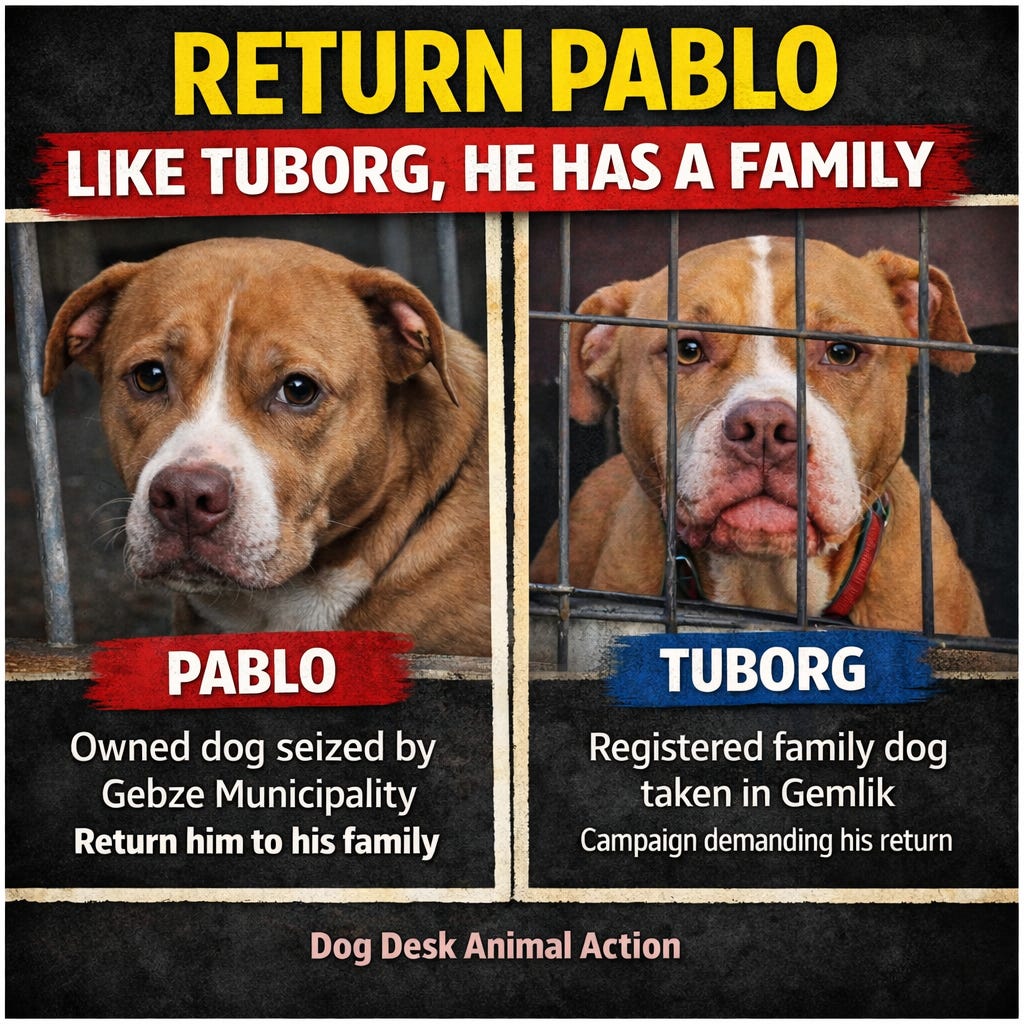
When the Law Takes a Family Dog
Pablo is not a stray dog. He is not an unidentified animal wandering the streets.
He is a dog who has a family.
Yet Pablo now sits inside a municipal shelter after being taken by authorities in Gebze. According to those advocating for his return, he was microchipped through a veterinary clinic within the legal timeframe the very system designed to ensure that dogs can be identified and returned to their guardians.
This raises an uncomfortable question.
If a dog who has been microchipped and lives with a family can still be taken and placed in a shelter, what protection does the identification system actually provide?
Pablo’s case is not occurring in isolation. It echoes another recent case that drew national attention, the seizure of a dog named Tuborg in Gemlik, Bursa.
Two different dogs. Two different municipalities.
But the same underlying issue: what happens when enforcement mechanisms begin to collide with the rights of animals who already belong to families?
Pablo’s case now sits at the centre of that question.
The Case of Pablo
According to reports, Pablo was taken by the Gebze Municipality and placed in a municipal shelter, despite being a dog who already had a family and had been microchipped.
Animal welfare advocates argue that the removal was carried out in violation of existing procedures governing identification and registration of pets.
The president of the Animal Rights Protection Federation (HAYFED) called on the district governor to intervene and ensure Pablo is returned to his family. The argument is straightforward:
Pablo was microchipped in a private veterinary clinic within the legal timeframe
Responsibility for database entry and registration lies with veterinary authorities and the national system, not with the dog’s guardians
If this is correct, then a technical or administrative discrepancy may have been interpreted as grounds to confiscate the dog.
That should never happen.
Not an Isolated Case
Those following animal welfare issues in Turkey will recognise a worrying pattern.
Only recently, there was the case of Tuborg, a dog who was also removed from his family and placed into a municipal facility despite belonging to someone.
Cases like Tuborg’s and Pablo’s create the same troubling question:
If a dog who already has a home can be taken by authorities and placed into a shelter, what protection does identification actually provide?
Microchipping and registration were introduced precisely to prevent this kind of situation to ensure that dogs could be quickly identified and returned to their guardians.
When those same systems are used, or misinterpreted, to justify confiscation, the law begins to operate in reverse.
When Bureaucracy Becomes a Risk to Animals
Identification systems involve several actors:
veterinary clinics
veterinary chambers
national databases
municipalities
ministries
When information fails to move correctly between these systems, administrative errors can occur.
But administrative errors should be resolved administratively.
They should never result in the seizure of an animal who already belongs to a family.
In cases like Pablo’s, the concern raised by advocates is that a gap or delay in the registration system may have been interpreted as unregistered.
The dog then pays the price for a bureaucratic problem.
Why Municipal Shelters Are Not a Neutral Outcome
When a dog is taken and placed into a municipal shelter, it is sometimes described as a procedural step. But for the dog, it is a profound disruption.
Municipal shelters across Turkey are currently under enormous capacity pressure, particularly as more dogs are removed from the streets.
For a dog who has lived with a family, sudden confinement in a shelter environment can be extremely stressful.
Dogs understand:
routine
familiar people
familiar spaces
Removing them from their family is not a minor administrative action. It is a rupture in the dog’s world.
The Principle at Stake
The core issue raised by Pablo’s case is simple.
If a dog is:
microchipped
registered through an authorised veterinary clinic
living with a family
then the presumption should always be clear:
That dog belongs with their family.
Administrative discrepancies should be corrected within the system not by confiscating animals.
The cases of Tuborg and Pablo highlight why this principle must be reinforced.
What Should Happen Now
Animal welfare advocates are calling for three straightforward steps:
Pablo should be returned to his family immediately.
Authorities should investigate how the confiscation occurred.
Clear guidance should be issued so similar cases do not happen again.
Resolving Pablo’s case would not only help one dog.
It would restore confidence that identification systems exist to reunite dogs with their families not to separate them from them.
A Reminder
Debates about stray dog policy often focus on numbers.
But every policy eventually reaches an individual animal.
In this case, that animal is Pablo.
Like Tuborg before him, he already has a home.
The law should recognise that and act accordingly.
Legal Context: Ownership and Identification
Under Turkish animal protection law, dogs who live with families and are properly identified are recognised as owned animals. Identification through microchipping was introduced to ensure that dogs can be linked to their guardians and returned to them if they become lost or separated.
Where a dog has been microchipped through an authorised veterinary clinic within the required timeframe, responsibility for the recording and transfer of that data lies within the national identification system. The dog’s guardian cannot control how that data is processed once it has been submitted by the veterinarian.
For this reason, administrative discrepancies within a database cannot reasonably justify the confiscation of a dog who already belongs to a family.
The purpose of identification laws is the opposite: to ensure that animals can be quickly traced and returned to their guardians.
Municipal authorities do have responsibilities for managing unowned dogs under the framework of Law No. 5199 on the Protection of Animals, but that authority applies to stray animals, not dogs who are demonstrably owned and registered.
Where a dog is identified as belonging to a guardian, the appropriate action is reunification.
The Principle of Proportionality
Administrative issues should be resolved administratively.
They should not result in the removal of an animal from their home and placement into a municipal shelter.
Dogs who have lived with families experience confinement in shelters as a sudden and highly stressful disruption. Removing them from their home environment should therefore only occur where there is clear legal justification.
In cases such as Pablo’s, the central legal question becomes simple:
If a dog has a guardian and has been microchipped in accordance with the law, on what basis can that dog be held by a municipality?
A Test of Principle
The cases of Pablo and Tuborg illustrate a growing tension between enforcement and the rights of animals who already belong to families.
Neither case concerns an unowned street dog.
Both concern dogs who lived with guardians and were identifiable as belonging to someone.
This distinction matters.
Law No. 5199 was created to address the protection and management of animals, particularly those living on the streets. It was not designed to enable the removal of family dogs from their homes because of administrative uncertainty or interpretation.
Where a dog has been microchipped through a veterinary clinic and lives with a guardian, the principle should be simple: that relationship should be recognised and respected.
If authorities begin treating owned dogs as if they are unowned, the legal framework loses clarity. The identification system itself begins to lose credibility, because the very mechanism intended to protect dogs becomes a pathway for their removal.
For families who have followed the law, the expectation is straightforward. They register their dogs so that those dogs can always be traced back to them.
That is the promise of microchipping.
Pablo’s case now raises a question that extends far beyond one municipality or one dog:
If identification does not guarantee reunification, what protection does it actually provide?
Resolving this question should not require prolonged debate.
Like Tuborg, Pablo is not a statistic, a policy problem, or a bureaucratic file.
He is a dog with a family. And the law should recognise that.
Pablo should be returned home.
Agreed. 100%. What now?