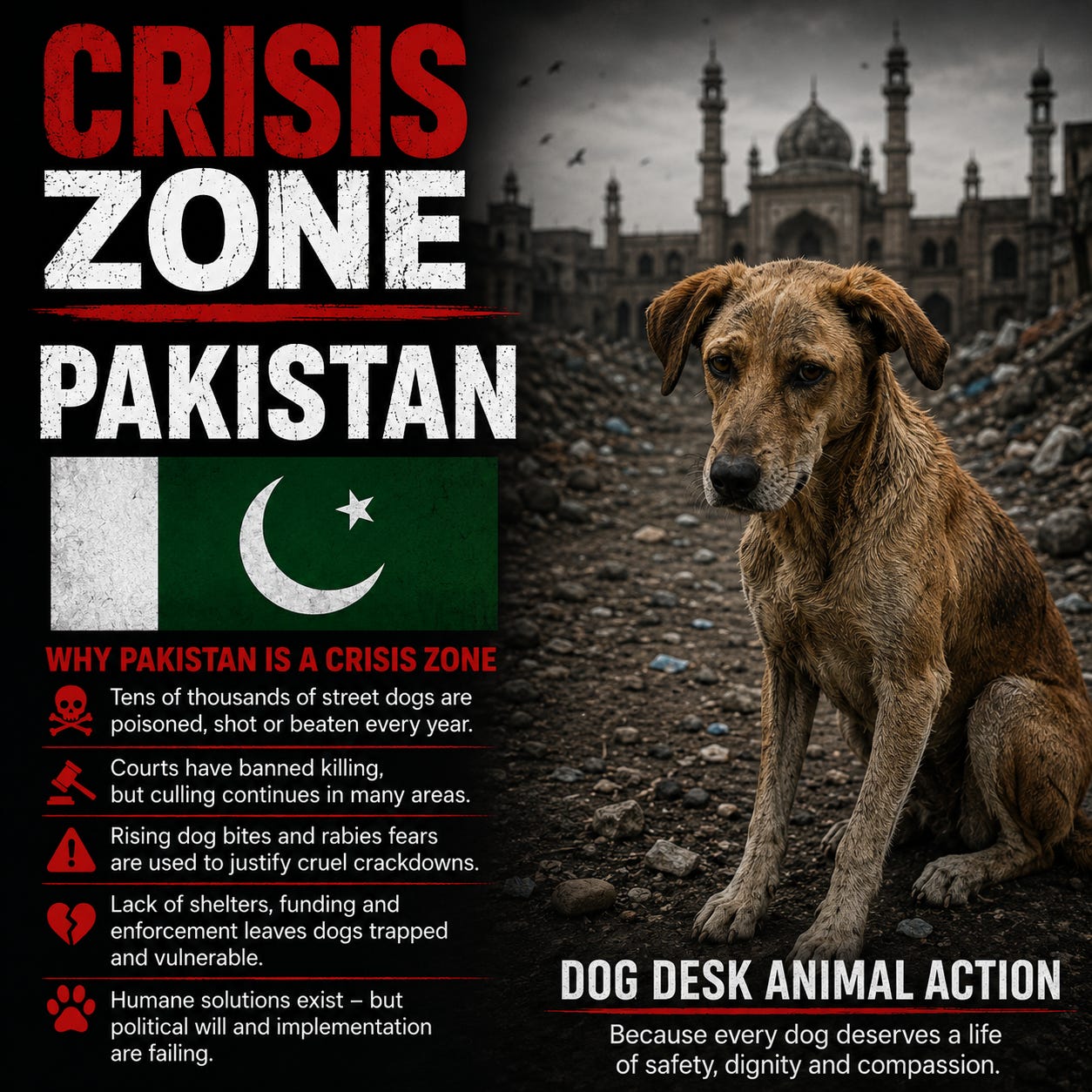
Across parts of Pakistan, the debate over street dogs is no longer simply about population control. It is becoming a confrontation between public fear, municipal pressure, animal welfare law, and the growing question of whether authorities are obeying the courts at all.
In recent months, Pakistan’s courts have issued some of the clearest legal rejections of indiscriminate dog killing seen anywhere in South Asia. Judges have repeatedly stated that healthy street dogs cannot simply be poisoned, shot, or removed as a matter of policy. Humane management, vaccination, sterilisation, veterinary oversight, and documented decision-making were supposed to replace mass culling campaigns.
But reports emerging from Lahore and wider Punjab suggest the reality on the ground may look very different.
According to recent reporting, dog culling operations are allegedly continuing in parts of Lahore despite undertakings given to the Lahore High Court that humane control measures would be implemented instead. Witnesses described dead dogs being dumped in open areas, allegations of poisoning and gunshot killings, and ongoing municipal collection drives.
The scale of the wider crisis is becoming harder to ignore.
Media estimates suggest more than 50,000 street dogs are killed annually in Pakistan through poisoning and shooting campaigns. The article described Punjab as facing a grave stray dog crisis and argued that authorities are openly disregarding both animal welfare law and court rulings. At the same time, authorities continue to point to rising bite incidents and rabies fears.
Official figures stated that over 3,000 people had reportedly been injured by street dogs in Punjab within ten months, while several deaths were also reported. High-profile attacks involving children have intensified public pressure on local governments to remove dogs rapidly from urban areas. This is where Pakistan’s crisis becomes especially significant.
The country is now caught between two competing realities. One reality is public fear. Many residents are genuinely frightened after bite incidents and rabies concerns. Families want safer streets. Politicians and municipalities are under pressure to show immediate action. The other reality is that courts, animal welfare organisations, and veterinary advocates increasingly argue that indiscriminate killing is both unlawful and ineffective.
Pakistan’s judiciary has repeatedly pushed authorities toward CNVR programmes, catch, neuter, vaccinate and release rather than repeated culling campaigns. The Islamabad High Court recently imposed a permanent ban on poisoning, shooting, or indiscriminately killing street dogs, ruling that euthanasia should occur only in exceptional veterinary circumstances such as confirmed rabies or catastrophic suffering.
The court also reportedly demanded stronger record-keeping and transparency regarding captured, sterilised, vaccinated, released, or euthanised dogs. That detail matters more than it may initially appear. One of the biggest problems in street dog policy globally is the absence of independently verifiable data.
Authorities often announce large scale removals, sterilisation numbers, or euthanasia figures, but the public has little ability to verify what actually happened to the animals involved. Pakistan’s courts now appear to be recognising that transparency itself is becoming part of the crisis.
Yet despite the legal direction being set by the courts, allegations of ongoing culling continue to emerge. That contradiction is deeply important.
When courts prohibit indiscriminate killing but dogs continue to disappear, die, or allegedly turn up poisoned, it raises serious questions about enforcement, oversight, and institutional accountability.
Pakistan is not alone in this pattern.
Around the world, street dog crises often escalate when governments attempt to rapidly reduce visible dog populations without the infrastructure, funding, veterinary systems, or long-term management strategies required to sustain humane control programmes.
Mass killing can reduce numbers temporarily, but unless sterilisation coverage, vaccination, waste management, and public health systems improve simultaneously, dog populations often rebound. Courts in Pakistan are now openly acknowledging this argument.
The situation in Punjab increasingly resembles a system under strain rather than one moving toward stability.
Municipal authorities face pressure to act quickly after attacks. Animal welfare groups call out unlawful killing. Courts issue rulings demanding humane alternatives. Residents continue reporting fear and frustration. Meanwhile, the dogs remain trapped in the middle.
What makes Pakistan particularly important to watch now is not only the suffering of the animals themselves, but the wider signal it sends about how governments respond when public pressure, fear, and visible street dog populations collide.
The question facing Pakistan is no longer whether street dogs are controversial. The question is whether humane management systems can survive once political pressure intensifies. And in parts of Punjab, that answer is beginning to look increasingly uncertain.


