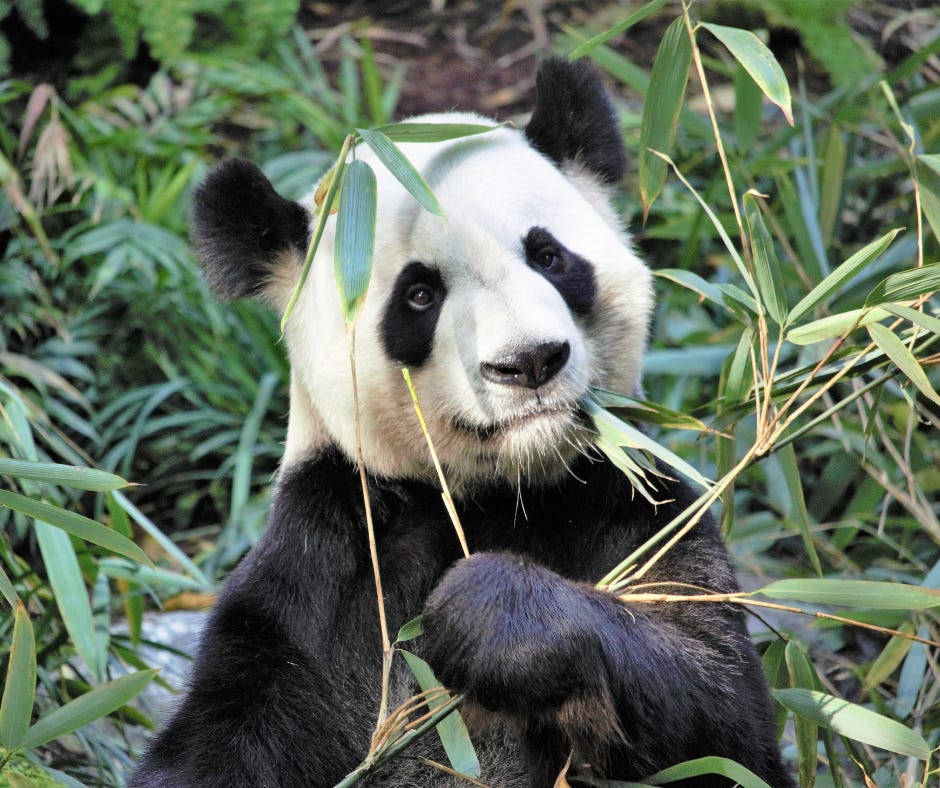
Pandas: The Gentle Icons of Conservation

Few animals capture public imagination quite like the panda. With their unmistakable black-and-white coats and slow, deliberate movements, they have become global symbols of wildlife protection. Yet behind the softness and charm lies a survival story shaped by habitat loss, human pressure, and one of the most ambitious conservation efforts ever attempted.
A Specialist in a Changing World
The giant panda (Ailuropoda melanoleuca) lives almost exclusively in the mountain forests of central China. These high-altitude bamboo ecosystems are cool, damp, and seasonal and pandas are uniquely adapted to them.
Although technically carnivores, pandas eat almost nothing but bamboo. Around 99% of their diet comes from it, and an adult can consume 12–38 kg per day. Their pseudo-thumb an enlarged wrist bone functions like a finger, allowing them to grip stalks and strip leaves efficiently.
This extreme specialisation, however, is also their greatest vulnerability.
When bamboo forests disappear or become fragmented, pandas cannot easily switch to other food sources or migrate long distances. Historically, expanding agriculture, roads, and settlements divided their habitat into isolated pockets, separating breeding populations and shrinking their range dramatically.
From Endangered to Vulnerable - A Rare Conservation Success
For decades, the panda was considered one of the world’s most endangered mammals. By the late 20th century, fewer than 1,000 remained in the wild.
China’s response reshaped modern conservation policy.
Key protection measures
Creation of large protected mountain reserves
Reforestation and bamboo corridor restoration
Anti-poaching enforcement
Long-term scientific monitoring
Captive breeding and gradual reintroduction programs
Over time, fragmented habitats were reconnected, allowing isolated groups to mix again. Genetic diversity improved. Cubs born in managed breeding centres were prepared for wild conditions rather than lifelong captivity.
In 2016, the International Union for Conservation of Nature (IUCN) changed the panda’s status from Endangered to Vulnerable, one of the few high-profile cases where sustained conservation reversed decline rather than merely slowing it.
Why Pandas Matter Beyond Pandas
The panda is often called an umbrella species. Protecting it protects far more than a single animal.
The mountain forests it inhabits are also home to:
Golden snub-nosed monkeys
Takin (goat-antelope species)
Clouded leopards
Hundreds of bird and amphibian species
Major watershed ecosystems supporting millions of people downstream
Safeguarding panda habitat therefore preserves biodiversity, stabilises soil, reduces flood risk, and stores carbon linking wildlife conservation directly to human wellbeing and climate resilience.
The Challenges Ahead
Despite progress, pandas are not secure.
Climate models predict bamboo forests may shift to higher elevations over the next century. Because mountains eventually end, suitable habitat could shrink again. Human infrastructure continues expanding near reserve borders, and small isolated populations remain vulnerable to disease and genetic bottlenecks.
Conservation has moved from emergency rescue to long-term management, a quieter but more complex phase requiring sustained commitment rather than crisis response.
What the Panda Teaches Us
The panda’s recovery did not happen quickly, cheaply, or accidentally. It required decades of policy changes, land protection, scientific research, and international cooperation.
Most importantly, it shows conservation works best when:
Habitat is prioritised over short-term convenience
Science guides decisions
Protection is consistent across generations
The panda is no longer simply a symbol of animals in danger.
It has become proof that intervention, when persistent and properly designed, can alter the trajectory of a species.
Not every story ends this way but this one shows it can.