


As the Philippines prepares to welcome international leaders to Metro Manila in November, reports of street dogs being captured and impounded have raised concerns about what happens to the animals once they are removed from public view.
The 49th ASEAN Summit is scheduled for 16 to 18 November 2026, bringing together government leaders from across Southeast Asia. Preparations are underway, including security arrangements, traffic management and operations intended to ensure public spaces are ready for the event.
Among those preparations are reported operations involving the collection of free-roaming animals from the streets.
On 13 October, Philippine news outlet Interaksyon reported concerns raised by animal welfare organisation CARA Welfare Philippines about the possible impoundment of community dogs ahead of the summit. The report referred to an earlier television broadcast, dated 2 October, describing cooperation between the Philippine National Police and Pasay City authorities on street-clearing operations, including the capture of stray animals for impoundment.
CARA issued an advisory encouraging residents and community carers to remain vigilant, while distinguishing the reported operations from unverified claims circulating online.
The concern now is what happens to the dogs after they are captured, particularly given the country’s laws governing municipal impoundment.
Three Days in a Municipal Pound
Under the Philippines’ Anti-Rabies Act of 2007, Republic Act No. 9482, local authorities are empowered to capture and impound stray, unregistered and unvaccinated dogs.
Section 9 provides that dogs remaining unclaimed after three days may be offered for adoption, with assistance from animal welfare organisations where feasible, or otherwise disposed of through legally authorised procedures.
This means a dog entering a municipal pound may face a decision about its future after only three days. Euthanasia is among the outcomes permitted under applicable animal welfare law, although it is not automatic.
For community dogs, this creates a particular problem. Many free-roaming dogs are not entirely without human care. They may have lived in the same neighbourhood for years, be recognised by residents and receive regular food from people who consider them part of their community.
If one of those dogs is collected during a street-clearing operation, how would the people caring for it know where to find it? Would they even be aware that it had been impounded? And could they locate and reclaim it before the three-day period expired?
Where Are the Captured Dogs Going?
Pasay City operates an animal control facility through its City Veterinary Office. The city has previously stated that its animal management services include impoundment, vaccination and adoption.
In November 2025, the city administration publicly rejected allegations about the killing of impounded animals using vehicle exhaust fumes, stating that its facility operated in accordance with national animal welfare requirements.
Those statements concerned an earlier controversy. They do not establish what is happening during the present summit preparations.
The reported operations have not been accompanied by publicly identified figures showing how many dogs have been collected, where they have been taken or their subsequent outcomes.
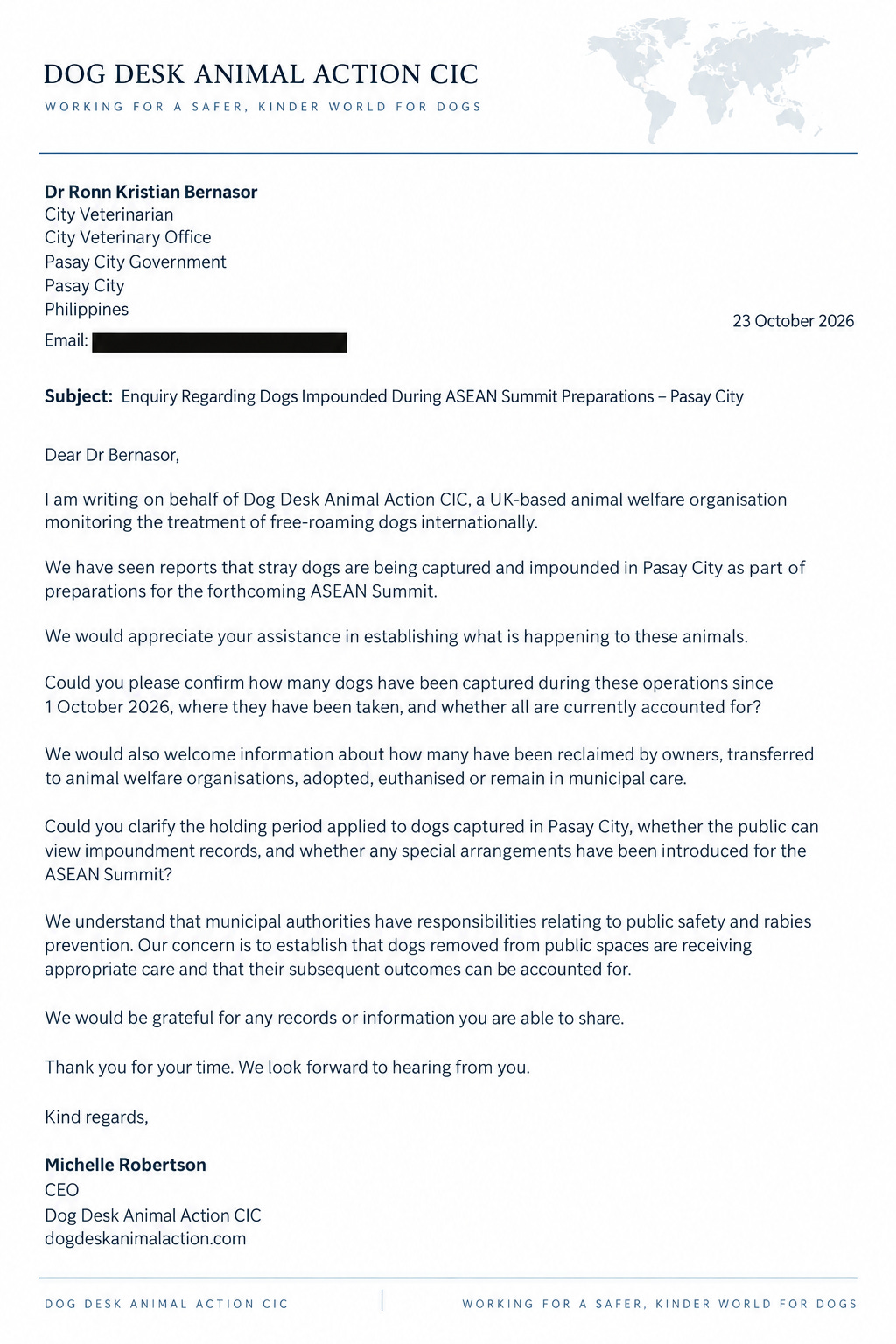
These are the records Dog Desk Animal Action is seeking from the Pasay City Veterinary Office, alongside clarification about arrangements for community carers attempting to locate dogs removed from their neighbourhoods.
When Public Events Change the Lives of Street Animals
Major international events place considerable pressure on host cities to present an orderly and welcoming environment. But the presence of community dogs cannot be responsibly addressed simply by removing them from sight.
There is a difference between routine animal-control work undertaken for public safety and intensified collection operations associated with preparations for an international event.
If dogs are being collected specifically because the summit is approaching, the authorities should be able to explain why the removals are necessary, what safeguards are in place and how the animals are being cared for.
Removing a dog from the street does not resolve the responsibility for that animal. It transfers that responsibility to the authority that captured it.
Philippines Remains on Watchlist
The Philippines is currently classified WATCHLIST on the Dog Desk Animal Action Global Stray Dog Crisis Map.
The reported collections warrant further investigation, but there is not yet sufficient evidence to justify changing the country’s classification. There is also no confirmed evidence that dogs collected during these preparations have been euthanised.
The ASEAN Summit will last three days. For a dog captured and placed in a municipal pound, three days may be enough to determine whether it ever leaves alive.
The world may see “clean streets” when international leaders arrive in Manila. We want to know what has happened to the dogs who were living on those streets before the preparations began.
Supporting Sources
Interaksyon — 13 October 2026. Animal org raises alarm over claims of pet impounding ahead of ASEAN Summit. Reports CARA Welfare Philippines’ advisory and the earlier report of street-animal impoundment in Pasay City.
Republic Act No. 9482 — Anti-Rabies Act of 2007. Philippine Supreme Court E-Library. Section 9 establishes the three-day impoundment provision and subsequent disposition of unclaimed dogs.
Implementing Rules and Regulations of Republic Act No. 9482. Philippine Supreme Court E-Library. Further provisions concerning animal impoundment and rabies-control responsibilities.
Philippine Information Agency — October 2026. NCRPO beefs up inter-agency coordination for ASEAN Summit in November. Official information concerning summit security preparations.
Manila Bulletin — 6 November 2025. Mayor Emi rejects allegations concerning treatment of impounded animals in Pasay. Background on the city’s previous statements about its animal control facility.