
Rethinking Behaviour and Environment in Abandoned Working LGD's
Since moving many of the shelter dogs onto the land, we’ve been making some fascinating observations.
The shelter has always been free-roaming, but new dogs spend time in an observation area before joining the main pack. It was during Apollo’s time in this space that we began to notice something interesting.
Apollo’s Story
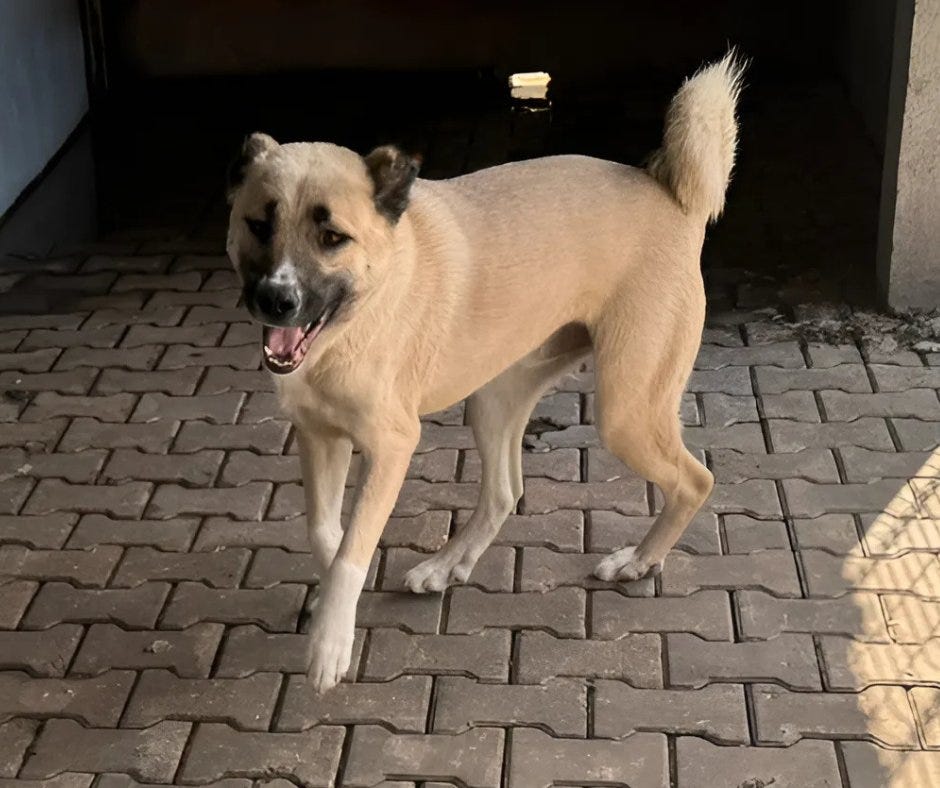
Apollo is a Kangal mix, a large guardian breed traditionally used to protect livestock. He came to us as a patient after being abandoned and involved in a hit-and-run accident. Having spent his life working in open fields, Apollo had no understanding of roads, buildings, or confinement.
Once discharged from treatment, Apollo was moved into an observation area where he shared space with two other dogs, Rufus, an elderly ex-hunting terrier, and a female hound mix. He accepted his kennel mates well enough and bonded positively with our female shelter worker. However, Apollo was unpredictable around men and highly territorial.
His behaviour wasn’t particularly surprising for a livestock guardian dog. Kangals are bred to be vigilant, protective, and deeply bonded to their environment. But what we observed next was unexpected.
A Change of Space and a Change of Mind
When Apollo was moved from the observation area to the land, a vast open space with mature trees, shelters, food and water troughs, and the company of many other dogs something unexpected happened.
He changed.
The same Apollo who had once been guardy and reactive around men began to welcome all visitors to his space, male and female alike. He remained respectful and calm, almost as if he’d found peace. His territorial behaviour melted away. He no longer saw humans as potential threats or intruders as long as introductions were managed by the female shelter manager, he accepted everyone with quiet confidence.
What Caused the Transformation?
This shift in Apollo’s temperament raises important questions.
Was his previous unpredictable behaviour a product of stress?
Did the confinement of smaller spaces, the walls, the proximity, and the human presence trigger feelings of fear and frustration in a dog who had only ever known the freedom of open land?
And if so, how many other dogs are we misunderstanding because their behaviour is shaped by an environment that feels unnatural to them?
It’s a question that challenges some of our assumptions about rehabilitation and rehoming
Adoption or Lifetime Sanctuary?
For a dog like Apollo, is it right to push for adoption — to expect him to adapt to the constraints of domestic life after years of freedom? Or is a lifetime sanctuary, where he can live in safety and familiarity without pressure to conform, the kindest option?
Apollo’s story suggests that some dogs, particularly those who have lived as working animals or lifelong street dogs, may never truly adjust to conventional living environments. They don’t necessarily need to — not if we can offer spaces that honour who they are and how they live best.
What We’re Learning
The land has become more than a refuge; it’s an education. Every day we see how environment shapes behaviour, how stress manifests in ways that can be misread as aggression or unpredictability, and how the right setting can unlock calmness and trust.
Apollo is thriving not because we changed him, but because we changed what was around him.
And perhaps that’s the greatest lesson of all.


