


For months the message across Türkiye has been increasingly clear. Dogs are to be removed from the streets, municipalities are under pressure to collect them and shelters and so called natural life areas are being developed to accommodate a population that has lived alongside people in towns, cities and villages for generations. For the people who have spent years caring for these dogs, however, the question of what happens next is nowhere near as simple as the policy makes it sound.
Many community carers are trying to protect the dogs they know in the only ways available to them. Dogs are being brought into gardens, kept within residential grounds or allowed to remain around businesses where people can watch over them. These are people who have often fed the same animals for years, arranged veterinary treatment when they became sick or injured and paid for sterilisation from their own pockets. As the risk of collection has increased, some have tried to move those dogs away from public streets and into places where they hope they will be safe.
A case emerging from Tuzla in Istanbul raises an uncomfortable question about whether even that is enough.
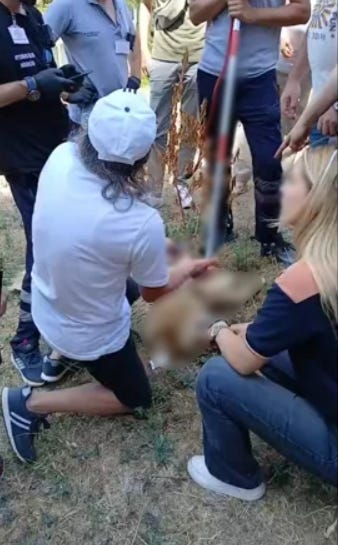
An elderly blind Golden Retriever known locally as Sarı, or Tonton, had reportedly been living within the garden of a TOKİ residential complex in Aydınlı, where residents had cared for him for years. He was known, fed and watched over by the people around him and, although the available reporting does not establish that he was microchipped or formally registered to an individual owner, he was certainly not a dog living without human care.
When municipal personnel arrived to collect him, residents reportedly objected and asked that he be left where he was, but Sarı was taken despite their objections. Serious allegations have subsequently been made about the manner in which the elderly blind dog was captured, with those involved claiming that a catch pole was used, that he struggled to breathe, was dragged and suffered bleeding around his mouth and nose. A criminal complaint has reportedly been submitted to the Chief Public Prosecutor’s Office.
An elderly blind dog who had been cared for within the grounds of a residential community was removed despite the people caring for him asking for him to remain, and at the time of writing we have been unable to establish where Sarı is now.
His case brings us back to something that is becoming increasingly difficult to ignore as we continue monitoring Türkiye’s management of its street dog population. If dogs cannot remain on the streets, what exactly are the people who care for them supposed to do with them?
It is easy to say that people should take responsibility and bring the dogs into their homes & gardens, but the reality of Türkiye’s community dogs is considerably more complicated. Many of these animals have lived freely for their entire lives. They have territories they understand, routines they have followed for years and relationships spread across entire neighbourhoods. They know where they are fed in the morning, where they can find shade during the hottest part of the day and which person will appear with food in the evening. They may not belong to somebody in the conventional sense of pet ownership, but that does not mean they live without care or without relationships.
Closing a gate behind a dog that has lived freely for eight or ten years does not automatically transform that animal into a different dog. Some will adapt perfectly well, while others will struggle with the sudden loss of everything familiar to them. They may pace, bark, attempt to escape or become distressed by confinement, leaving the person who was previously caring for a dog within the community suddenly responsible for managing an animal whose entire way of life has changed.
There is also another part of this conversation which receives far too little attention, and that is tolerance. Gardens have neighbours, residential complexes have other residents and businesses have customers. Someone may have cared peacefully for several community dogs for years while those animals moved freely around the neighbourhood, yet bringing those same dogs permanently behind a garden wall can completely change the relationship with the people living nearby.
We know just how serious those tensions can become because one of the community carers we support was threatened with a firearm by a neighbour because she had dogs in her garden. Her intention was to keep those animals safe, yet doing so created another danger entirely. That is an extreme example, but it demonstrates why moving dogs from public streets onto private land cannot simply be presented as an easy alternative to municipal collection.
There are practical limits too. Someone capable of putting food down for six community dogs every evening does not necessarily have enough land to permanently house six dogs. An elderly person who has cared for dogs outside their home for years may not physically be able to manage several animals inside a confined space. Others simply do not have the fencing, money or facilities required to turn their garden into what effectively becomes a small private shelter.
None of that means these people have failed the dogs. In many communities they are the reason those dogs have survived.
This is why the circumstances surrounding Sarı deserve attention beyond the treatment of one elderly Golden Retriever. Here was a dog who had somewhere familiar to live and people prepared to continue caring for him, yet he was still collected. We do not currently know whether he was microchipped or formally registered and we are looking more closely at how registration affects the legal position of dogs being kept within gardens and other private or residential spaces, particularly as reports continue to emerge of dogs being collected from places where carers believed they were safe.
There is an important distinction to make because a community garden is not necessarily the same thing as somebody’s enclosed private property, and we should not suggest that Sarı was taken from a private domestic garden when the reporting describes the grounds of a TOKİ residential complex. Nevertheless, his case exposes the uncertainty now facing people attempting to protect community dogs. If moving a dog away from the street and caring for him within residential grounds does not necessarily prevent collection, carers need to know exactly what will.
Türkiye cannot expect every person who has spent years feeding community animals to suddenly turn their home into a shelter, nor can it assume that every lifelong street dog can simply be placed behind a gate without consequences for the animal or the person trying to protect them. Most importantly, it cannot afford to disregard the enormous informal network of people who have been keeping these animals alive for years.
Throughout our monitoring of Türkiye we have repeatedly argued that the success of this policy cannot be measured simply by counting how many dogs disappear from the streets. We need to know where those dogs go, how they are collected, what conditions await them and whether their welfare is actually improved by their removal. Sarı’s case adds another question to that list because we must also ask what consideration is being given to the people who were already providing the care that authorities say these animals need.
A blind elderly dog knew his surroundings, knew the people around him and had people willing to continue caring for him. Whatever his administrative status may have been, he was not without care, and removing him from everything familiar should never be treated as an insignificant administrative act.
Türkiye wants its dogs off the streets, but the country still needs to answer what happens when ordinary people try to help make that possible. If they bring the dogs closer, provide somewhere for them to stay, feed them, protect them and accept responsibility for their welfare, there has to be a point at which that care is recognised rather than swept aside, because if even an elderly blind dog surrounded by people asking to continue caring for him can simply be taken away, it is increasingly difficult to understand what those people are expected to do next.