

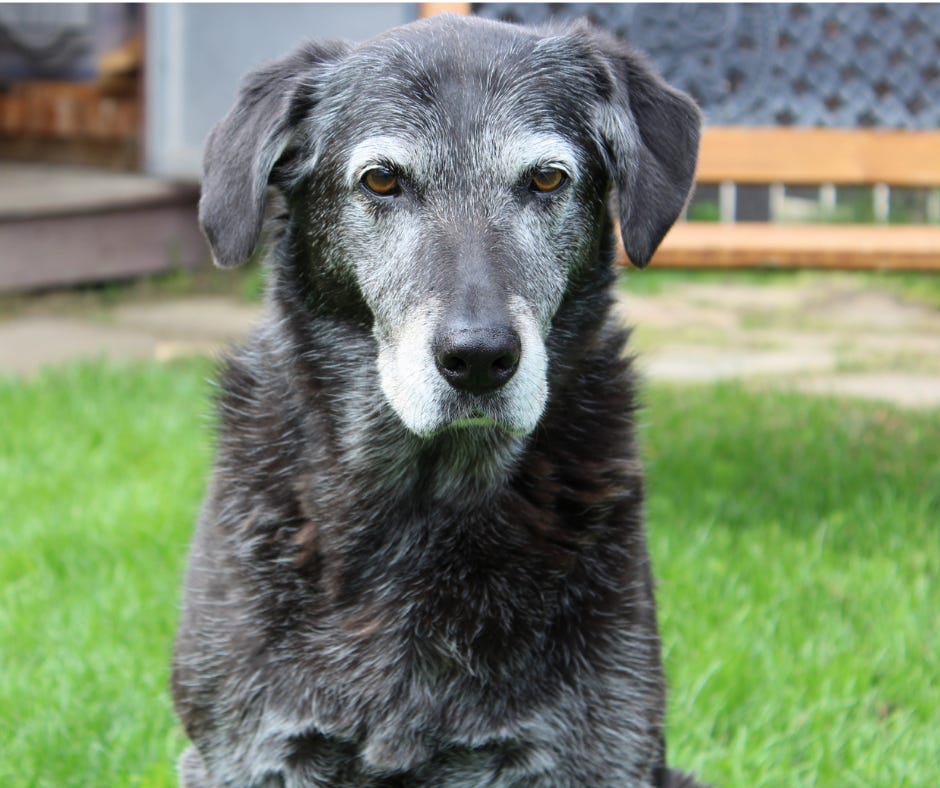
November is Senior Pet Month & I want to talk about older dogs because there is something particularly difficult about seeing a senior dog waiting for a home.
Some of these dogs will have spent ten or twelve years sleeping on the same sofa, walking the same streets & recognising the sound of the same person coming through the front door. Then suddenly everything changes.
Their person may have died, somebody may have become ill, a relationship may have broken down, housing circumstances may have changed or sometimes, sadly, somebody simply decides they no longer want an ageing dog.
Whatever happened the dog doesn’t understand the explanation. They just know the world they understood has disappeared.
We talk a lot about puppies needing stability, patience & security but I think we sometimes forget how important those things are to older dogs too. A senior dog has spent years learning how their world works. They have routines, preferences & people they trust. They know where they sleep, when they eat & probably exactly which cupboard contains the treats.
Losing all of that can be enormous. Then they arrive in rescue & face another problem. Their age. People looking for a dog will often walk straight past the older ones & I do understand some of the reasons why.
People worry they won’t have enough time with them. They worry about veterinary bills, existing medical conditions & whether an older dog will adapt to a completely new home. Perhaps most of all they worry about falling in love with a dog they may have to say goodbye to sooner than they would like. I understand that because losing a dog hurts terribly.
But there is something rather sad about rejecting the possibility of several wonderful years with a dog because there might not be enough of them. None of us know how long we are going to have with any dog. Bringing home a puppy doesn’t come with a guarantee of fifteen healthy years because life simply doesn’t work like that.
Older dogs bring something very different to a home.
The frantic puppy stage is long behind them. They already understand living in a house & be perfectly happy with a comfortable bed, a gentle walk, something good to eat & somebody to sit beside.
That doesn’t mean every senior dog is easy.
Some older dogs are incredibly energetic. Some have behavioural problems. Some have never lived inside a home. Some need considerable veterinary care & some need people who understand that years of previous experiences don’t simply disappear because a dog has been rescued. Others will settle onto the sofa on day one .
They are individuals. I think that’s something we sometimes lose when we talk about senior dogs because we turn them into a category.
Underneath that grey muzzle is exactly the same dog who once charged around as a puppy. They didn’t wake up one morning & become less valuable because somebody decided they had crossed an invisible line into old age. Their needs changed. Their value didn’t.
Growing older might mean walks become shorter. Medication might appear alongside breakfast. We may need to put a rug on a slippery floor, provide a more comfortable bed or help somebody into the car instead of expecting them to jump. Hearing may fade, eyesight may deteriorate, joints may become stiff & there may be more trips to the vet. That isn’t a reason to pity senior dogs. It is simply part of caring for an ageing animal.
Those of us fortunate enough to have a dog grow old beside us often make these adjustments without even thinking about them. The walk gets a little shorter, the pace becomes a little slower, we wait at the bottom of the steps, move the bed somewhere warmer & notice they are sleeping a little more. We learn what they need now instead of expecting them to remain the dog they were five years ago. A senior dog entering a new home deserves exactly the same consideration.
Perhaps that dog has six years ahead of them. Perhaps three. Perhaps one. We don’t know. What we do know is that those years matter to the dog.
A year is still a year of warm beds, walks, good food, companionship & feeling safe. Six months of being loved isn’t somehow meaningless because another dog might have given us ten years.
Dogs don’t measure the value of their lives by how long we get to keep them. Maybe we shouldn’t either. I am known in our rescue environment for saying “we measure a dogs life in happiness” because many of our dogs are very unwell when they come to us. Dogs living with terminal conditions or young dogs so ravaged by a hard life on the streets their bodies aged well beyond their years.
Senior Pet Month will quite rightly be used to encourage people to consider adopting older animals & I hope some people will. But I think there is a wider message too. Growing old shouldn’t make a dog invisible. Not in rescue. Not in shelters. Not in our homes & certainly not when decisions are being made about how much care, money or effort an older dog is considered worth.
Ageing isn’t a failure. It is what happens when a dog has been lucky enough to live. Grey faces, slower legs & longer naps aren’t signs that a dog’s best days no longer matter. They are signs of a life already lived.
And there can still be an awful lot of living left to do.