
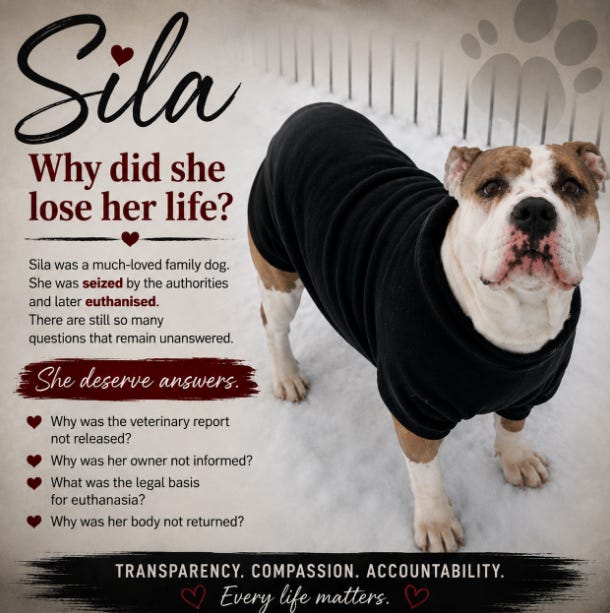
Şila: The Questions That Remain After an American Bully Was Seized and Euthanised in Türkiye
The death of a dog called Şila is now causing increasing public concern in Türkiye, not only because she died but also because important questions concerning the way and reason for her death are still without answers. The situation has triggered a great deal of support on social media, with numerous individuals demanding more transparency following the statement by the Adana Metropolitan Municipality that Şila had been seized but without providing a public explanation for the decision that eventually resulted in her being put down.
The municipality states that Şila was spotted as a result of an operation carried out in the Yumurtalık district and was seized on the basis of an order from the Public Prosecutor. In its public statement, the municipality claims that Şila is an American Bully, a breed which is included in Turkey’s list of prohibited breeds, that she is not microchipped, has not been sterilised and is of foreign origin. It adds that all the administrative procedures were carried out in accordance with Law No. 5199 and the relevant implementing regulations. The statement gives no reason for Şila being euthanised.
Giving a reason for the seizure of a dog is quite different from giving a reason for ending that dog’s life. The municipality’s statement does not mention a veterinary examination, a behavioural assessment, a medical necessity or any particular legal authority that could justify euthanasia. Rather, it concentrates on the circumstances relating to the seizure.
The owner of Şila has publicly questioned the municipality’s version of events and states that important questions have still not been answered. In a number of emotional social media postings, the owner refers to Şila as a beloved member of the family and claims that she entered Turkey using German documents. He alleges that Şila was taken from her and euthanised without being given the chance to say goodbye and has on several occasions requested the release of the veterinary report, an explanation of the legal grounds for the decision and the return of Şila’s body.
The depth of the grief is shown in one posting addressed to another animal which the owner had previously lost; the owner, as if having been reunited with it, states that Şila “came to you too” and that she had been taken away and her life had ended before there was even an opportunity for a final farewell. This is a highly personal account and it demonstrates the human impact of a case which, for many observers, has come to be about much more than just the legal procedure.
Supporters have also started to raise broader questions. A number of them have asked the owner, someone who they think is a German citizen to get help via the German legal system and the international press. Others have wondered if euthanasia could be considered legal when legal proceedings were still going on, even though Dog Desk Animal Action has not come across any official documents confirming the position of the case at the time that Şila died.
The situation from a legal point of view also needs to be looked at carefully. The Animal Protection Law in Türkiye imposes strict regulations on a number of breeds regarded as dangerous, such as the American Bully. The law makes it clear that it has the authority to regulate ownership and, in some cases, to seize dogs who fall within those provisions. Nevertheless, our examination of the legislation available to the public has not come across any clause stating that a dog can be euthanised just because it belongs to a banned breed. This does not imply that in Şila’s case some other legal body, such as a veterinarian, or the prosecuting authority, did not make a decision, but if such documents do exist they have not been made public.
The lack of information is central to this case. If euthanasia had been regarded as necessary, what veterinary evidence was there to support the decision? Who gave the order? What legal authority was cited? Has the owner have been properly informed in advance? Why has the veterinary report not been made available? And why was the body allegedly not returned? All of these are reasonable questions and should have clear answers.
We are not claiming that the Adana Metropolitan Municipality has acted unlawfully, nor are we drawing any conclusions that are not backed by the evidence currently available. The municipality has given a reason for Şila being seized, but it has not provided a public explanation for why she was euthanised. Until such information is made public, the main issue in this case will remain unanswered.
It is important that there should be transparency whenever public authorities exercise their powers over companion animals, especially in cases where such powers lead to the death of an animal which had been a member of some person’s family. Making the relevant documents available would not only allow the owner to have their questions answered but also help to reinforce the public’s confidence in the fact that decisions of this kind are taken in a legal, proportionate and appropriate manner with sufficient veterinary supervision.
Dog Desk Animal Action will keep an eye on this case and will revise this article if any further official information becomes available.


