

Statement From Turkey’s Interior Ministry on Spay & Neuter Conflicts With Established Research

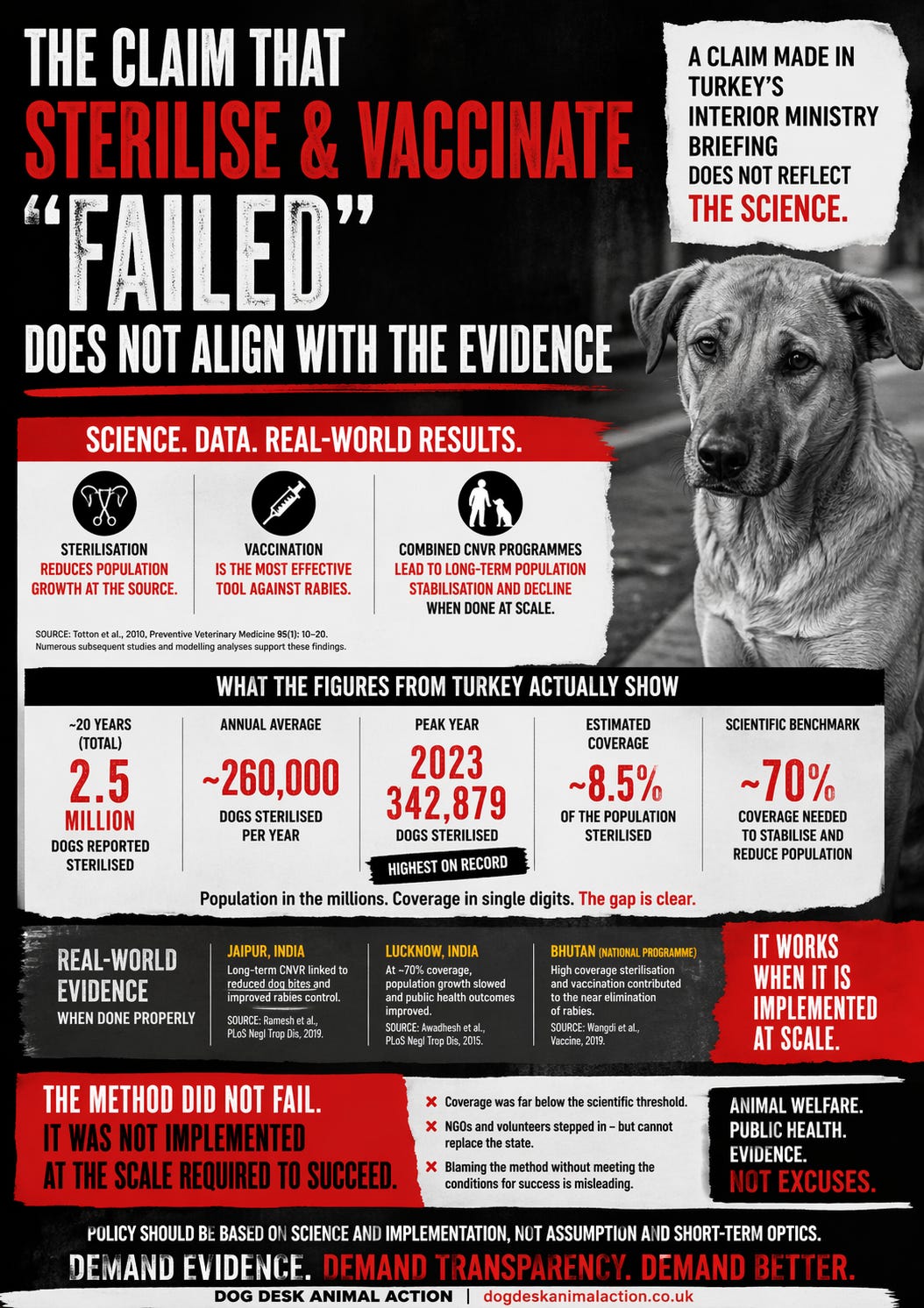
A recent statement attributed to Ahmet Yavuz Karaca advisor to the Minister of Interior, suggests that the long-standing sterilise, vaccinate, and release (SVR/CNVR) approach did not achieve the expected results, and that newer regulatory measures are proving more effective.
It is a significant claim.
But before accepting it, there is a more fundamental question to address:
Was the method ever implemented at the scale required to succeed?
What the Scientific Literature Actually Shows
Across peer-reviewed research in Veterinary epidemiology, the core findings are consistent:
Sterilisation reduces population growth at its source
Vaccination is the primary tool for controlling rabies transmission
Combined CNVR/SVR programmes are associated with long-term population stabilisation and gradual decline, particularly when coverage is high and sustained
A systematic review published in Preventive Veterinary Medicine (Totton et al., 2010, with later supporting studies) concluded that:
Outcomes depend heavily on coverage, consistency, and duration
Programmes typically require around 70% reach to produce measurable population effects
These conclusions have been reinforced by subsequent modelling and field studies over the past decade.
What Happens When It Is Done Properly
Evidence from real-world programmes provides context:
Jaipur, India
Long-term CNVR implementation has been associated with:Reduced dog-bite incidence
Improved rabies control
Lucknow, India
When sterilisation and vaccination approached ~70% coverage:Population growth slowed
Public health indicators improved
Bhutan (national programme)
Sustained, high-coverage sterilisation and vaccination contributed to:Significant progress toward rabies elimination
These are not isolated cases. They are frequently cited in international guidance from organisations such as WOAH and the ICAM Coalition.
What the Available Figures Indicate
Publicly reported figures provide important context when assessing implementation.
Approximately 2.5 million dogs are reported to have been sterilised over the past two decades
Annual sterilisation levels have generally been in the hundreds of thousands
The highest reported annual figure is approximately 342,879 in 2023
At the same time, widely cited estimates place the free-roaming dog population in the millions.
Set against the scientific benchmark where around 70% coverage is typically required to stabilise and reduce populations these figures suggest that:
Sterilisation efforts, while ongoing, may not have reached the level necessary to produce population-wide effects.
This distinction is important when interpreting outcomes.
The Question of Implementation
A consistent finding across the literature is that partial implementation produces partial results.
Where programmes appear ineffective, studies commonly identify:
Insufficient sterilisation coverage
Interrupted or inconsistent delivery
Limited geographic reach
Resource constraints
Under those conditions, it becomes difficult to assess the method itself, because the threshold required for success has not been reached.
The Role of Non-Governmental Efforts
In many regions, including Turkey, a significant proportion of sterilisation and vaccination work has been funded by:
Veterinary professionals
Local volunteers
Animal welfare organisations
These efforts are critical and often highly effective at a local level.
However, the research is clear on one point:
Population-level outcomes require population-level coverage.
Non-governmental groups can support, supplement, and innovate but they are rarely resourced to deliver nationwide, sustained implementation alone.
How Effectiveness Is Measured
The term effective can mean different things depending on the metric:
A rapid reduction in visible street dogs
A long-term decline in population size
Improvements in animal welfare
Reductions in public health risks such as rabies
Scientific studies typically evaluate effectiveness over longer timeframes, particularly where fertility control is involved, because the mechanism is gradual rather than immediate.
The Importance of Transparent Data
Assessing any population management strategy depends on:
Reliable baseline estimates
Ongoing population monitoring
Clear reporting of outcomes
Where comprehensive datasets are not publicly available, it becomes more difficult to draw firm conclusions about comparative effectiveness.
What the Evidence Supports
Based on the current body of research:
Sterilisation and vaccination are well-established components of effective dog population management
CNVR/SVR programmes have demonstrated positive outcomes in multiple peer-reviewed studies and field applications
Success depends on scale, consistency, and duration, rather than short-term interventions
A Measured Conclusion
It is reasonable to review and refine policy approaches. It is also reasonable to ask whether previous strategies delivered the intended results.
But the scientific literature suggests a more precise interpretation:
Where sterilisation and vaccination programmes do not reach sufficient coverage, their impact will be limited.
This does not necessarily indicate that the method itself is ineffective,
only that the conditions required for success may not have been fully met.
Final Line
Before concluding that a long-established, evidence-based approach has failed, the key question remains:
Was it ever implemented at the scale required to demonstrate what the science says it can achieve?
Without that clarity, comparisons between approaches remain incomplete and the evidence base remains unchanged.