
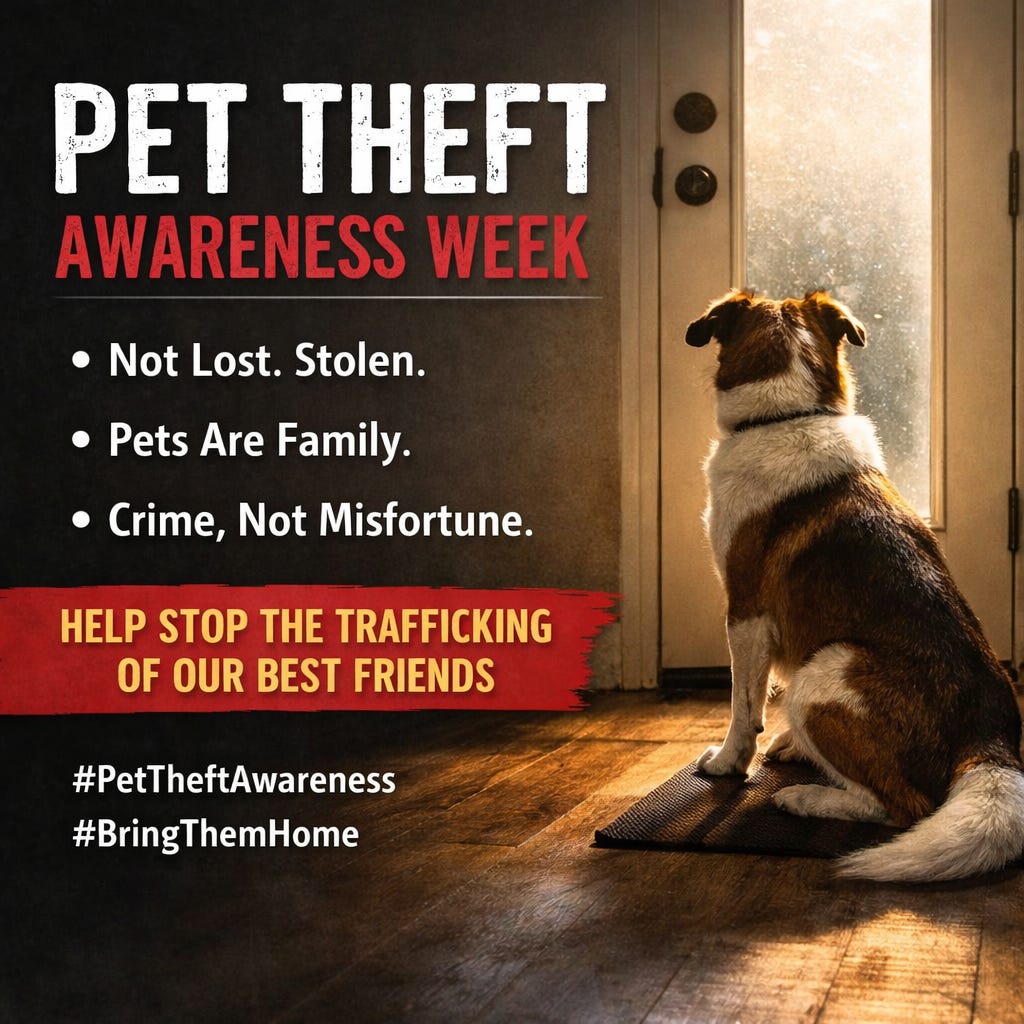
Dog theft, like so many crimes is devastating
There is no quiet acceptance, no simple replacement, no insurance payout that restores what was taken.
There is an empty bed, an untouched food bowl, a lead still hanging by the door and a routine that suddenly collapses. The crime scene is not a street or a garden. It is a relationship.
For years, however, the law did not see it that way.
When the law treated dogs as property
Historically in the UK, stealing a dog was prosecuted under the same framework as stealing a bicycle or a mobile phone. The value of the crime was calculated in pounds, not attachment. A pedigree dog could carry a higher sentence than a beloved elderly mongrel simply because of resale price.
The emotional harm did not exist legally.
This created a serious problem:
Police resources follow legal priority. If the offence is categorised as low-value property theft, investigation often becomes limited, slow or non-urgent. Owners quickly discovered that someone has stolen my dog did not trigger the same response as violence, burglary or vehicle crime.
Yet the lived reality was far closer to a family bereavement than a lost possession.
The lockdown surge: when theft became organised
During the pandemic the UK saw a sharp increase in dog ownership. Demand rose faster than responsible breeding could meet. Prices for popular breeds multiplied.
Where high prices appear, organised crime follows.
Dogs were no longer taken opportunistically.
They were selected.
Certain breeds began disappearing from:
gardens
outside shops
cars
walking routes
Many were later discovered in breeding pipelines, online resale markets or transported across regions. The motive was rarely companionship. It was profit.
This changed the nature of the crime entirely. Dog theft moved from petty stealing to trafficking.
The human impact
The emotional consequences are often underestimated in official statistics. Families experience:
prolonged uncertainty rather than closure
ongoing search behaviour similar to missing-person cases
anxiety around public spaces
guilt for circumstances outside their control
Unlike most theft, there is a constant belief the victim is alive and suffering somewhere. Owners do not simply grieve, they wait.
Children struggle to understand why a loved animal was taken. Elderly owners may lose daily structure and companionship overnight. In many cases, dogs are medical support, routine anchors or emotional stability for vulnerable people.
The harm cannot be measured by resale value because the damage is relational.
A turning point in UK law
Public pressure eventually forced recognition that animals are not interchangeable goods.
Campaigns driven by stolen dog cases led to a legal shift:
the offence became pet abduction, acknowledging sentience and emotional harm.
This matters because legal language determines legal seriousness.
When the category changes, policing priorities change.
The law now recognises:
distress to both animal and guardian
welfare risk to the animal
the unique nature of companion animals
It is an acknowledgement that theft involving a sentient being is not equivalent to property crime.
Where stolen dogs often end up
Contrary to popular belief, many stolen dogs are not kept.
They are commonly:
resold quickly through online marketplaces
used for breeding
transported between regions
laundered through informal sales networks
This makes the crime closer to animal exploitation than simple stealing. The dog becomes a commodity within a chain rather than the end goal.
Understanding this helps explain why recovery rates historically remained low. Once moved through several hands, identification becomes difficult without microchips and documentation.
Prevention is shared responsibility
Legislation helps, but prevention still relies on public awareness:
secure gardens and gates
avoid leaving dogs unattended outside shops
verify sellers and breeders carefully
ensure microchip details remain updated
report suspicious selling patterns
Dog theft thrives where demand for quick purchases exists. Every impulsive sale fuels the market that incentivises stealing.
More than a legal change
Recognising dog theft as a welfare crime rather than property crime represents a cultural shift.
It accepts a truth most people already understand:
companion animals occupy a social space somewhere between property and personhood. They are dependents, not objects.
When a dog is stolen, something living is removed from a home and placed into uncertainty. The harm flows in both directions human and animal.
The law is only just beginning to catch up with what owners always knew.
A dog is not replaceable.


In law pets are classed as property are cows and pigs etc classed as property not sentient creatures.