


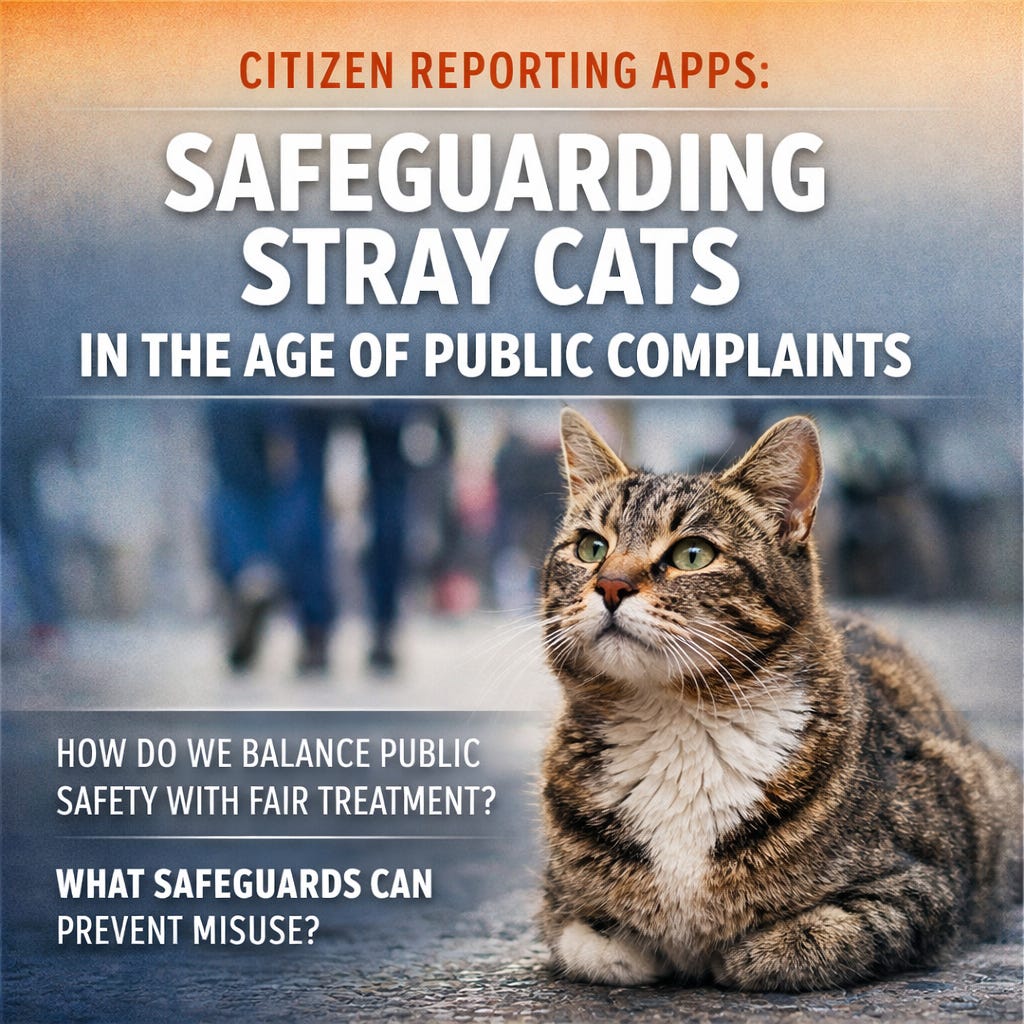
Turkey’s Güvenilir Gıda (Reliable Food) app represents a shift toward citizen-led reporting in public health. It is designed to improve food safety through transparency, speed, and public participation.
In principle, this is a positive step.
But when reporting systems expand beyond professional oversight into high-volume public input, it is important to ask a quieter question:
What happens to those who cannot represent themselves when attention becomes pressure?
Where Stray Cats Enter the Picture
Turkey’s urban environment includes a long-standing presence of free-living cats, often informally supported by local communities.
These animals exist in spaces that overlap with:
Food businesses
Public streets and markets
Residential areas
In such environments, the line between public health concern and everyday coexistence is not always clear.
A reporting tool that allows rapid complaints tied to location introduces a new dynamic into that space.
The Risk of Volume Over Context
Citizen reporting systems are effective when they highlight genuine issues.
However, they can also:
Amplify repeated reports about the same location
Create clusters of complaints around visible but non-critical situations
Prioritise what is most reported, rather than what is most harmful
In areas where stray cats are present, this could lead to disproportionate attention on environments where animals are visible, rather than where risks are objectively highest.
Misinterpretation of Everyday Conditions
Public reporting relies on individual judgement.
But in shared urban spaces:
The presence of animals may be interpreted as unsanitary, even where no violation exists
Feeding points may be viewed as risk factors without understanding local management practices
Temporary or informal care arrangements may be mistaken for neglect
Without clear guidance, ordinary coexistence can be reframed as a reportable issue.
Targeted or Concentrated Reporting
Digital reporting tools can also change how attention is directed.
Where strong views exist, there is potential for:
Repeated reporting of specific locations
Focus on particular types of environments
Escalation driven by visibility rather than verified risk
This does not require malicious intent. It can arise from belief, concern, or organised focus.
But the outcome is the same:
👉 Pressure becomes concentrated on certain spaces or practices, including those where stray cats are present.
Pressure on Enforcement Systems
An increase in reporting volume places pressure on authorities to respond.
In high-volume scenarios:
Complaints may be triaged quickly
Decisions may rely on limited initial information
Resources may be directed toward frequently reported sites
This creates a risk that response follows reporting intensity, rather than a balanced assessment of need.
Why Safeguards Are Essential
The effectiveness of Güvenilir Gıda will depend on how well it balances public input with professional judgement.
Key safeguards include:
Evidence thresholds before action is taken
On-site verification by trained inspectors
Monitoring for patterns of repeated or coordinated reporting
Clear guidance on what constitutes a genuine food safety risk
Context-aware assessment of shared urban environments involving animals
Policy Considerations
As citizen-led reporting becomes more embedded in regulatory systems, it is important to ensure that:
Visibility does not become a proxy for risk
Volume does not override evidence
Informal community practices are assessed with context, not assumption
Enforcement remains proportionate and grounded in professional standards
Stray cats are part of the urban landscape in many parts of Turkey. They do not engage with systems, submit responses, or provide context for their presence.
That responsibility sits entirely with us.
A reporting tool can strengthen public health.
But without careful safeguards, it can also shift pressure onto the most visible and least protected.
The question is not whether the system works.
It is whether it works fairly, proportionately, and with full awareness of those who cannot speak within it.