


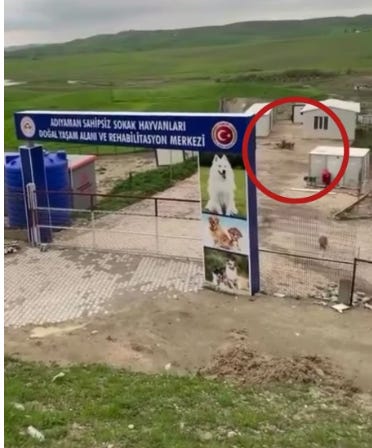
There is a line in this story that should stop everything:
Dogs, kept in a shelter facility, were so hungry they ate the body of another dead dog.
That is not a stray dog problem. That is not a behaviour problem.
That is a system failing in plain sight.
What Actually Happened
In Adıyaman, dogs collected from the streets were placed in what is described as a natural living area in a shelter owned by the municipality
But according to those who filmed and reported it:
The dogs were not adequately fed
They were kept together in uncontrolled conditions
They were left hungry for extended periods
And eventually, out of sheer survival, they consumed the body of a dead dog
Let’s be very clear about what that means.
This is not aggression. This is not dangerous dogs.
This is starvation.
The Lie Hidden in Plain Sight
Stories like this are incredibly useful to a certain narrative.
Because if you show starving animals behaving in extreme ways, you can present that behaviour as proof that they are the problem.
“Look what they do.”
“Look how dangerous they are.”
“Look why they need controlling.”
But what you are actually looking at is what happens when living beings are denied food, care, and basic welfare.
You are not witnessing danger. You are witnessing neglect reaching its logical end point.
They Were Not Stray in That Moment
This is the part that should anger you. These dogs were no longer on the street.
They were in a facility. Collected. Contained. Controlled. Which means responsibility had already shifted. They were under human management.
And under that management:
They were not fed properly
They were not monitored properly
They were not protected from each other
They were allowed to reach a state where survival instincts took over
So when people try to frame this as a stray dog issue, it is simply false.
This happened inside a system that claims to protect them.
Starvation Is Not an Accident
Dogs do not reach that level of hunger overnight.
This is not a missed meal. This is not a delay. This is sustained deprivation.
It takes time to push animals to the point where they will consume the dead to survive.
Which means there were opportunities to intervene. Repeatedly.
And those opportunities were ignored.
Rehabilitation Without Care Is Just Containment
There is a recurring pattern:
Dogs are collected from the streets
They are placed in large facilities
The facilities are labelled “natural,” “rehabilitation,” or “shelter”
And then the reality inside those spaces is hidden until something breaks
What you are seeing here is what happens when capacity replaces care. When numbers matter more than welfare.
The Real Risk to Public Safety
This is where the narrative completely collapses. Because if you want to talk about danger, then be honest about where it actually sits.
The risk is not a dog on a street. The risk is a system that:
Removes animals from communities
Concentrates them into overcrowded environments
Fails to meet their basic needs
And then allows suffering to escalate unchecked
That is where instability is created. Not on the street. Inside the system.
What This Story Should Have Said
It should have said:
Animals placed in a government-linked facility were starved to the point of extreme survival behaviour.
It should have asked:
Who is responsible for feeding them?
What budget was allocated?
How many animals are being held there?
What oversight exists?
Instead, these stories often drift toward shock value, the imagery, the reaction without confronting the structure that created it.
Final Thought
Dogs do not choose to eat the dead. They choose to survive.
If survival leads them there, it is because every other option has been taken away.
So the question is not:
“What is wrong with these dogs?”
It is:
Who put them in a position where this was the only outcome left?
Until that question is answered honestly, this will keep happening hidden behind labels like rehabilitation, softened by language, and blamed on the very animals that were failed.