


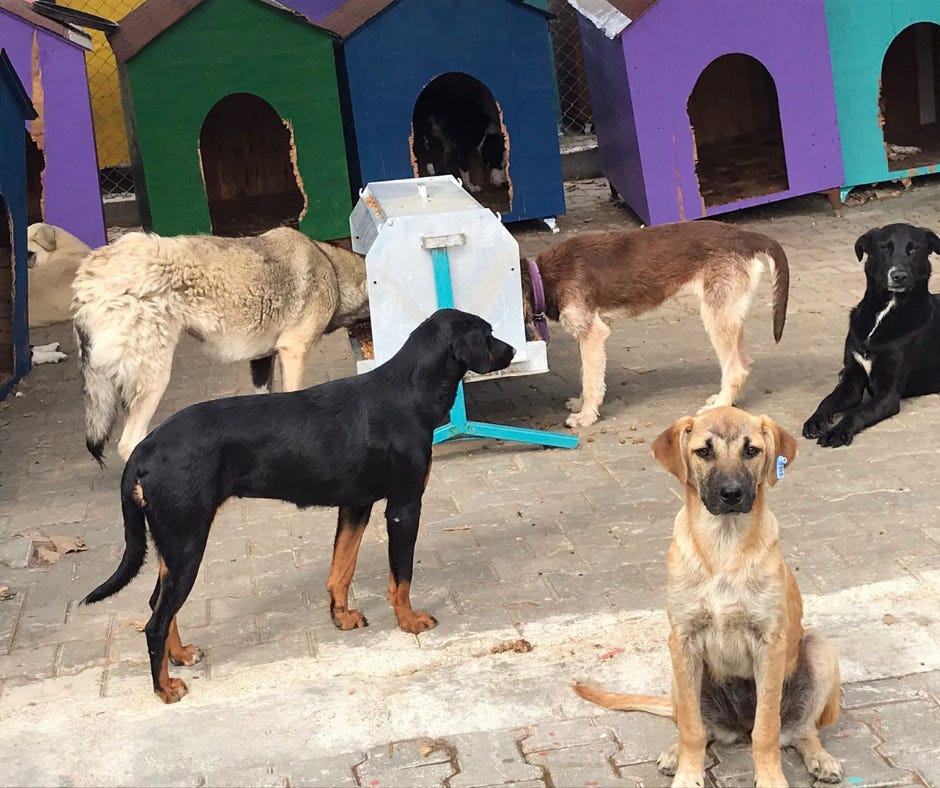
In large mixed-population shelters, behavioural patterns emerge that are not immediately visible in smaller settings.
One pattern repeats consistently:
Street-born dogs appear to recognise that house-raised dogs have developed under different environmental pressures and they adjust their behaviour accordingly.
This is not sentiment. It is observable social differentiation.
Developmental Environment and Behavioural Conditioning
Early environment shapes behavioural repertoire.
Street-born dogs develop within high-variability environments. Their formative period includes:
Unpredictable human interaction
Resource competition
Traffic exposure
Territorial negotiation
Variable access to food and shelter
This produces early environmental conditioning characterised by:
Heightened spatial awareness
Rapid social assessment
Flexible resource negotiation
Context-dependent behavioural inhibition
Their social literacy is shaped through consequence-based learning. Behavioural errors carry cost.
House-raised dogs, particularly those reared in stable domestic settings, often develop under:
Predictable feeding routines
Human-mediated conflict interruption
Controlled exposure to conspecifics
Stable resting territories
This produces a different behavioural profile:
Reduced necessity for competitive signalling
Stronger human-orientation
Fixed resource expectation
Lower exposure to fluid hierarchy dynamics
Neither developmental pathway is superior.
They are simply different adaptive responses to environment.
Social Assessment and Signal Reading
When a house-raised dog enters a mixed shelter environment, street-born dogs frequently engage in what can best be described as structured assessment.
They observe first. This often includes:
Controlled approach arcs
Lateral positioning
Distance calibration
Subtle displacement behaviours
Rather than immediate escalation, many street-born dogs demonstrate delayed engagement, suggesting evaluation of:
Social confidence
Signal accuracy
Stress threshold
In contrast, house-raised dogs with limited broad canine exposure may:
Approach directly without arc
Display over-exaggerated appeasement signals
Freeze under pressure
Exhibit abrupt stress behaviours
The difference is not temperament alone.
It reflects variation in early social conditioning and adaptive experience.
Fluid Hierarchy vs Fixed Expectation
Street populations operate within dynamic social systems.
Hierarchy in these environments is often:
Context-specific
Resource-dependent
Temporally fluid
Position shifts according to access, energy state, and situational need.
House-raised dogs often operate from:
Fixed spatial ownership (bed, bowl, human)
Consistent reinforcement patterns
Reduced requirement for negotiated access
When introduced into communal settings, rigidity in expectation can create stress responses particularly around feeding zones or resting spaces.
Street-born dogs frequently display behavioural modulation in response.
This may include:
De-escalation through avoidance
Brief corrective signalling without prolonged engagement
Rapid disengagement once social information is gathered
There is often differentiation rather than indiscriminate challenge.
Stress Response and Adaptive Inhibition
Street-born dogs commonly demonstrate what might be termed adaptive inhibition, the ability to withhold escalation once outcome is assessed as unnecessary.
This is not passivity. It is cost-benefit behavioural calculation.
In high-risk environments, unnecessary escalation wastes energy and increases injury risk. Over time, selective response becomes advantageous.
House-raised dogs may show:
Lower threshold reactivity in novel group settings
Heightened cortisol response to unpredictable density
Reliance on human mediation that is absent in communal shelter contexts
Again, this reflects conditioning, not moral character.
Misinterpretation of Social Competence
A persistent narrative suggests that street dogs are socially deficient.
In large, mixed populations, observational evidence often contradicts this.
Many demonstrate:
Advanced signal discrimination
Measured corrective behaviour
Context-aware engagement
Efficient disengagement
They appear to categorise unfamiliar behavioural styles quickly.
Not with hostility. With classification.
Integration and Human Error
Where conflict emerges, it is frequently linked to human management decisions:
Rapid transition without staged exposure
Failure to account for prior social experience
Overcrowding
Resource clustering
Origin alone does not determine outcome.
Context determines outcome.
What Long-Term Observation Suggests
Across large-scale shelter environments, the pattern repeats:
Street-born dogs often identify behavioural difference within hours of exposure to house-raised dogs.
They adjust distance. They moderate intensity. They categorise.
They know the difference.
If we observe without projection, we see it clearly.