

The Day a Dog Realises Food Is Guaranteed

The moment survival turns into living
At first, they eat fast. Not hungry feast urgent fast. They will quickly scoff back their meals like another will never come.
The kind of eating where the body stays tense and the eyes stay busy.
Mouth working, mind scanning.
You could refill the bowl and they would barely pause between bites.
Not because they are greedy. Because experience has taught them the food might disappear.
For a street dog, meals are not a routine. They are an event. And events are unpredictable.
Hunger Is Not Just Physical
When humans think of hunger, we imagine an empty stomach.
For animals who have lived without certainty, hunger lives in the brain.
The canine survival system is designed to prioritise calories above comfort. A dog that hesitates loses food. A dog that trusts too soon goes without. Over time, the brain learns a rule:
Eat now. Decide later.
This is why newly rescued dogs often:
gulp food without chewing
guard bowls even when no one approaches
carry food away before eating
return repeatedly to check the bowl
search the floor long after the meal is finished
They are not worried about this meal. They are worried about the next one.
The Stress Hormone Behind the Bowl
In unpredictable environments, cortisol the primary stress hormone stays elevated.
Cortisol sharpens attention and speeds behaviour. Helpful for survival, but exhausting for daily life.
When food availability is uncertain, cortisol rises before, during, and after eating.
The body treats feeding as a competitive event.
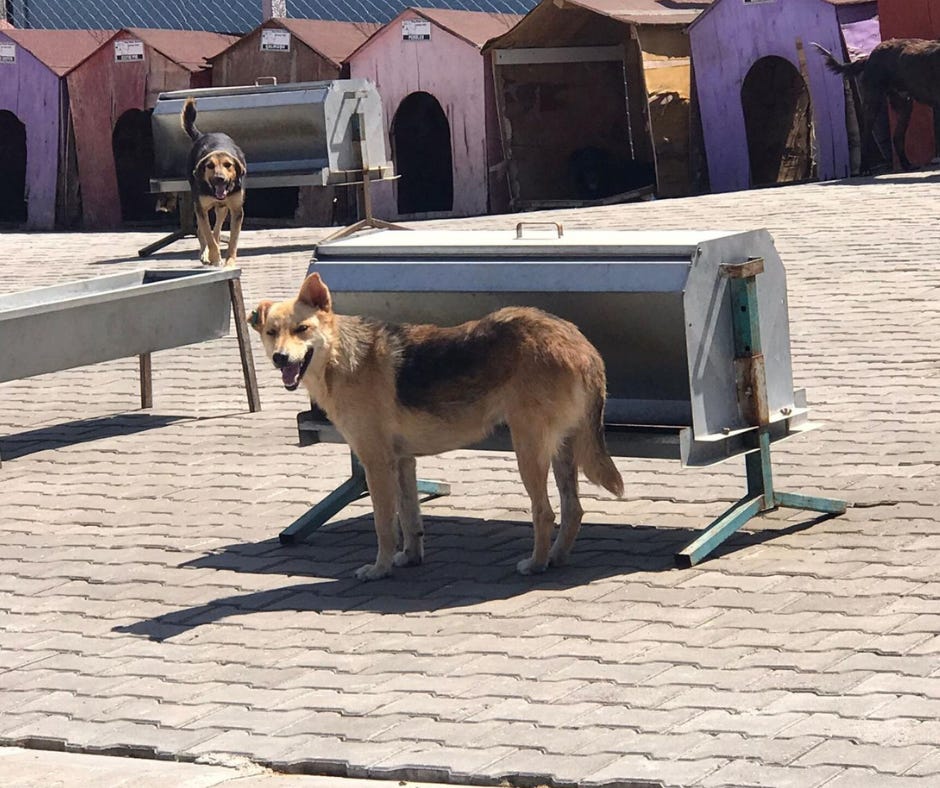
This is why some dogs cannot settle after meals. They pace, watch doors, or stay near the feeding area. Some dogs at the shelter project will lie in the feeding troughs. Not necessarily guarding, waiting for the next meal.
The First Change: Speed Slows Down
Days or weeks into consistent feeding, a small change appears. They pause.
Sometimes it lasts only half a second. A glance up. A breath. But it is the first time the brain interrupts the reflex.
Soon they chew instead of swallow. Soon they leave crumbs behind.
To humans, leftovers look unremarkable. To behaviour science, they are enormous. A dog only abandons calories when the brain predicts future calories.
The Second Change: They Walk Away
The real moment often happens quietly. They finish eating and leave the bowl.
No circling back. No checking corners. No frantic licking of metal or plastic long after the smell is gone.
They choose something else instead, a bed, a person, a patch of sun. This is the day the nervous system shifts from survival to expectation. The body no longer stores urgency because tomorrow has become believable.
What the Brain Has Learned
Predictable feeding rewires the reward system. Dopamine, the anticipation chemical stops spiking only at sight of food and begins appearing around routines: footsteps, voices, preparation sounds.
Food is no longer the only good thing. Life contains other good things. Play increases. Sleep deepens. Social behaviour grows. Energy once reserved for searching becomes available for living.
Why This Moment Matters So Much
For a long time, the dog did not live in days. They lived in meals.
Morning was not morning. It was before eating or after eating.
Once food becomes guaranteed, time expands. The brain can plan, rest, attach, and explore.
You often see it immediately:
slower movements
softer eyes
relaxed posture near the bowl
willingness to leave food unfinished
These are not training outcomes. They are neurological relief.
The Bowl Stops Being Important
Eventually the bowl becomes ordinary.
The dog stops watching it. Stops guarding it. Stops thinking about it between meals.
They may even fall asleep while food is nearby, something impossible in survival mode.
The centre of their world shifts.
Not food. Not safety checks. But connection.
What They Are Really Learning
Not just “I will be fed.”
They learn something much larger:
The world repeats good things. I don’t have to secure them myself.
And when that belief forms, behaviour changes everywhere, walking, greeting, resting, playing.
Because hunger is not only satisfied in the stomach. It is satisfied in certainty.
The Quietest Milestone
There is no celebration when it happens. No visible breakthrough moment.
Just a bowl, half finished. A dog who turns away. And lies down.
For the first time, eating is no longer the purpose of the day.
Living is.