
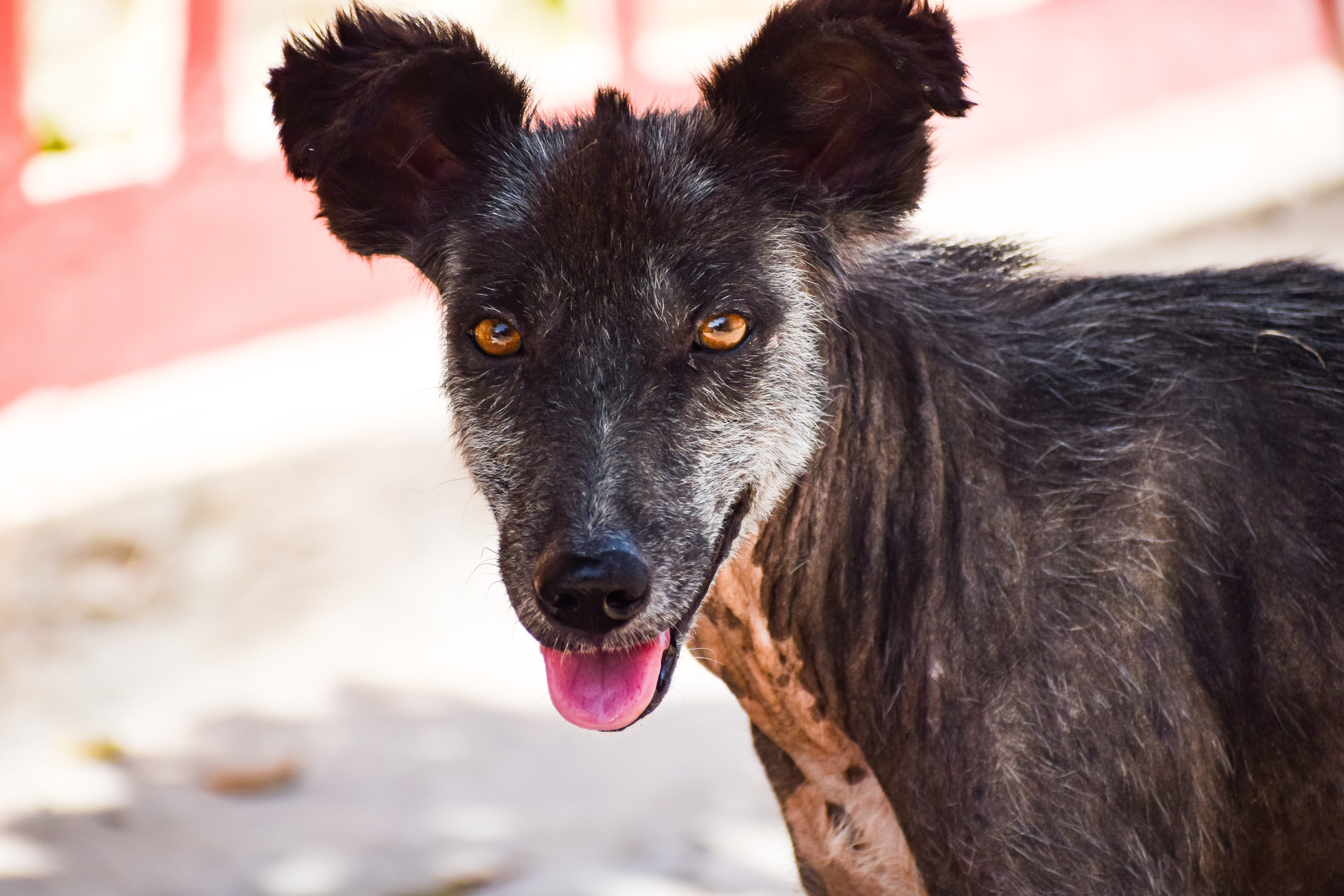
There is something rather wonderful about a dog that nobody designed. Nobody decided how long their legs should be, whether their ears should stand up or flop over, what colour their coat should be or whether their tail should curl neatly over their back. There was no plan for how they should look and no expectation that they should conform to a particular standard. They simply came into the world as they are, and on National Mutt Day we think that is something worth celebrating.
Mixed breed dogs are everywhere, and for those of us who spend a great deal of time around street and community dogs they are simply part of everyday life. They come in every imaginable shape and size, sometimes beautifully proportioned and sometimes looking as though nature became a little more adventurous along the way. There are dogs with enormous ears, tiny feet, long bodies, short legs, shaggy coats and combinations of features that don’t fit neatly into any category. We often meet dogs whose ancestry we could never begin to unravel, but the truth is that we don’t particularly need to.
There is a tendency when we meet a dog to immediately ask what breed they are, and when the answer is unknown the conversation can quickly turn into an attempt to work it out. Perhaps there is some of this in there, maybe a little of that, perhaps the ears came from somewhere else entirely. It can be entertaining speculation, but for many mixed breed dogs, particularly those descended from generations of free roaming dogs, there may be no meaningful answer at all. Their family trees were never recorded and their ancestors were not necessarily members of recognisable breeds. They are simply dogs whose families have been living alongside human communities for generations.
Spend any amount of time with one of those dogs and what might be hidden somewhere in their ancestry very quickly becomes one of the least interesting things about them. You begin to discover who the dog actually is. You learn whether they are confident or cautious, whether they want to be in the middle of everything or prefer to watch from a comfortable distance, which other dogs they choose as friends and which people they trust. You discover the little routines that make them individuals, the things that make them excited, the things they dislike and the peculiar habits that eventually become so familiar that you cannot imagine them behaving any other way.
We see this constantly through our work at Dog Desk Animal Action. A photograph from a street can show what appears at first glance to be another brown dog, another black dog or another scruffy face among the millions of free roaming dogs around the world, but that is only what somebody looking from the outside sees. To the people who actually share that dog’s world, there is nothing anonymous about them. A community carer knows where they appear each morning and which food they prefer. A shopkeeper may know the patch of pavement where they sleep. Another dog may be their constant companion and somebody living nearby may recognise their bark without even looking outside. They have relationships, routines and a place within the community around them.
That is one of the things we wish more people understood about street dogs in particular. When large numbers of dogs are discussed as populations, it becomes very easy for their individuality to disappear. We hear about thousands of dogs being collected, moved, sheltered or removed and the numbers can become so large that the individual animals almost vanish from the conversation. Yet every one of those numbers represents a dog who already has a life. They may have a regular sleeping place, dogs they spend their days with and people they recognise and trust. Being mixed breed and without a recorded history does not make that life any less individual.
Perhaps that is also why we have such affection for the word mutt. It has sometimes been used dismissively, as though a dog without an identifiable breed or documented ancestry is somehow an ordinary version of something more important. Our experience of these dogs could not be further from that idea. There is nothing particularly ordinary about a dog once you know them.
One may be extraordinarily gentle with frightened newcomers while another considers every meal a competitive sporting event. One will find the softest bed available while another inexplicably chooses the floor beside it. Some approach everyone as though they have been waiting all day for their arrival, while others make people earn their trust slowly. There are dogs who seem to take responsibility for everyone around them and others whose principal contribution to sanctuary or shelter life is sleeping somewhere inconvenient. None of those characteristics can be explained by looking at them and trying to decide what mixture of breeds might exist somewhere in their past. They belong to the individual dog.
There is something refreshing about that in a world where dogs are so often presented through labels and appearances. Trends come and go, particular looks become fashionable and enormous attention can be paid to what a dog is supposed to be. The dogs themselves, of course, know absolutely nothing about any of this. They do not know whether their ears are the right shape, whether their coat is desirable or whether anyone could identify their ancestors. They know whether they are hungry, whether they feel safe, which people have treated them kindly, where the best sleeping spot is and exactly when somebody has opened a packet of food three rooms away.
Over the years we have had the privilege of knowing many dogs whose beginnings we will never fully understand. There are no records telling us where they came from and no family trees explaining how they ended up looking exactly as they do. What we do have are their names, their histories from the point at which our lives crossed, and all the small details that gradually turn a dog we once knew nothing about into somebody we know incredibly well.
That is what we are celebrating this National Mutt Day. Not what might be hidden somewhere in their ancestry and not an attempt to fit them into another category, but the wonderful variety and individuality of dogs who need no explanation for how they came to be.
They are the dogs nobody designed, and we wouldn’t change a thing about them.


