


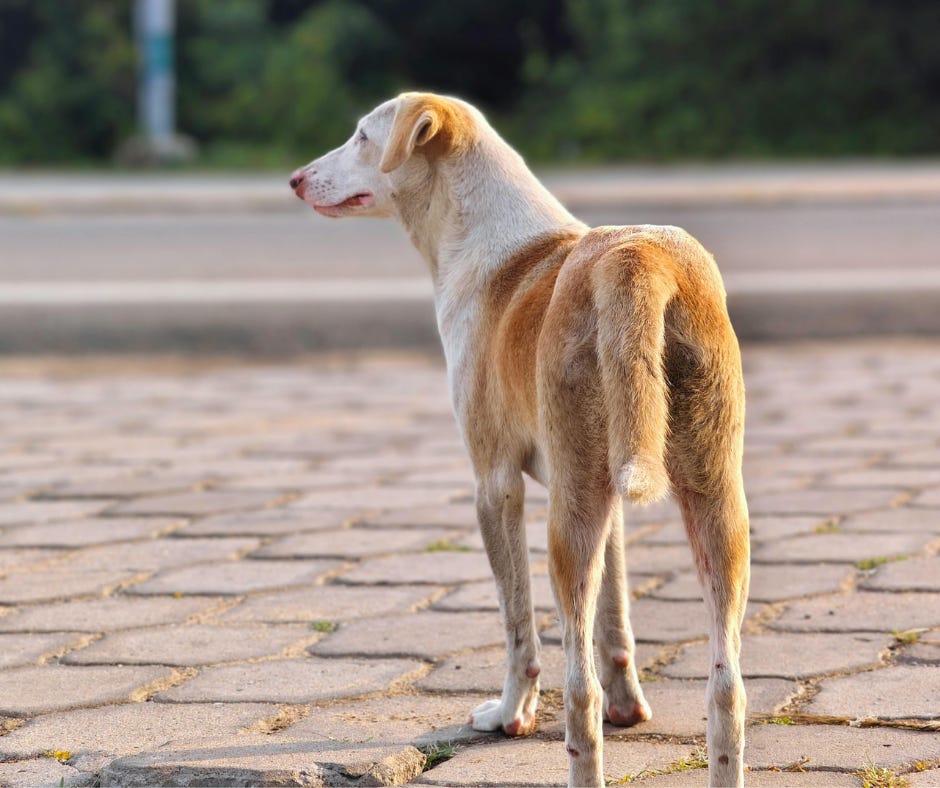
Some of the most successful dogs in animal welfare will never have a rescue story. There will be no photograph of the moment somebody found them, no emergency appeal, no journey to safety and no before and after photographs showing how far they have come. We may never know their names because nothing happened to them that required somebody to save them.
A puppy was never born onto a dangerous street because a sterilisation programme reached enough of the population to prevent that litter. A dog remained with the family who loved them because support was available when circumstances became difficult. A community dog never contracted rabies because vaccination coverage was maintained. A street dog was never collected and confined because policy focused on humane population management rather than simply removing dogs from sight. None of those dogs will appear in rescue statistics, but perhaps that is exactly what success should look like.
Animal welfare naturally focuses on the dogs we can see. The injured dog on the roadside demands attention. The abandoned puppy needs somewhere to go. The frightened dog behind shelter gates needs an outcome. Their stories can be told, their progress can be photographed and the intervention that changed their lives can be measured. Prevention is much harder to show because its success is often the absence of an event. There is no photograph of the dog who was never abandoned and no dramatic story about the disease that never happened.
That can make prevention seem less important than rescue when, in reality, it may protect far more dogs.
Rescue usually begins after something has already gone wrong. The dog has been abandoned, the accident has happened, the disease has taken hold, the shelter has become overcrowded or the unwanted litter has already been born. By the time we meet that dog, the options may have narrowed considerably and somebody has to respond.
Dog Desk Animal Action knows the importance of that response because we have dogs in our own care who needed somebody to intervene. Our sanctuary project exists because there are dogs for whom the system had already failed and who needed somewhere safe. We will continue to respond when dogs need us because prevention tomorrow cannot help the dog suffering today.
But the dogs already in our care also make us ask why the next dog should have to follow the same route. Could the crisis have been prevented?
Sometimes it could not. Accidents happen, illness occurs and circumstances change in ways nobody could reasonably have predicted. But many of the routes into animal welfare systems are remarkably familiar. Uncontrolled reproduction produces another litter for which nobody has a plan. A dog is abandoned when an owner can no longer cope. Preventable disease spreads through an inadequately vaccinated population. Street dogs are repeatedly collected because sustained population management never happened. Shelters fill because animals continue entering faster than safe outcomes can be found for them.
Rescue arrives at the end of all of this and tries to repair the damage. We can become exceptionally good at doing that. We can rescue more dogs, create more shelter places, raise more money and build larger networks. Those achievements are vital because real dogs benefit from them. But if the number of dogs needing emergency intervention continues to rise, we also have to ask whether we are changing the problem or simply becoming better at responding to it.
Prevention asks us to look much further back. A sustained sterilisation programme may mean fewer puppies are born into circumstances where survival depends upon rescue. Those puppies never appear in a shelter intake figure because they were never there to be counted. That can sound uncomfortable because we are talking about animals who never existed, but preventing uncontrolled reproduction is precisely how we reduce the number of dogs born into suffering.
Support for owners can create another kind of invisible success. A family experiencing temporary financial difficulty may need food, veterinary assistance or practical help to keep their dog. If that support is available and the dog remains safely at home, there is no rescue photograph and no new adoption statistic. The dog simply stays with the people who love them. Avoiding surrender was the intervention.
Vaccination is perhaps one of the clearest examples of prevention disappearing from view. When vaccination coverage works, dogs do not develop a preventable disease and communities do not face the same risk of outbreaks. Nothing dramatic happens. That is the point. We should not have to wait until dogs are dying before an intervention becomes visible enough to be valued.
Policy can create exactly the same kind of unseen protection. When authorities invest in sustained humane population management, address abandonment, maintain vaccination and sterilisation programmes and enforce appropriate ownership measures, dogs may never reach the point where large scale collection is considered necessary. Those dogs do not disappear through shelter gates because they never needed to enter them.
This is one of the reasons Dog Desk Animal Action has moved beyond rescue alone. Our sanctuary work matters because the individual dogs in our care matter, but sanctuary cannot be the answer for millions of dogs. Our Stray to Home work can change the future of an individual dog, but rehoming alone cannot absorb an endlessly replenishing population. Prevention, research and policy allow us to ask what happened before a dog needed rescuing and whether something could have changed that journey.
Our Global Stray Dog Crisis Map takes that question further. When we follow developments across countries, we are not simply recording where dogs are in trouble. We are looking at the decisions that determine what happens next and asking whether policies are reducing future need or creating another cycle of collection, confinement and crisis management.
The difficulty is that prevention rarely gives animal welfare the images we have become accustomed to using to demonstrate impact. There may be nobody to hold, nobody to name and nobody whose transformation can be shared. The dog never spends years behind shelter gates. The dog never experiences capture. The dog never becomes another municipal number. The dog never requires emergency treatment for a preventable disease. The dog never needs an appeal to keep them alive.
They simply get to live without becoming an animal welfare case. Perhaps we need to become much better at recognising the value of that.
A prevented abandonment is an outcome. A prevented disease is an outcome. A successful sterilisation programme that reduces unwanted births is an outcome. A policy that means fewer dogs need to be collected is an outcome. A family keeping their dog because support was available is an outcome. None of these things should become less important simply because they are harder to photograph.
We will always celebrate the dogs who make it through rescue. Every one of those lives matters. But if animal welfare is genuinely succeeding at a systemic level, eventually some of our biggest numbers should begin to fall. Fewer dogs should enter shelters. Fewer should be abandoned. Fewer should be born into circumstances where nobody can care for them. Fewer should contract preventable disease. Fewer should require emergency intervention. Fewer dogs should need us to rescue them.
We may never know who those dogs were. Their names will not appear in our records and their photographs will not appear on our social media. They will never contribute to an impressive annual rescue total. But their absence from those statistics may tell us something far more important. It may tell us that, somewhere, animal welfare worked before rescue became necessary.