


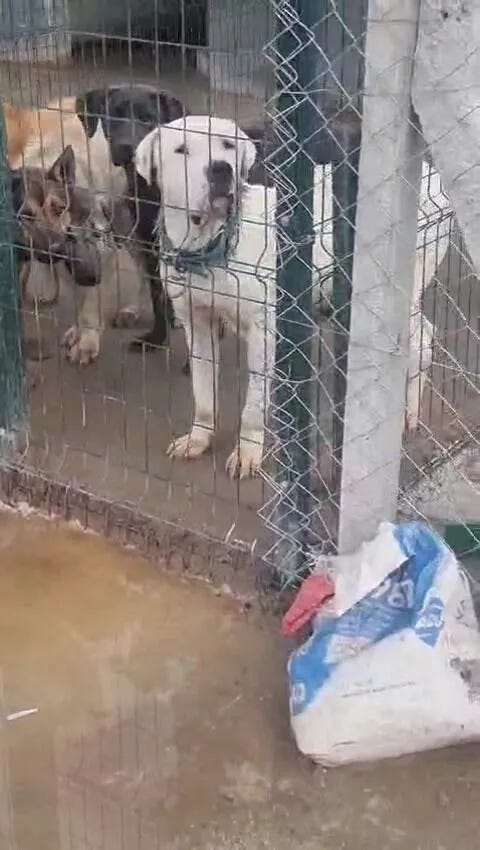
On 28 February 2026, reports emerged from the district of Geyve, in Sakarya, Turkey concerning conditions inside the municipal dog shelter.
The story entered the public domain after members of SOHAYKO (Sokak Hayvanlarını Koruma Yaşatma ve Rehabilitasyon Derneği) visited the facility following what they described as a tip-off. Local media coverage characterised the visit as a raid and published images from inside the premises.
The visuals and statements have prompted wider concern.
What Was Alleged
According to statements attributed to SOHAYKO representatives:
Dogs were allegedly being housed in unsanitary conditions, including standing water and faecal contamination.
There were reportedly no staff present at the time of inspection including no veterinarian or caregiver.
Sick and healthy dogs were kept together, including puppies.
The group called for urgent intervention by both Sakarya Governor’s Office and Geyve Municipality.
These claims have not yet been accompanied by a full official response detailing the municipality’s position or corrective measures, though local authorities may still be reviewing the matter.
Why This Matters
Municipal shelters in Turkey operate under a legal framework that places responsibility on local authorities for:
Collection of unowned dogs
Sterilisation
Vaccination
Rehabilitation
Return or rehoming where appropriate
When shelters become overwhelmed, under-resourced, or poorly managed, the consequences are predictable:
Disease spread (particularly when isolation protocols are absent)
Increased stress behaviours among confined dogs
Escalating mortality rates
Public mistrust
In recent months, scrutiny of municipal shelters across multiple provinces has intensified. Footage whether from activists, staff, or whistle blowers increasingly shapes public perception long before formal investigations conclude.
The Structural Problem
It is important to step back from personalities and focus on systems.
When a shelter shows:
Absence of veterinary oversight
Lack of staffing
Mixed medical cohorts
Poor sanitation
the issue is rarely a single incident. It usually indicates:
Budgetary strain
Insufficient inspection mechanisms
Weak accountability structures
Political pressure around stray dog management
The real question is not whether one organisation exposed poor conditions.
The question is: How many facilities operate in similar ways without inspection?
Activism, Oversight, and Public Confidence
When NGOs conduct inspections or publish footage, reactions tend to polarise:
Supporters argue that civil society oversight is essential.
Critics argue that publicity damages municipal reputation.
Both perspectives exist. However, transparency is not reputational damage. Poor conditions are.
For any municipality, the most effective response is straightforward:
Open access
Publish veterinary records
Publish mortality data
Demonstrate corrective action
Silence fuels speculation. Data restores credibility.
A Wider Context
Across Turkey, stray dog policy is under intense debate. Municipalities face pressure from:
Residents concerned about street safety
Animal welfare groups advocating non-lethal management
Central government directives
Budget constraints
In this environment, shelters become the physical manifestation of policy decisions.
When those shelters fail, the debate intensifies.
What Should Happen Next
For Geyve specifically, responsible next steps would include:
An official inspection report.
Veterinary assessment documentation.
Immediate sanitation and staffing measures if deficiencies are confirmed.
Ongoing monitoring.
For the wider system, the lesson is clear:
Municipal shelters must not operate as closed environments.
They are public facilities, funded by public resources, responsible for sentient beings.
Public oversight is not hostility. It is governance.
Final Reflection
The Geyve situation should not become a social-media spectacle or a factional dispute between organisations.
It should be treated as a case study.
When conditions are exposed, the objective is not outrage.
It is correction.
If municipalities respond transparently and decisively, public trust can be strengthened rather than eroded.
And that ultimately is the standard that matters.