

The Growing Pet Crisis in Dubai: A Question of Readiness

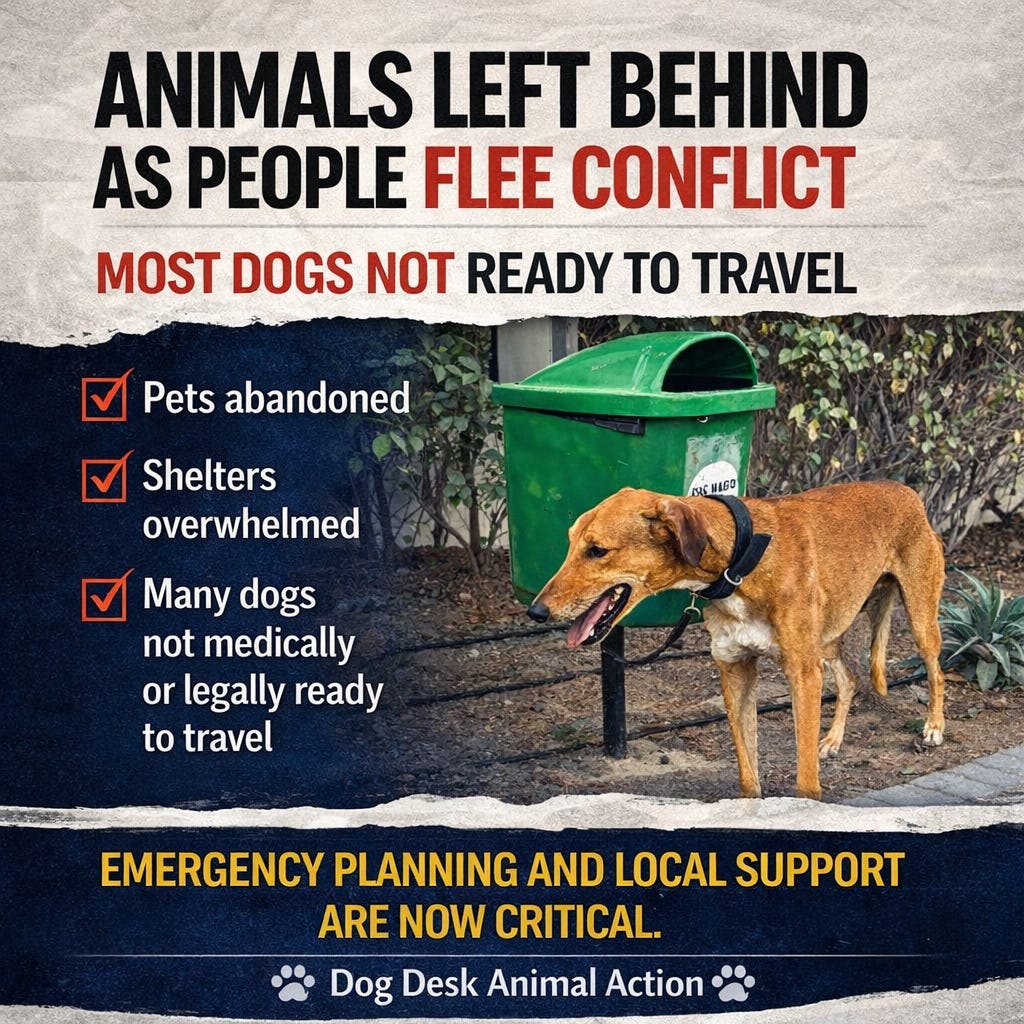
In recent days we have been contacted repeatedly about abandoned pets in Dubai. The messages are urgent and deeply distressing: animals left behind, rescues overwhelmed, and individuals desperately trying to find help.
This situation is not developing in isolation. It is connected to the wider instability caused by the war in the region and the movement of people trying to leave quickly for safety.
When evacuations happen suddenly, animals are often the first casualties of disruption.
Evacuations and the Animals Left Behind
Dubai has a large expatriate population, many of whom work on fixed-term contracts. In normal circumstances, when people relocate, they plan for their pets to travel with them.
But when conflict escalates and people begin evacuating quickly, planning disappears.
Flights fill rapidly.
Transport options become limited.
Documentation requirements become difficult to manage.
And suddenly families who intended to take their animals with them are forced into impossible decisions.
Some manage to arrange relocation for their pets. Others leave animals temporarily with friends or rescuers.
But many animals are simply abandoned when owners have no immediate way to take them.
Volunteer rescuers in Dubai are now reporting increasing numbers of dogs and cats being left in apartments, buildings, or on the outskirts of the city.
The Readiness Problem
Situations like this reveal a larger structural issue: readiness.
Cities with large expatriate populations and complex geopolitical surroundings need contingency plans for animals when crises occur.
That means having systems in place before emergencies happen:
Emergency relocation pathways for pets
Supported rescue infrastructure
Veterinary and holding facilities
Coordination between authorities and welfare organisations
Clear guidance for pet owners during evacuations
Without these systems, the burden falls almost entirely on small volunteer groups and individual rescuers.
And that is exactly what we are seeing now.
Requests for Help
We are being asked whether Dog Desk Animal Action can help.
We understand the desperation behind those requests. When animals are suffering, people will reach out to anyone they believe might be able to assist.
We would genuinely love to help.
But the reality is that we simply do not have the funding to intervene directly in Dubai.
Animal welfare interventions at this scale require aircraft transport, veterinary coordination, quarantine management, and international rehoming networks.
Those are not small operations.
Calling on Organisations With the Capacity to Respond
Because of the urgency of the situation, we have reached out to every major organisation we know that has the resources to intervene.
These are well-funded international groups with the ability to mobilise large-scale evacuations, organisations that have previously moved animals out of disaster zones and conflict areas.
They have the logistical capability, funding, and global adoption networks needed to help animals safely.
We have asked them to look closely at what is now unfolding in Dubai.
A Shared Responsibility in Animal Welfare
The animals now being abandoned are not the cause of the crisis. They are victims of it.
People fleeing conflict often have to make decisions under extreme pressure, and rescue volunteers are left trying to manage the consequences with very limited support.
Situations like this remind us that animal welfare must be part of emergency planning, not an afterthought.
What Happens Next
Right now, volunteers in Dubai are doing everything they can to protect animals who have suddenly been left behind.
We hope that the larger international organisations with the capacity to act will step forward and provide the assistance that this situation now requires.
For now, our role is to raise awareness and connect those asking for help with organisations that have the resources to respond.
But situations like this remind us why building strong, well-supported animal welfare organisations matters. The more people who support our work, the more capacity we can build. And with greater capacity comes the ability to respond when animals are caught in crises like this.
It is our hope that one day we will have the resources needed to step forward directly when help is needed.