


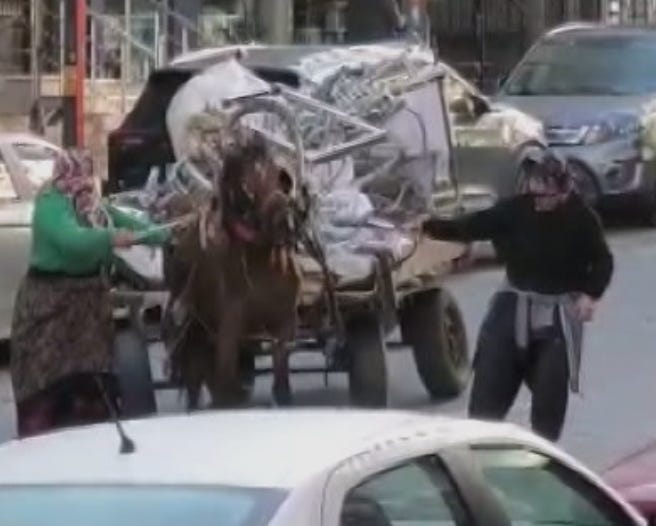
In Avcılar, Turkey a horse collapsed in the street after being forced to pull a cart so overloaded it could no longer move.
The cart was filled with doors, windows, and scrap materials collected for recycling. When the horse struggled under the weight, those using him responded not by unloading the cart, but by beating him.
The horse, already exhausted, was struck repeatedly with a stick and a belt. He was forced to change direction, forced to continue, and eventually collapsed onto the asphalt.
He could not walk. So they beat him. After falling, he was lifted back up and made to continue. When people nearby intervened, those responsible reacted with anger and left the scene.
This Is Not an Isolated Incident
It is easy to look at this and call it cruelty by individuals. But that misses the point.
This horse was not in a field. He was not part of a regulated system. He was part of an informal economy where animals are used as tools.
In parts of urban Turkey, horses are still used to pull heavy loads through city streets, often in waste collection or scrap transport. When the system depends on output rather than welfare, the animal becomes expendable.
And when an animal becomes expendable, suffering becomes inevitable. What we are seeing here is not a moment. It is a structure.
When an Animal Collapses, the System Has Already Failed
By the time a horse falls to the ground, several things have already happened:
The load exceeded what the animal could safely carry
The handler ignored signs of distress
There was no oversight or intervention
The animal had no ability to refuse
The beating is what people react to. But the real failure happens long before that. The collapse is not the beginning of the problem. It is the visible end of it.
Public Reaction vs Real Accountability
What often follows incidents like this is outrage. Videos circulate. People comment.
There may be calls for punishment. But without structural enforcement, very little changes.
Because the same conditions remain:
Unregulated working animals
Economic pressure on handlers
Lack of monitoring
Minimal deterrence
The horse is replaced. The system continues.
The Quiet Reality of Working Animals
Unlike stray dogs, working animals do not attract the same sustained public attention. They are not seen as victims in the same way. They are seen as part of labour.
But the reality is simple:
An animal forced to work beyond its physical limits, without rest, without protection, and without the ability to escape, is experiencing prolonged suffering.
Not occasionally. Continuously.
What This Forces Us to Ask
This is not just about one horse in Avcılar. It raises a broader question:
What happens to animals that exist outside the systems we choose to care about? Because this horse was visible only when he collapsed. Before that, he was working.
And working animals are rarely questioned. Rarely seen
Final Reflection
The most disturbing part of this case is not the violence itself. It is how normal it appeared to those carrying it out.
No urgency. No pause. No recognition that the animal had reached a limit. That is what makes these incidents so difficult to address.
Because when suffering becomes routine, intervention feels like disruption rather than responsibility. And until that changes, the next horse will walk the same road.
Editor’s Note
At the time of writing, those responsible for the abuse shown in this incident have not been taken into custody.
There are also calls for the horse to be confiscated and taken for urgent veterinary care, however this has not yet happened.
No confirmed information has been released to indicate that enforcement action has followed.
We will update this piece if and when there is a verified development.