

The Most Dangerous Time of Her Life
The risks faced by female stray dogs of reproductive age

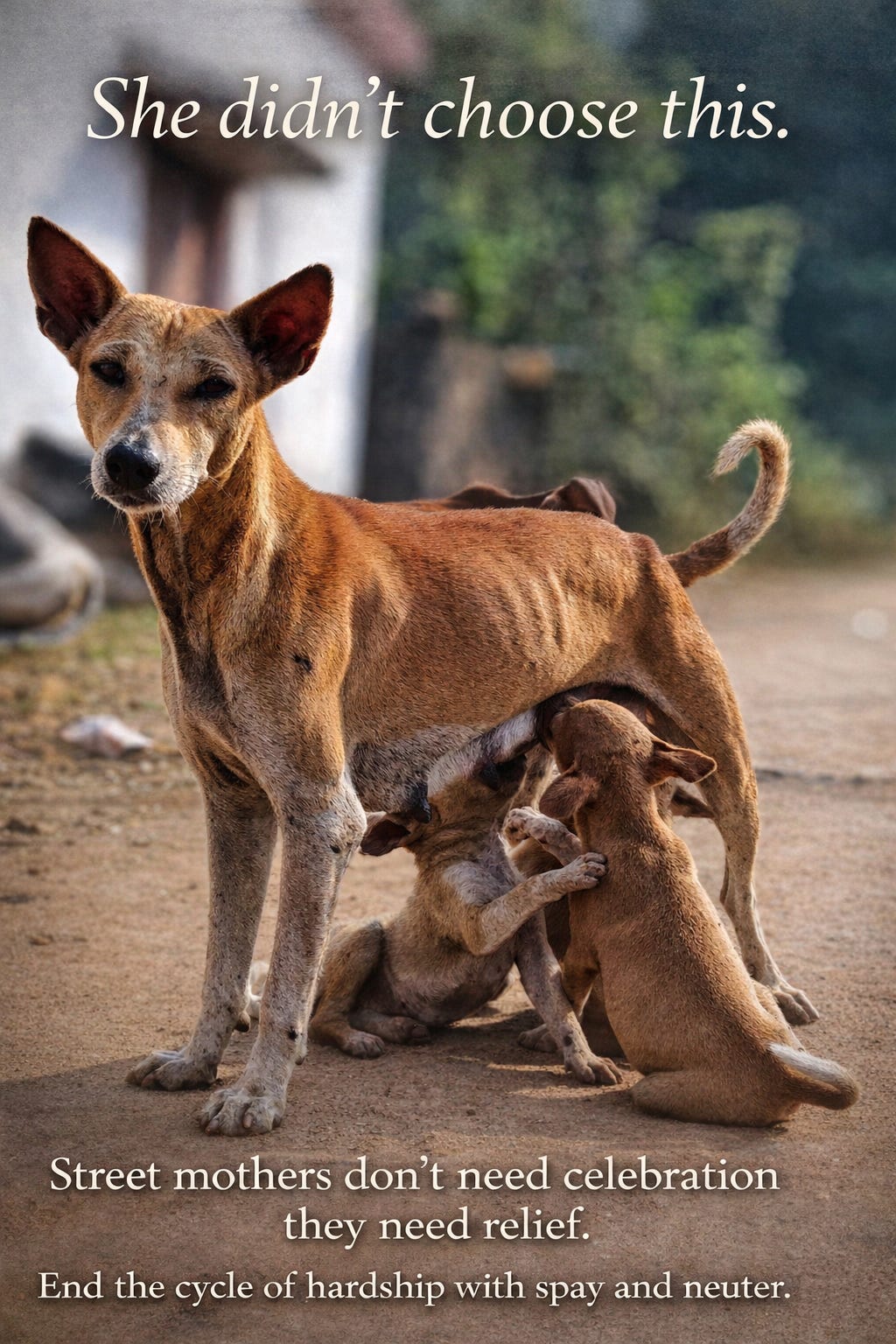
For a female stray dog, reaching reproductive maturity does not mark adulthood.
It marks vulnerability.
While pet dogs experience their seasons indoors, protected and supervised, a street dog’s heat cycle happens in the open, in public spaces, under constant pressure and danger. For weeks at a time she cannot simply exist she becomes the centre of attention in a way that puts her health, safety and survival at risk.
This is one of the least understood welfare crises affecting free-roaming dogs.
Relentless pursuit by male dogs
When a female comes into season she releases pheromones detectable from remarkable distances. Within hours male dogs begin to gather.
At first it is a few. Then it becomes many.
They follow her everywhere:
while she searches for food
while she tries to sleep
while she crosses roads
while she attempts to care for existing puppies
She cannot rest. She cannot recover energy. She cannot safely hide.
Fights between males are common and she often ends up caught in the middle, bitten, crushed or trampled. Even if she escapes, she must keep moving to avoid the attention. Continuous movement leads to exhaustion and weight loss at precisely the time her body needs strength.
Increased risk of injury and traffic accidents
Heat cycles dramatically change behaviour patterns.
A female dog will travel far beyond her normal territory trying to escape harassment or find a safe place. The pack following her runs blindly behind. Roads become one of the greatest threats.
Many road traffic accidents involving street dogs occur during breeding periods because:
dogs cross unfamiliar routes
they move at unusual hours
they run distracted
they ignore normal caution signals
Entire groups can be struck at once. The female, already physically stressed, is often the least able to escape quickly.
Human conflict and deliberate harm
Unfortunately, attention from dogs also draws attention from people.
Residents frequently complain about noise from male competition fights, barking, and chasing behaviour. The female becomes associated with causing the problem despite being the victim of instinctive biology.
This leads to:
removal requests to municipalities
relocation to unfamiliar territories
abandonment in remote areas
poisoning or physical violence in extreme cases
At the very time she needs stability, she is most likely to lose her territory.
Pregnancy while malnourished
Street dogs rarely have consistent nutrition. Pregnancy dramatically increases calorie and mineral requirements, yet food intake often stays the same or decreases due to stress and competition.
Consequences include:
miscarriage
stillbirths
skeletal depletion
weakened immune system
life-threatening complications during birth
Her body prioritises survival of the puppies over her own recovery. Each litter leaves her physically diminished.
Unsafe births
Owned dogs give birth in prepared, quiet spaces.
Stray mothers must improvise.
They often deliver puppies in:
construction sites
drainage pipes
bushes near roads
abandoned buildings
under vehicles
These locations expose newborns to:
hypothermia
flooding
crushing
predators
human disturbance
If discovered, litters are sometimes moved by well-meaning people, causing the mother to panic and relocate repeatedly, risking abandonment of weaker pups she physically cannot carry.
Nursing under constant pressure
Lactation is one of the most energy-intensive biological processes. Yet a street mother must leave the puppies to find food and water, knowing predators, other dogs or people may approach while she is gone.
Male dogs frequently return even after birth, harassing her again before her body has recovered. In many regions females enter another heat cycle shortly after weaning, restarting the entire process within months.
Cumulative physical collapse
Repeated breeding cycles lead to long-term medical consequences:
mammary tumours
uterine infections (pyometra)
severe parasite burden
chronic anaemia
shortened lifespan
By middle age many street females appear elderly. Their bodies have simply worn out.
The humane solution
The dangers female stray dogs face are not caused by their existence they are caused by uncontrolled reproduction.
Spaying does more than prevent puppies.
It removes the most dangerous period of her life.
After sterilisation:
male pursuit stops
roaming decreases
injuries reduce
disease risk drops dramatically
lifespan increases
community conflict decreases
Most importantly, she can finally live rather than survive cycle to cycle.
A different kind of protection
Food helps today.
Shelter helps tonight.
But sterilisation protects every day that follows.
If we want fewer puppies suffering on the streets, we must first protect their mothers.
Because for a stray female dog, safety does not begin at rescue.
It begins when the cycle ends.