


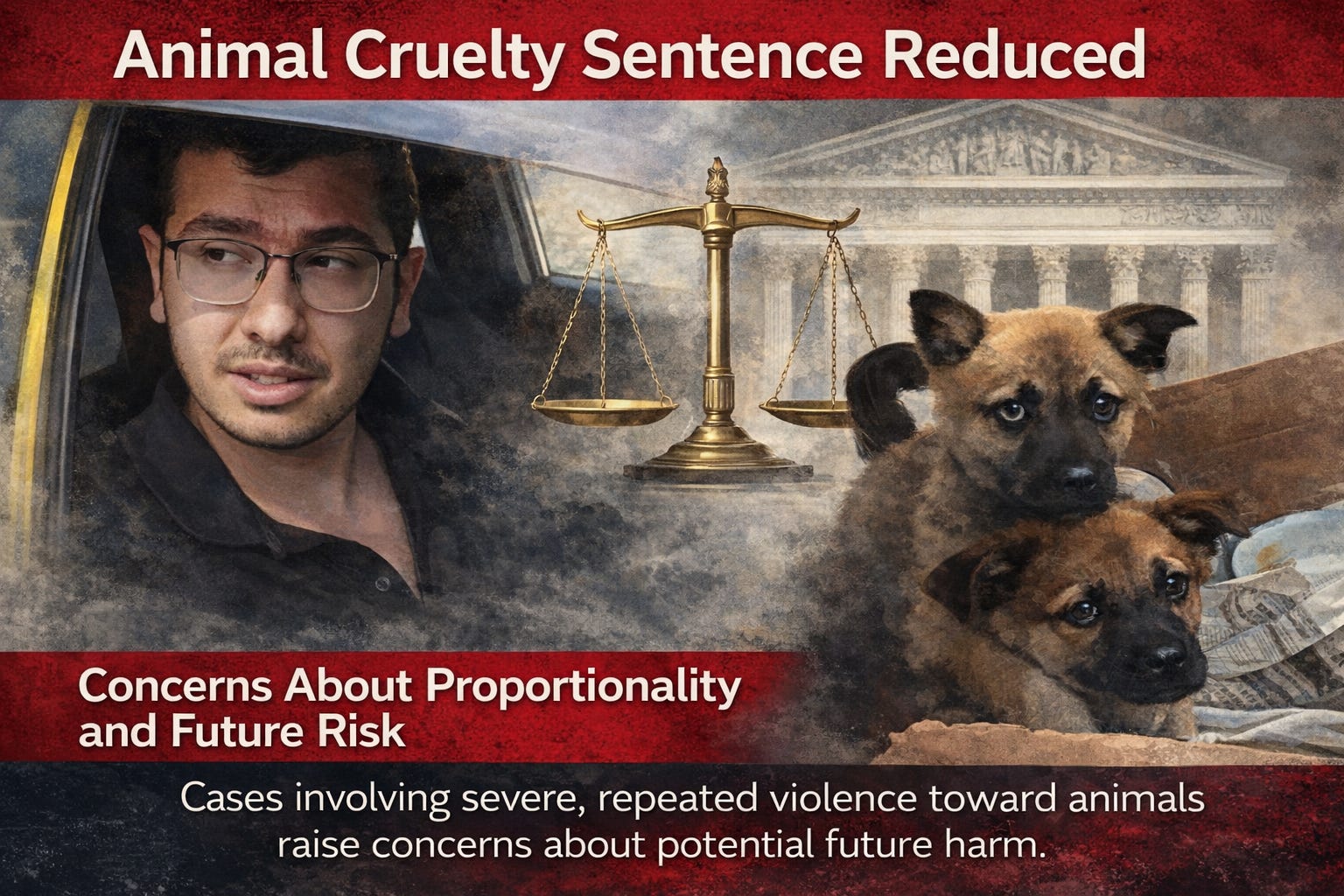
The reduction of the prison sentence given to MuhammetMustafa Duman, convicted in a case involving the torture and killing of 26 puppies in Ankara, has caused shock and distress across the animal welfare community.
Public reaction has understandably been emotional.
But beyond emotion sits a serious question:
What does a reduced consequence mean after an extreme act of cruelty and what does research say about future risk following such crimes?
Why Severe Animal Cruelty Is Considered an Indicator Crime
Modern criminology does not treat extreme animal cruelty as an isolated behaviour.
It is widely recognised as an indicator offence, behaviour statistically associated with elevated risk of future interpersonal violence.
Researchers consistently identify links between severe intentional cruelty and later violent offending. The mechanism is not simply lack of empathy. It is behavioural rehearsal: the repeated overcoming of natural inhibition against causing suffering.
Acts involving prolonged harm, multiple victims, or deliberate infliction of pain are treated differently from neglect or impulsive harm because they demonstrate:
control
domination
desensitisation
escalation tolerance
Courts, therefore, are not only responding to a past act.
They are implicitly addressing future risk.
The Role of Consequences in Behaviour
Punishment functions psychologically in two ways:
External deterrence - society observing consequences
Internal deterrence - the offender forming a lasting boundary
For internal deterrence to form, three factors typically matter:
Certainty
Severity
Meaningful duration
When a serious offence is followed by a substantial reduction in custodial outcome, the internal perception of limits can change.
The behaviour becomes something survived rather than something prohibitive.
This does not mean an individual will reoffend.
But it alters the behavioural calculation around risk.
Why the Nature of the Crime Matters
Criminologists distinguish between impulsive and patterned acts.
Impulsive acts tend to decline naturally over time.
Patterned acts, especially those involving repetition or sustained activity are more stable behavioural pathways.
Extreme cruelty cases often fall into the latter category because they involve persistence and continuation rather than a momentary loss of control.
That distinction matters when considering deterrence.
The Psychological Effect of Sentence Reduction
A rarely discussed factor is post-judicial reinforcement.
If a person experiences:
survival of legal consequence
public attention
or perceived relief through reduction
the event can psychologically shift from punishment to episode.
In behavioural psychology this is known as weakened extinction, when consequences fail to fully suppress a learned behaviour pattern.
Again, this does not predict future crime.
But it reduces a known protective factor: a strong negative association.
The Period After Release
Research into violent offending consistently identifies the highest risk period as:
the first one to three years after release
This is when individuals return to previous environments and coping mechanisms.
Without strong deterrent memory or rehabilitative intervention, behavioural pathways remain available.
The concern raised by observers in cases like the Duman sentencing reduction is therefore not purely moral it is preventive.
Why the Public Reacts So Strongly
Public reaction is often characterised as outrage.
In reality it reflects instinctive risk assessment.
People are not only responding to what happened to the puppies.
They are responding to uncertainty about whether future harm to animals or people has been adequately guarded against.
Sentencing serves several purposes:
punishment
deterrence
protection
public confidence
When a severe act receives a significantly reduced custodial outcome, the public naturally asks whether deterrence has been sufficiently achieved.
A Preventive Perspective
Discussing the Mustafa Duman sentence reduction should centre on clarity
how risk is evaluated
how deterrence is ensured
how recurrence is prevented
Because sentencing is not only about responding to harm already done.
It is about reducing the probability of harm happening again.
And that is why extreme cruelty cases resonate far beyond the courtroom.
They are not only about justice for past victims.
They are about safety for the future.
We have opened a public email petition requesting a lawful review and clarification following the reduction of the prison sentence in the Ankara case involving the killing of 26 puppies.
The aim is simple: to ask authorities to explain the reasoning behind the reduction, how future risk has been assessed, and whether available review mechanisms will be considered in the interest of deterrence.
You can read the submission and add your name here:
https://dogdeskanimalaction.com/ankarapuppykiller/
Signed and shared!