


When Türkiye’s Slaughter Law came into force on 30 July 2024, much of the public discussion focused on legislation, municipal responsibilities and the practical challenges of implementation. Questions were asked about shelter capacity, budgets, collection targets and the scale of the task facing local authorities. Two years later, those same issues continue to dominate official statements and political debate. Yet while attention has remained fixed on the mechanics of implementation, far less consideration has been given to the animals whose lives have been irrevocably changed by it.
For Türkiye’s community dogs, the law was never simply a legal reform. It marked the beginning of a very different existence. The community dogs that had lived for years on the streets where they were known and cared for suddenly became animals to be removed. Some had spent their entire lives within the same neighbourhoods, recognised by shopkeepers, greeted by schoolchildren and fed by residents who regarded them as part of the community. They were not anonymous animals. They had histories, relationships and territories that had often been established over many years.
Over the past two years, Dog Desk Animal Action has documented the consequences of that change. Our investigations have followed individual dogs, monitored municipal practices, examined official announcements and reported on incidents from across Türkiye. Although each case has been different, a disturbing pattern has emerged. The names of the municipalities have changed, the dogs have changed and the people reporting the incidents have changed, yet the forms of suffering have remained remarkably consistent.
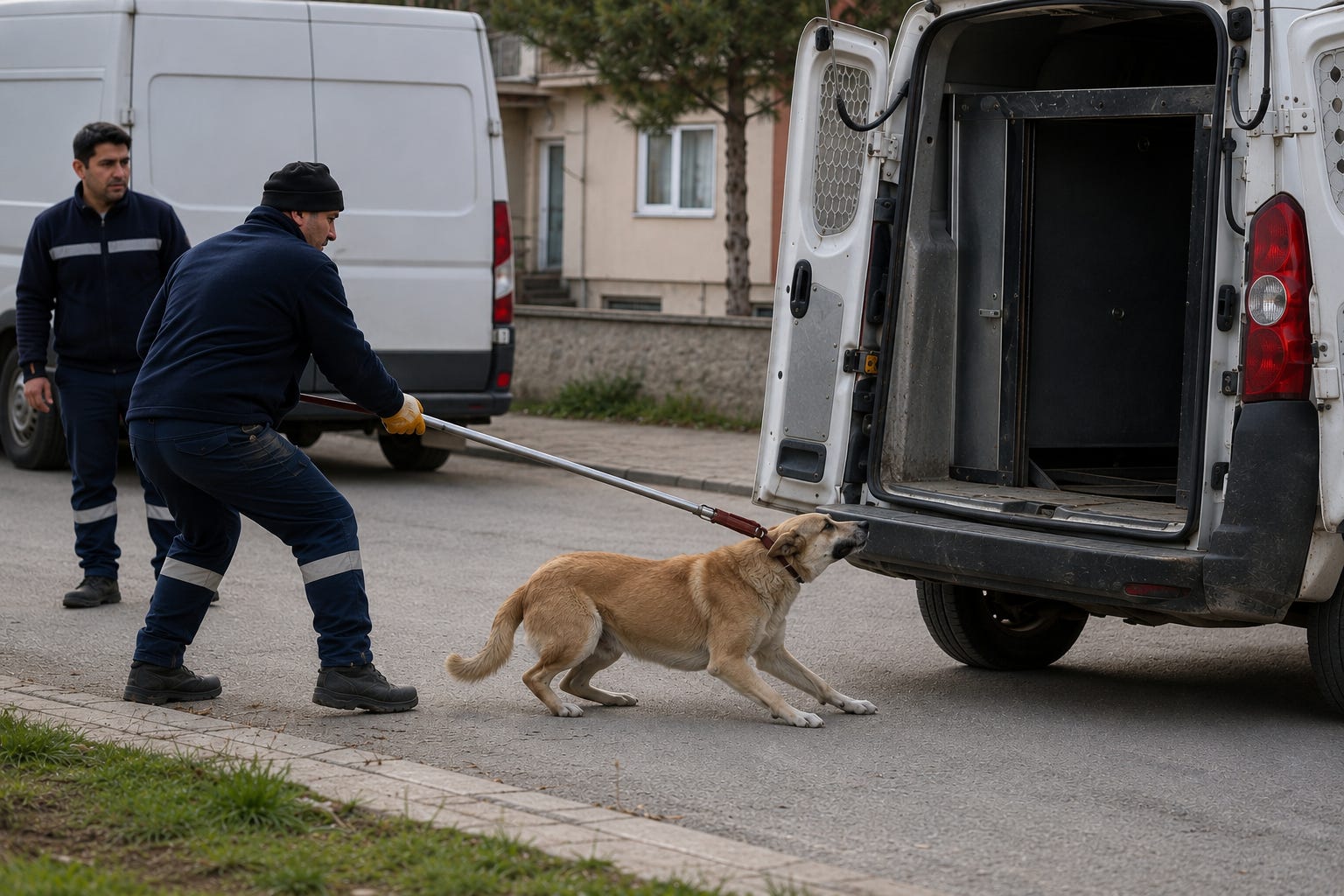
For many dogs, suffering began during capture. Community dogs were chased through streets, industrial areas, parks and residential neighbourhoods before being restrained and loaded into collection vehicles. Our reporting has documented repeated concerns surrounding the use of catch poles, including cases in which dogs sustained severe injuries and, in documented incidents, died following their use. The purpose of a catch pole is restraint, yet over the past two years our investigations have repeatedly raised questions about the way these devices have been used and the consequences for the animals subjected to them.
We have also reported extensively on the use of chemical darting. Darting is not a routine procedure without risk. The physiological condition of a free roaming dog is rarely known in advance, and our investigations have documented dogs that died after being darted during collection operations. These cases prompted wider questions about veterinary oversight, decision making and the risks associated with chemically immobilising animals whose medical history was unknown. Those questions remain relevant today.
For other dogs, the suffering continued after capture. Our archive contains documented cases of dogs dying in transport vehicles before ever reaching a municipal shelter. Others arrived alive only to face entirely different challenges. Throughout the implementation of the law, Dog Desk Animal Action has investigated repeated reports of communicable disease, untreated illness, injury, overcrowding and prolonged confinement within municipal facilities. While conditions have varied between municipalities, the recurring appearance of these concerns across different parts of the country has become one of the defining themes of our reporting.
Not every dog died from disease or neglect. Some died through acts of extreme violence. During the past two years we have reported on dogs beaten to death, including investigations that shocked local communities and prompted widespread condemnation. We have documented reports of pregnant dogs allegedly dragged to their deaths, family dogs removed from their homes, elderly dogs taken from the only territories they had ever known, and animals whose final hours were characterised not by care but by fear. Each investigation has centred on an individual dog, yet taken together they reveal a much larger picture of the risks faced by community dogs during the implementation of the law.
Some of those dogs became known far beyond Türkiye. Tosun’s story travelled internationally after he was taken and died days later. Patron became known because people refused to allow his death to pass unnoticed. Haylaz was taken from his home and later killed in a shelter. These names remain important because they remind us that behind every investigation was an individual life. At the same time, they also remind us of those whose names we will never know. For every Tosun or Patron whose story reached an international audience, there were countless other community dogs whose lives ended without public attention beyond the people who had cared for them.
The tragedy of the past two years cannot be understood solely through the dogs whose stories became widely known. It must also be understood through the ordinary community dogs that disappeared quietly from neighbourhoods across the country. Residents searched shelters carrying photographs on their mobile phones, hoping to recognise familiar faces behind kennel doors. Some travelled long distances in the hope of finding a dog they had fed every day for years. Many returned home without answers. Their stories form an important part of the history of the Slaughter Law because they demonstrate that behind every collection operation there were communities left trying to understand what had happened to animals they regarded as part of their daily lives.
As our reporting has expanded, individual incidents have become evidence of something much larger. Two years ago it was possible to regard each investigation as an isolated event. Today that is no longer possible. The archive built by Dog Desk Animal Action documents recurring forms of suffering reported from municipality after municipality. Dogs dying after darting. Dogs injured or killed during capture. Dogs dying in transport vehicles. Dogs beaten to death. Dogs succumbing to communicable disease. Dogs enduring prolonged confinement. Dogs disappearing from communities where they had lived peacefully for years. Different locations. Different circumstances. The same patterns emerging again and again.
The significance of those patterns extends beyond the individual investigations themselves. They demonstrate that the price paid by Türkiye’s community dogs cannot be measured simply by the number collected or the number of shelters constructed. It must also be measured through the experiences of the animals whose lives were transformed by the implementation of the law. It must be measured in fear during capture, in injuries sustained during restraint, in deaths during transport, in disease, in neglect, in violence and in the uncertainty faced by the countless dogs whose fate was never fully explained.
As Türkiye enters the third year of implementation, the suffering documented over the past two years cannot be regarded as history. Many community dogs remain in municipal facilities. New collection operations continue. New investigations continue to emerge. For many dogs, the consequences of the Slaughter Law are not something that happened in the past; they remain an ongoing reality.
The purpose of documenting these cases has never been to pursue sensationalism. It has been to ensure that the experiences of Türkiye’s community dogs are recorded accurately, carefully and truthfully. Statistics alone cannot tell this story. Neither can political debate. The history of the Slaughter Law must also be written through the lives of the animals who experienced its implementation.
That is the price paid by Türkiye’s community dogs. It is written not only in legislation or official records, but in the stories of the dogs whose lives were changed forever and in the evidence that continues to emerge, two years after the law came into force.