


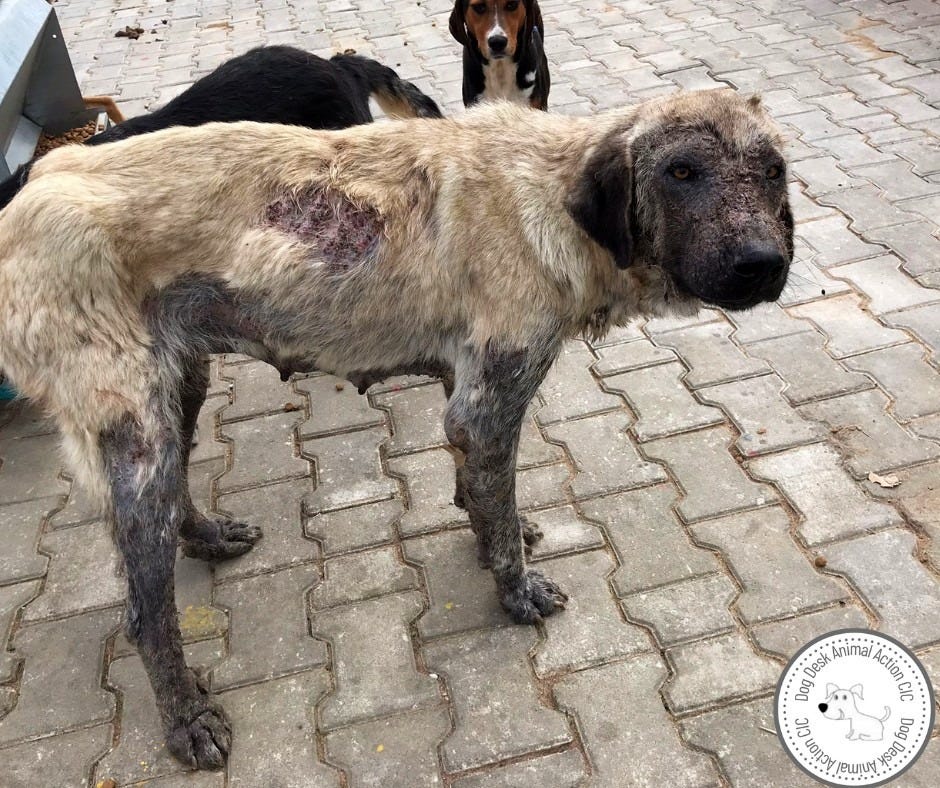
A recent local headline describing an alleged “uyuz köpek paniği” (Panic caused by mangy dogs) in Şanlıurfa Turkey is a familiar pattern.
A dog with visible hair loss. A suggestion of contagion. A word like panic.
And suddenly an unwell animal becomes a public threat.
Let’s separate medical reality from emotional framing.
What Mange Is and What It Is Not
Mange is not a mystery disease. It is not a sudden outbreak.
It is not evidence of aggression.
In dogs, the two most common forms are:
Sarcoptic mange caused by microscopic mites, contagious between dogs and occasionally transmissible to humans through prolonged, close contact.
Demodectic mange associated with immune suppression and not contagious in the same way.
Both are well understood. Both are routinely treated in veterinary practice.
Neither justifies public alarm.
Modern antiparasitic medications are highly effective. In many cases, clinical improvement begins within days. Hair regrowth follows as inflammation settles and secondary infections are controlled.
This is not an untreatable condition. It is a solvable one.
What Mange Actually Means for the Dog
The real story here is not danger.
It is discomfort. Mange causes:
Persistent itching
Inflamed, sometimes cracked skin
Hair loss
Sleep disruption
Increased vulnerability to secondary infection
For a street dog already managing environmental stressors, temperature fluctuation, food insecurity, social hierarchy untreated skin disease compounds that burden.
The animal is not frightening.
It is miserable.
Experience Matters
At the Shelter Project, mange cases have been treated every week since 2022.
Every week.
Street dogs. Shelter dogs. Young, old, immunocompromised.
Not once has a member of staff contracted mange.
That is not anecdotal optimism. It reflects:
Correct diagnosis
Appropriate dosing of antiparasitic medication
Basic hygiene protocols
Understanding of transmission dynamics
When illness is managed with competence, it does not become a public health crisis.
It becomes a routine veterinary matter.
The Public Health Reality
In communities where free-roaming dogs exist, skin conditions will appear periodically. That is not evidence of collapse. It is evidence that veterinary infrastructure must be consistent.
Where CNVR (Catch–Neuter–Vaccinate–Return) programmes function properly, visible disease decreases over time because:
Dogs are monitored
Treatment is administered
Populations stabilise
Where intervention is inconsistent, illness becomes more visible and visibility often triggers sensational language.
But panic is not policy. Medical outreach is policy.
Language Shapes Outcomes
When media uses the language of panic, the implication is that the animal represents imminent harm.
That framing matters.
It shifts public sentiment from:
This dog needs treatment.
to
This dog needs removal.
Fear escalates faster than facts. And in regions already struggling with stray dog management, escalation rarely benefits the animal or the community.
Responsible reporting would:
Confirm veterinary assessment
Clarify transmission risk accurately
Explain treatability
Emphasise structured response
Instead of amplifying alarm, it would reinforce practical solutions.
The Ethical Perspective
A dog with mange is not a political tool. It is not a headline opportunity.
It is an animal with inflamed skin, scratching through the night.
If we are serious about public health, we treat disease.
If we are serious about humane management, we support sterilisation and veterinary access.
If we are serious about communities, we reduce fear by increasing knowledge.
Illness should trigger intervention not hysteria.
The Record, Set Straight
Mange is:
Common in unmanaged dog populations
Readily diagnosable
Straightforward to treat
Preventable through structured veterinary oversight
It is uncomfortable for the dog. It is manageable for the community. It does not justify panic.
The most responsible response is not outrage, removal, or alarmist framing. It is treatment.
And treatment works.
Editorial Note
From time to time, local reporting frames visible illness in stray dogs as a public emergency.
As an organisation working directly in street-dog management and veterinary treatment, we believe it is important to respond when medical conditions are presented in ways that may increase fear rather than understanding.
This article is not written to criticise journalists. It is written to clarify facts.
We have treated mange cases in Turkey since 2022. We understand the condition clinically and operationally. We also understand how quickly language can influence public sentiment toward already vulnerable animals.
When illness is described accurately, communities are informed.
When it is described dramatically, communities become anxious.
Our role is to replace anxiety with evidence.
Michelle Robertson
Dog Desk Animal Action