


Every day, people trust Dog Desk Animal Action to help them understand complex animal welfare issues. Whether we are reporting on developments in Turkey, discussing rabies control, examining shelter systems or highlighting the experiences of individual animals, supporters place their trust in us to present information honestly. That trust is not something we take lightly. In fact, it is probably the most valuable thing we have.
In recent years, social media has changed the way animal welfare is discussed. Stories travel faster than ever before. A dramatic claim can reach hundreds of thousands of people in a matter of hours. A carefully researched article may reach only a fraction of that audience. The temptation is obvious. If attention is the goal, then emotion will almost always outperform evidence.
We see it every day. Complex issues are reduced to simple narratives. Questions are replaced with certainty. Claims are repeated before they are verified. Situations involving multiple competing interests are presented as though there is only one explanation and one obvious answer. The more emotionally powerful the story, the faster it spreads.
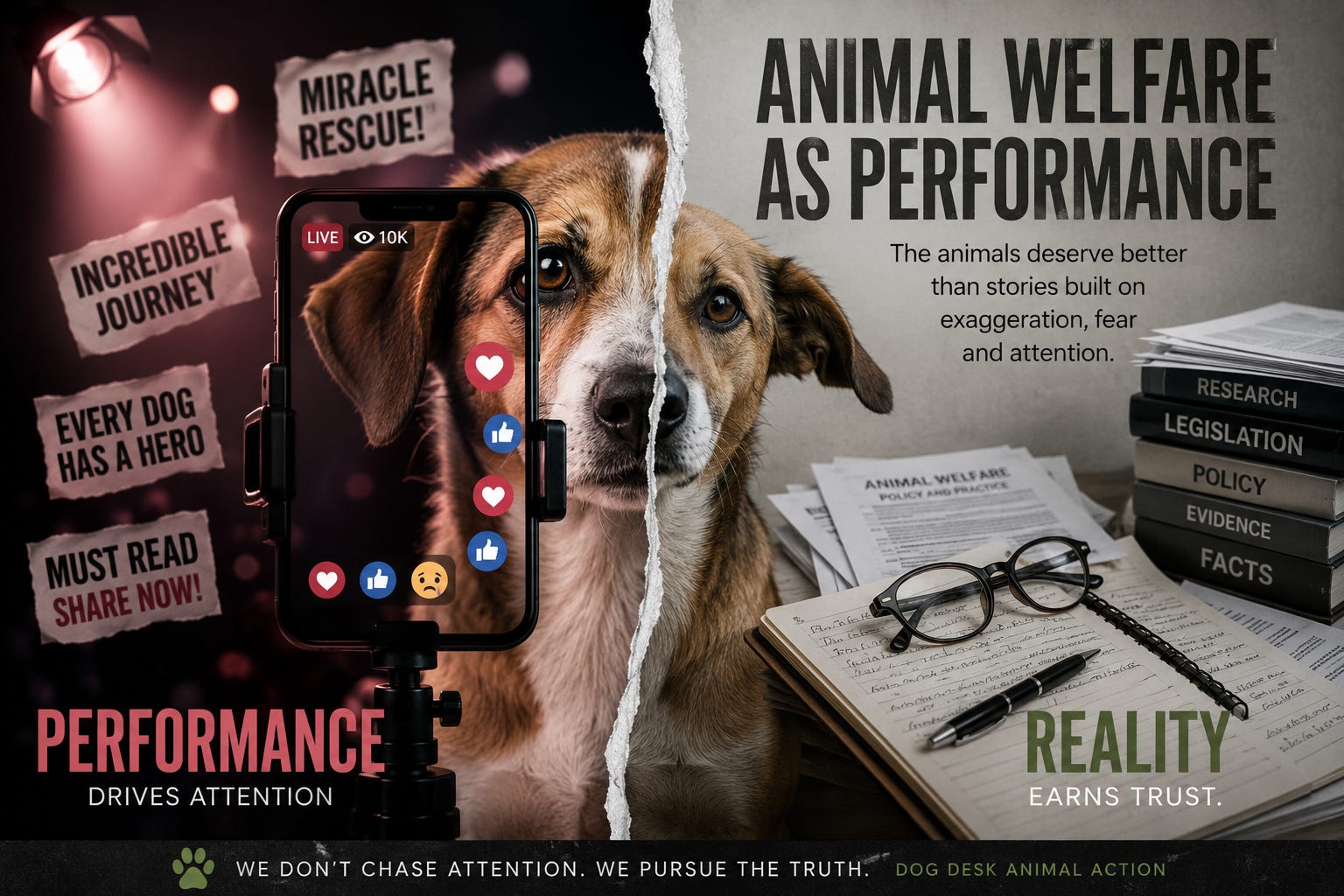
At the same time, animal welfare itself has increasingly become a performance. Ordinary events are transformed into extraordinary journeys. Routine outcomes become miracles. Every story is expected to contain a dramatic struggle, an inspiring lesson or a triumphant ending. The pressure to tell a compelling story can become greater than the desire to tell an accurate one.
The problem is that reality is rarely so neat.
Real animal welfare is often complicated. It involves incomplete information, conflicting viewpoints and uncomfortable facts. It requires investigation. It requires patience. Sometimes it requires admitting that we do not yet know the answer. Yet these are precisely the qualities that social media tends to discourage. Certainty attracts attention. Complexity rarely does.
Recently, we watched a major animal welfare debate spread rapidly across social media. The claims being shared were dramatic and alarming. They generated enormous engagement and strong reactions. Yet when we began reading the available information and examining the wider context, it became clear that the reality was considerably more complex than the version many people were sharing. The issue could not be understood through a single viral post. It required scrutiny, research and a willingness to challenge assumptions.
That experience reinforced something we have believed for a long time. Our responsibility is not to be first. It is not to be popular. It is not even to tell people what they want to hear. Our responsibility is to get as close to the truth as we possibly can.
Sometimes that means publishing information that is uncomfortable. Sometimes it means challenging claims that are widely accepted. Sometimes it means acknowledging uncertainty where others are offering simple answers. None of those approaches are particularly good for generating viral content. They are, however, essential if people are going to trust what we say.
Animal welfare already contains enough genuine suffering. There are dogs dying from preventable diseases, animals trapped in failing systems, carers struggling under immense pressure and communities trying to navigate difficult problems with limited resources. We do not need to exaggerate reality to make it matter. We do not need to manufacture villains, create artificial drama or turn every situation into a crisis. The truth is powerful enough on its own.
We are not interested in defending narratives. We are interested in understanding reality. That means supporting claims with evidence, asking questions before reaching conclusions and being willing to follow the facts wherever they lead. Advocacy should be strengthened by scrutiny, not protected from it.
Trust is built slowly and lost quickly. Once an organisation becomes known for exaggeration, selective storytelling or emotional manipulation, it becomes increasingly difficult for people to separate fact from performance. We have no desire to go down that road.
The world does not need another organisation competing for attention at any cost. It needs organisations that are prepared to investigate before they speak, verify before they share and think before they react.
That is the standard we hold ourselves to. We are not interested in performance, attention or storytelling for its own sake. Our responsibility is to understand what is happening, follow the evidence and tell the truth as accurately as we can. The animals we advocate for deserve nothing less.
The most valuable thing we have is your trust. We intend to protect it.