

The “Sphynx” heels are not just surrealism this is objectification taken further

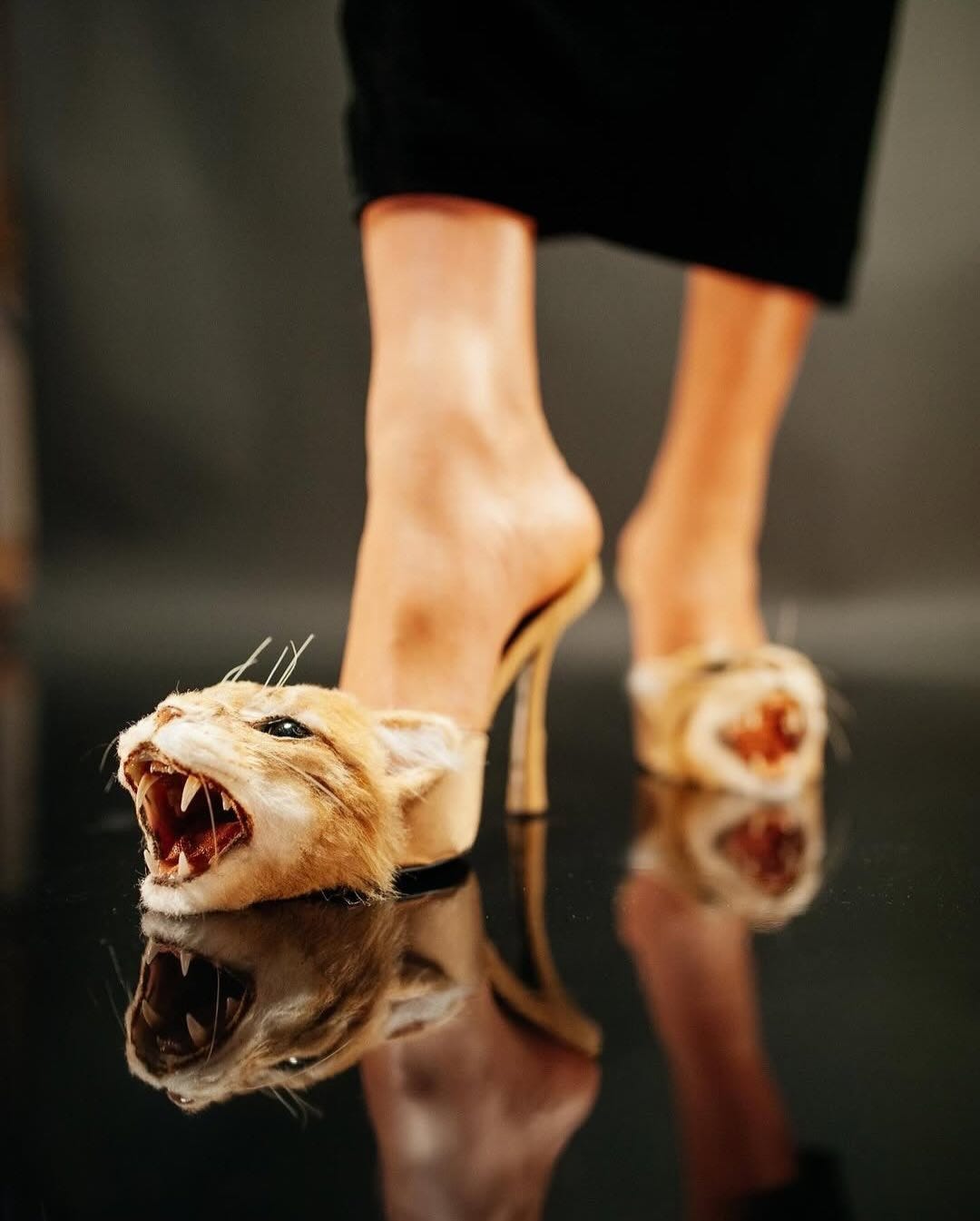
At Paris Fashion Week in March 2026, Daniel Roseberry unveiled one of the most talked-about pieces of the season: the “Sphynx” heels for Schiaparelli.
These were not ordinary shoes. They featured hyper-realistic cat heads at the toe, snarling, sculpted, and confrontational. Crafted from resin and felt, they deliberately blurred the line between fashion accessory and lifelike animal form.
The effect was immediate. Viral attention. Awe. Discomfort. Debate.
Because whether intended or not, the visual language is unmistakable: an animal’s head, reimagined as something to be worn.
Wearable Art or Objectification?
Schiaparelli has always positioned itself at the boundary between fashion and art. The house’s modern collections continue to explore that tension combining fantasy with wearability, and often deliberately provoking reaction.
But the “Sphynx” heels push a familiar question into sharper focus:
At what point does artistic expression begin to normalise animals as objects?
These designs are not cartoonish or symbolic. They are intentionally realistic. The cat’s open mouth, the sculpted fur, the sense of presence all contribute to what has been described as elegant hostility made wearable.
This matters.
Because realism changes perception. It moves the object from abstraction into something that resembles a body.
This Isn’t New It’s a Legacy
To understand this moment, we have to go back to Elsa Schiaparelli.
Schiaparelli’s work in the 1930s was deeply embedded in Surrealism a movement that sought to shock, unsettle, and reframe reality. She collaborated with artists like Salvador Dalí and produced pieces that turned the body into a canvas for the unexpected:
Dresses with exposed skeletal forms
Hats shaped like shoes
Jewellery that mimicked insects crawling on the skin
Surrealism thrived on disruption. It deliberately blurred boundaries between human, object, and animal.
In that context, today’s cat-head heels are not an anomaly they are a continuation.
From Surrealism to Spectacle
What has changed is not the concept, but the context.
In the 1930s, surrealist fashion existed within art circles, niche, intellectual, often inaccessible.
Today, these designs are:
Broadcast globally within seconds
Consumed through social media
Replicated, referenced, and normalised at scale
Modern Schiaparelli thrives on this visibility. Roseberry’s work often generates viral moments, continuing the house’s tradition of spectacle and image-making.
But scale amplifies impact.
What was once avant-garde experimentation becomes cultural messaging.
Animals as Aesthetic Language
Across recent collections, Schiaparelli has repeatedly used animals not just as inspiration but as forms:
Sculptural heads
Anatomical references
Hyper-real textures mimicking skin, fur, or bone
Even when no real animals are used, the symbolism remains.
Animals become:
Motifs
Props
Objects to be worn, carried, displayed
And this is where discomfort begins to deepen particularly for those working in animal welfare.
Because in the real world, animals are still:
Bought
Sold
Abandoned
Controlled
The visual language of objectification does not exist in isolation from that reality
Why This Matters Beyond Fashion
It would be easy to dismiss this as just art.
But imagery shapes perception.
When animals are repeatedly presented as:
Decorative
Possessable
Wearable
it reinforces a subtle but persistent hierarchy:
that animals exist for human use.
For organisations like Dog Desk Animal Action working daily with dogs who have been discarded, controlled, or neglected this isn’t theoretical.
It is lived reality.
The gap between symbolic objectification and real-world harm is not as wide as we might like to think.
A More Honest Question
The conversation is not about banning creativity.
Nor is it about misunderstanding surrealism.
It is about asking a more precise question:
What are we normalising and who does it affect?
Schiaparelli’s legacy is built on disruption. On making people look twice.
In that sense, the “Sphynx” heels succeed.
They force a reaction. They create discomfort.
And perhaps, unintentionally, they open a conversation that extends far beyond fashion.
Closing Reflection
Schiaparelli once turned a teacup into fur. Today, a shoe becomes a snarling animal. The artistic intention may be unchanged. But the world around it has.
And in that world where animals are still fighting for basic welfare
we have to decide:
Do we see these designs as harmless fantasy or as part of a deeper story about how animals are viewed, used, and valued?