
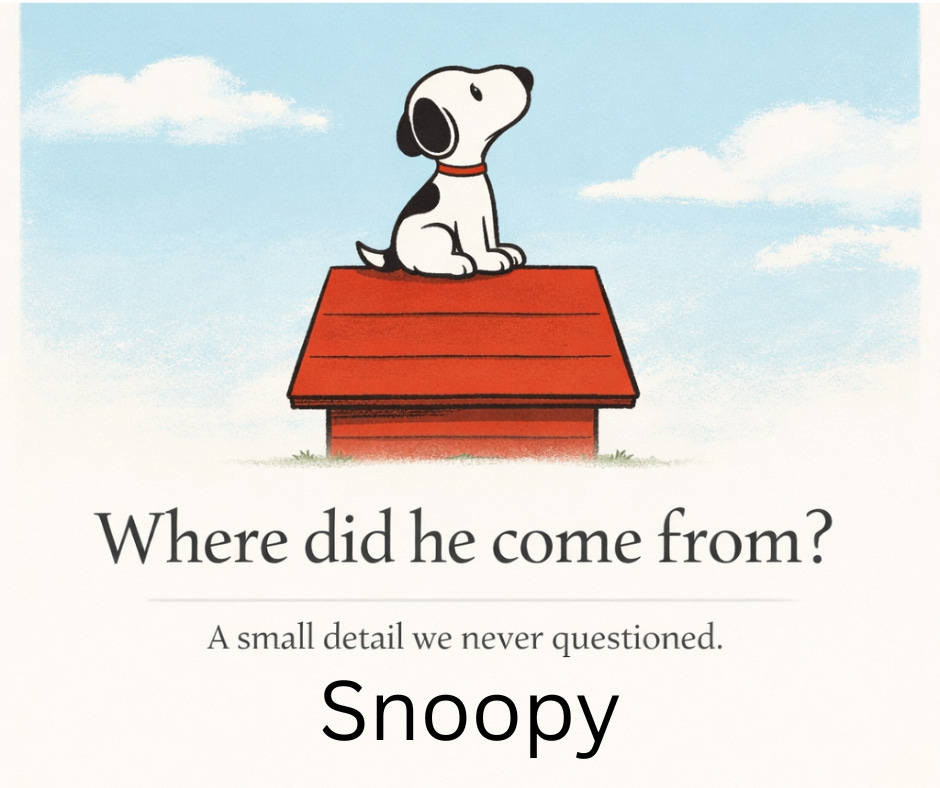
There’s Something We Missed About Snoopy
Most people would never think to question Snoopy’s beginnings.
He is one of the most recognisable dogs in the world, content on top of his kennel, loyal to Charlie Brown, and firmly placed in popular culture as the picture of a well-loved companion.
But there is a small detail, quietly written into the world of Peanuts, created by Charles M. Schulz, that lands a little differently today.
Snoopy came from a place called Daisy Hill Puppy Farm.
At the time, it was an unremarkable line. Today, it invites a more thoughtful question.
A Phrase That Has Changed Meaning
When Snoopy’s story was first written puppy farm was not a loaded term. It was used casually, without the awareness we now have around breeding practices and welfare. Today, the same words carry a very different weight.
In the world of Peanuts, Snoopy’s life unfolds in the best possible way.
He is:
chosen
cared for
safe
able to express his personality fully
His story is one of stability and belonging.
For many dogs, the outcome is similar, loving homes, responsible owners, and lives lived as companions.
But for others, the journey can be more uncertain.
Where dogs are bred without sufficient care or planning, challenges can arise:
early separation
lack of exposure to normal environments
difficulties adjusting later in life
These are not inevitable outcomes, but they are part of a broader conversation that has become more visible in recent years.
Looking Back Without Judgement
It would be easy to look at a phrase like “Daisy Hill Puppy Farm” through a modern lens and draw hard conclusions.
But that risks missing something important.
Charles M. Schulz did not set out to make a statement about breeding practices. He created a world centred on relationships between people, and between people and dogs.
Snoopy himself represents:
individuality
imagination
emotional connection
Those qualities have helped shape how many people see dogs today not as possessions, but as companions with their own inner lives.
That influence has, in many ways, supported the very welfare conversations we are now having.
What Has Changed And Why It Matters
The difference lies not in Snoopy’s story, but in our understanding.
We now know more about:
early development in puppies
the importance of environment and care
the long-term effects of how dogs are bred and raised
This knowledge has led to:
stronger expectations of breeders
greater awareness of adoption
more informed choices by the public
It has also encouraged a broader question not just where a dog comes from, but how that beginning shapes their life.
A Gentle Reflection
Snoopy’s origin story is not a problem to solve.
But it does offer a moment to pause and reflect.
A single line “puppy farm” once passed without notice. Today, it prompts curiosity, and sometimes concern. That shift tells us something meaningful: people are paying closer attention. And that attention matters.
Because whether a dog begins life in a carefully managed breeding environment, a rescue setting, or on the street, the goal is the same:
a life of safety
a chance to adapt
and a place where they are understood
Snoopy found that place with Charlie Brown.
The question we carry forward is how to make that outcome as widely possible as we can.


