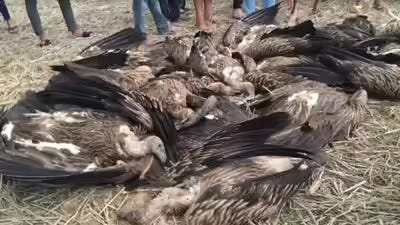

More than two dozen vultures were found dead in the buffer zone of Dudhwa Tiger Reserve in Uttar Pradesh.
Forest staff responding to the incident were not just recovering bird carcasses. They were collecting multiple animal remains from the area, a detail that matters, because it points to how this event likely unfolded.
What Happened
According to reports at least 24 vultures were discovered dead in the Dudhwa buffer zone. Initial findings suggest secondary poisoning.
This means the vultures themselves were not directly targeted. Instead, they are believed to have fed on the carcass of another animal that had already been poisoned.
Forest teams began collecting carcasses from the site for investigation, indicating that the poisoning event likely involved multiple animals, not a single isolated death.
Where Dogs Enter the Picture
This is where the incident moves beyond wildlife crime. Secondary poisoning events in India frequently originate in human attempts to control free-roaming animals, particularly dogs or livestock predators.
The mechanism is simple:
Poison is placed in bait or carcasses
The intended target is often a dog, jackal, or other scavenger
The poisoned animal dies
Scavengers, especially vultures feed on the body
The toxin moves up the food chain
What begins as a localised human–animal conflict becomes an ecosystem-level event.
The Wider Conflict
India has one of the largest populations of free-roaming dogs in the world. Their presence intersects with:
Human safety concerns (including bites)
Livestock protection
Waste management failures
Urban and rural coexistence pressures
In this environment, poisoning becomes a shortcut. It is not legal, and it is not controlled. But it is used. And when it is used, it does not stay contained.
Why Vultures Pay the Price
Vultures are uniquely vulnerable in these situations because of their ecological role.
They are:
Obligate scavengers
Highly efficient at locating carcasses
Social feeders (multiple birds gather at one site)
This means a single poisoned carcass can kill not one animal, but dozens. That is exactly what appears to have happened in Dudhwa.
The Pattern We Keep Seeing
This is not an isolated failure. It reflects a recurring pattern:
A human–animal conflict is left unresolved
Informal or illegal control methods are used
Non-target species are killed
The ecological consequences are far wider than intended
Dogs are often at the centre of the initial tension. But they are rarely the only victims.
The Real Problem
The Dudhwa incident is not fundamentally about vultures. It is about system failure in managing coexistence.
Free-roaming dog populations remain poorly managed
Waste systems continue to sustain those populations
Public safety concerns are real and unresolved
Enforcement against poisoning is weak
Ecological consequences are not factored into response
So the response becomes reactive, local, and often invisible until something like this happens.
What This Leaves Us With
More than 24 vultures are dead. But the more important point is this, they died as a result of a chain of decisions that started elsewhere.
Until the root conflict between people, dogs, and shared environments is addressed in a structured, lawful, and evidence-based way, events like this will continue.
Not always in the same place. Not always involving the same species.
But always following the same pattern.