


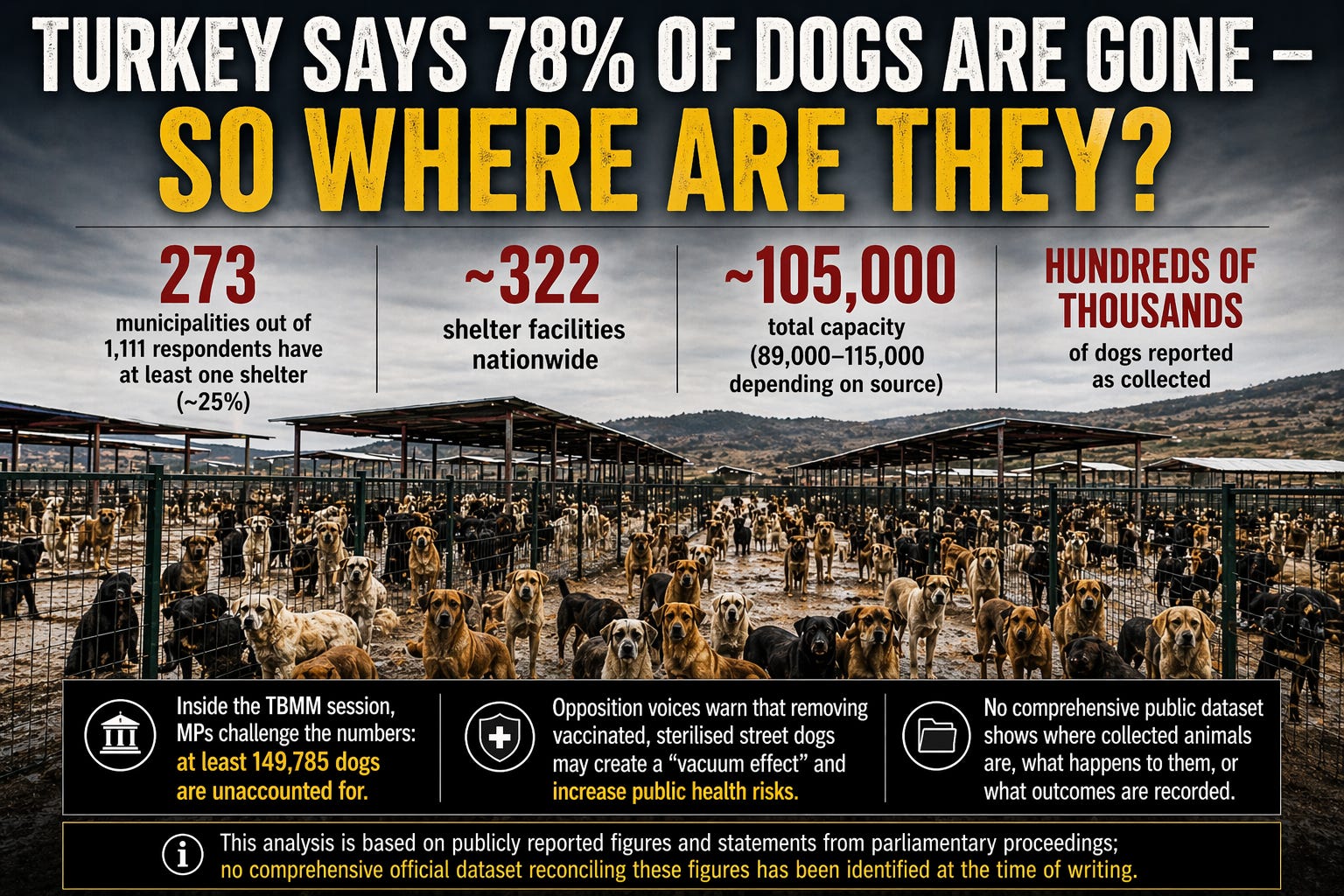
In the Grand National Assembly of Turkey commission session, officials state that around 78% of street dogs have been collected .
That is a national claim.
Now place it alongside the most concrete, publicly available data on capacity:
273 municipalities out of 1,111 respondents have at least one shelter
→ roughly 25% coverageEarlier estimates:
237 municipalities out of ~1,400
Repeated sector and parliamentary references:
~322 shelter facilities nationwide
~105,000 total capacity (commonly cited between ~89,000–115,000)
Even at the upper end, the system can hold around one hundred thousand animals.
At the same time, official and semi-official figures refer to hundreds of thousands of dogs collected.
Those figures do not reconcile.
The Dispute Is Not Outside the System It Is Inside It
This is not just an external criticism.
Inside the same TBMM session, those figures are directly challenged.
MP Nimet Özdemir, using ministry data, points to a gap:
452,587 dogs collected
239,466 sterilised
58,802 adopted
Leaving at least 149,785 animals unaccounted for.
Her question is simple:
Where are they?
That question is not answered.
Competing Claims About Public Health
The justification for large-scale collection is framed as public health and safety.
But this is also challenged inside the same session.
Opposition arguments include:
Removing vaccinated, sterilised street dogs creates a vacuum effect
Unvaccinated animals move in from rural and forest areas
This may increase, not reduce, zoonotic disease risk
At the same time, concerns are raised that:
overcrowded environments lead to disease spread and mortality
disruption of street populations alters ecological balance
These are not fringe claims.
They are being made on the parliamentary record.
The System Problem
Strip everything back, and the issue becomes structural:
A system that:
removes animals at scale
operates across hundreds of municipalities
relies on limited and uneven infrastructure
must be able to track outcomes clearly.
Yet there is no comprehensive, publicly available dataset that accounts for:
total intake
current population in care
verified adoptions
transfers
deaths or losses
Instead, there are:
percentages
presentations
partial figures
The Numbers Still Do Not Resolve
Even if every available shelter space were filled:
capacity: ~100,000
claimed collections: hundreds of thousands
A substantial number of animals remain unaccounted for within visible capacity.
That is not interpretation. It is the arithmetic consequence of the figures presented.
What This Means
This is no longer just a policy debate. It is a question of accountability. Because without traceability:
welfare cannot be verified
public health claims cannot be tested
outcomes cannot be independently assessed
And crucially conflicting narratives cannot be resolved
Final Point
Two things are now true at the same time:
A system claims large-scale success.
That same system cannot clearly show where all the animals are.
Those positions cannot coexist indefinitely.
If the numbers are accurate, the data should exist. If the data does not exist, the numbers cannot be relied on.
This analysis is based on publicly reported figures and statements from parliamentary proceedings; no comprehensive official dataset reconciling these figures has been identified at the time of writing.
TBMM Minutes Below
