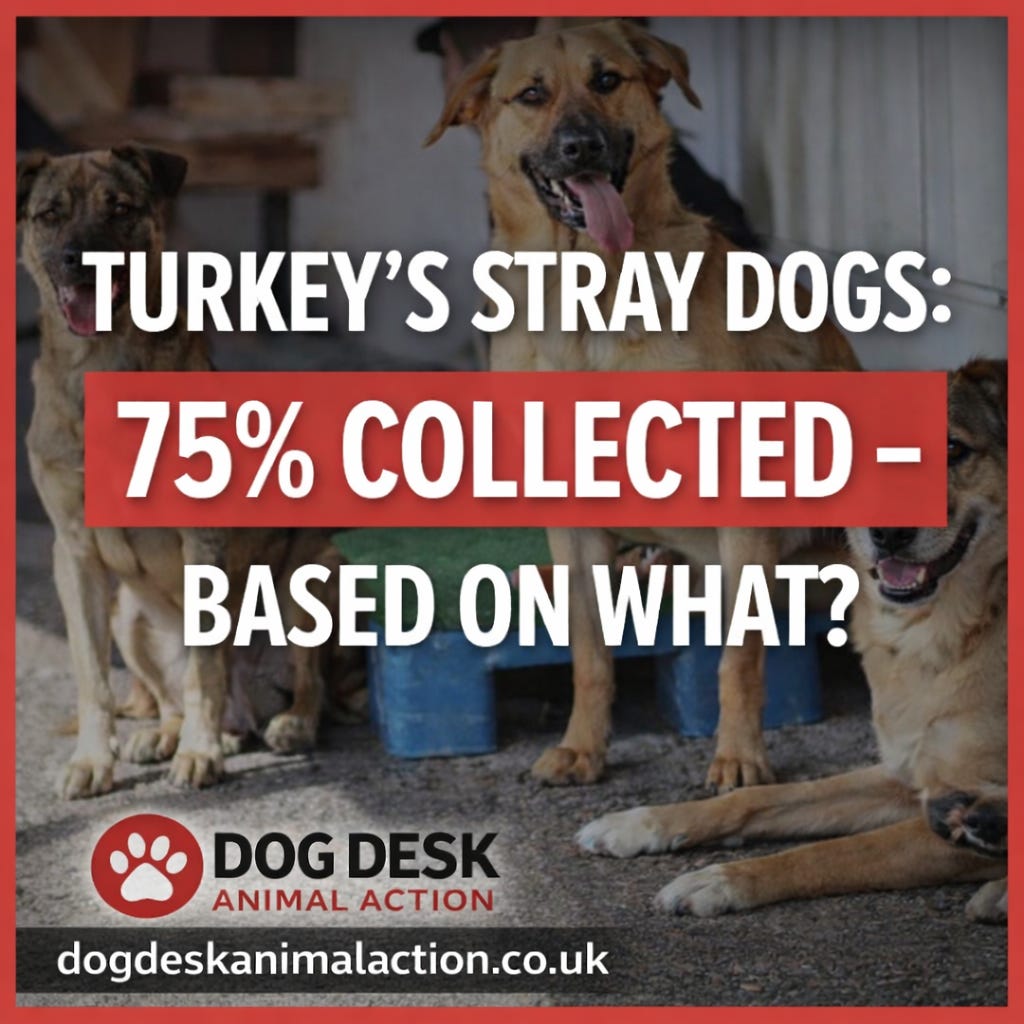


A headline has been circulating widely in the media.
“75% of stray dogs have been rounded up.”
It is a striking figure. It suggests scale, coordination, and progress. But it also raises an interesting question:
Where does this number come from and what does it actually represent?
Source of the Claim
The figure originates from a statement by Ali Yerlikaya, reported via outlets including Turkish Minute and broadcast on TRT Haber.
In that statement, it was said that:
Collection efforts had been completed in a number of provinces
Progress in metropolitan areas was ongoing
In total, “approximately three out of every four” stray dogs had been collected
This aggregate was then presented as a national figure: 75%
What the 75% Figure Actually Reflects
It is important to distinguish between:
A reported figure
A verified dataset
At present, the 75% appears to be:
Based on regional reporting aggregated centrally
Presented as a single national statistic
Unsupported by publicly available methodology or data
There is no accessible breakdown showing:
How many dogs were counted in the baseline population
How many were collected in each municipality
What criteria define “collected”
What has happened to those animals since
Without this, the figure cannot be independently assessed.
How Many Dogs Are There and How Would We Know Exactly?
There is no confirmed national count of free-roaming dogs in Turkey. Estimates are typically drawn from:
Municipal reporting based on local knowledge
Limited field counts in selected areas
Projections from academic or NGO modelling
These approaches produce ranges, not fixed totals. There is no unified system that:
counts every dog
tracks movement or removal
maintains a live national register
This leads to a simple but unavoidable problem. A percentage requires a known total. In this case, the total is not known. Which raises a basic question:
75% of what, exactly?
The Absence Behind the Number
A percentage on its own carries authority. It implies measurement, tracking, and oversight. But in this case, the underlying system is not visible.
There is no:
National registry of free-roaming dogs
Standardised municipal reporting framework
Public dataset tracking outcomes post-collection
This creates a gap between what is said and what can be examined.
Why This Matters
The issue is not whether the figure is correct or incorrect. The issue is that it cannot currently be verified with confidence. A number of this scale, tied to a policy affecting millions of animals, requires:
Transparency
Methodology
Accountability
Without these, it functions primarily as a statement of progress, rather than a measurable outcome.
The Unanswered Questions
If 75% of stray dogs have been collected, then several basic questions follow:
Where are those dogs now?
Which municipalities reported completion, and on what basis?
What conditions are they being held in?
What proportion have been rehomed, retained, or lost?
These are not secondary details. They are the substance behind the number.
A Figure Without a System
The claim of 75% has travelled quickly especially on social media. It has been repeated, shared, and accepted in headline form. But a statistic of this scale should not exist in isolation.
Without visible data, it is not a measurement in the conventional sense.
It is a reported figure without a traceable system behind it.
Conclusion
The 75% figure may represent an attempt to summarise progress. But in its current form, it raises more questions than it answers.
Turkey’s stray dog population is commonly estimated at around four million, though the true number may be higher or lower. What is clear is that existing shelter capacity has never been anywhere near that scale.
Even a basic calculation raises practical questions. If 75% of four million dogs have been collected, that would equate to around three million animals.
Where are they being held?
Available land, combined with legal minimum space requirements per dog, places clear physical limits on how many animals can be housed. When those limits are considered, the speed and scale implied by the figure become difficult to reconcile with what is currently visible on the ground.
This is not a question of interpretation. It is a question of capacity.
There has also been frustration that this figure is not being more widely reported as fact. Our position is straightforward. We work from provable, verifiable information. That data may exist, and if it is made available, it should be examined and reported on properly. But until there is transparency around how this figure has been calculated and what sits behind it, we cannot present it as a confirmed outcome.
Until there is clarity on numbers, locations, and outcomes, the claim remains:
A number without a method. A result without a record.