


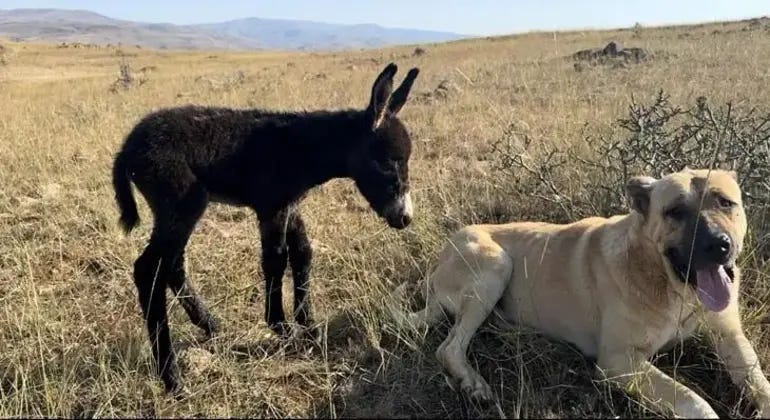
“If Kral had not been there, the bears would have eaten the child.”
That was the account given after a bear attack in eastern Turkey, where a livestock guardian dog named Kral intervened long enough for a child to survive.
The story was quickly framed as one of courage, loyalty and protection.
The dog became a hero. And yet elsewhere in Turkey, dogs continue disappearing from public streets under collection campaigns increasingly justified through the language of danger and public safety.
The contrast is becoming impossible to ignore.
In rural parts of Turkey, dogs are still openly recognised as essential. Livestock guardian dogs protect flocks from wolves and bears. Search dogs save lives after earthquakes. Police and military dogs are praised for discipline, intelligence and service. Family dogs are mourned deeply when lost.
But street dogs exist inside a completely different narrative.
The same society capable of celebrating a dog for saving a child’s life can also tolerate a climate where millions of free-roaming dogs are being confined and pushed in to euthanasia.
That contradiction reveals something uncomfortable about how animals are classified. Some are viewed as protectors, some are viewed as symbols of status,
some are viewed as useful and others become politically inconvenient.
The issue is no longer simply about dogs themselves. It is about perception. About which dogs are permitted value and visibility, and which are framed as disposable.
Kral disrupted that simplistic narrative
A dog capable of confronting bears to protect a child does not fit neatly into increasingly aggressive rhetoric surrounding dogs in modern Turkey. Neither do the countless community dogs that spend years living peacefully alongside residents before suddenly vanishing into systems the public rarely sees clearly.
The reality has always been more complicated than the headlines allow.
Dogs in Turkey are deeply woven into everyday life. They exist in villages, industrial areas, farms, ports, neighbourhoods and city streets. They guard, warn, accompany and coexist beside people every single day.
That coexistence has always been imperfect. But it also explains why the national conversation around dogs has become so emotionally charged. Because many people still know, from direct experience, what dogs are capable of giving back.
Kral is being celebrated today because he protected a child from bears.
Elsewhere, other dogs are still fighting simply to survive.