


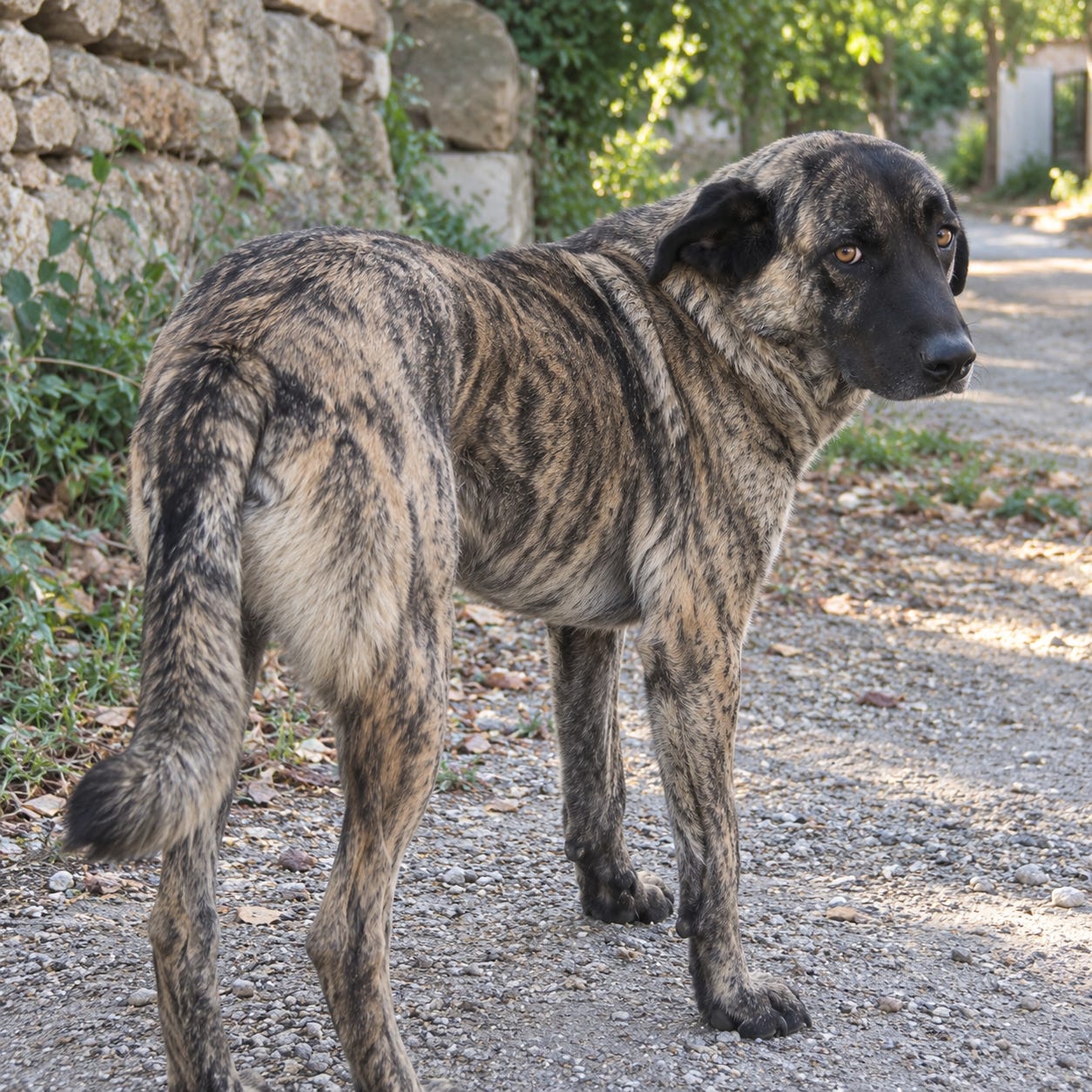
A tall brindle dog with slender body proportions, a long snout & comparatively small head was taken by Alaşehir Municipality in Manisa because they suspected him to be a banned breed mix. I find this very puzzling & even more so after I went looking for the criteria used to determine what a banned breed actually is in Turkey. I found none.
The dog was a well known community dog who had been taken care of by local people who were disturbed to find he had been taken away. But there was worse to come. When they went looking for him they discovered that he was dead. They were told that he had been euthanised because he was a banned breed hybrid. A fact that Alaşehir Mayor Ahmet Öküzcüoğlu is disputing.
Mr Öküzcüoğlu has offered a very different account. He says that the dog was anaesthetised for microchipping. A claim that may surprise you readers. Why would a dog have to be put under for a simple procedure like that? We handle a lot of dogs, most of them exhibit anxiety, sometimes they are aggressive through fear. We have never needed to put them under to microchip even in the worst cases. Two vet nurses holding the dog, a muzzle & a third nurse to soothe has been all we have ever needed to get the job done.
All anesthesia carries risk which increases with age & poor health, both unknown factors with dogs who come in with zero medical history. We avoid it at all costs only using it when it is absolutely necessary. You would think that this is a universal rule among all responsible for the well being of an animal.
The case we are discussing today becomes more tragic than a dog being taken away on suspicion. He never regained consciousness & passed away.
We have discovered that both a municipal veterinarian & a DKMP offical (DEFRA equivalent) both typed the dog as banned before he passed. Which is incredibly surprising when we look at our own government classification system. So I went looking for Turkish criteria.
It was easy to find which breeds are outlawed in Türkiye, the tehlike arz eden hayvanlar framework is widely published with 100% transparency. American Pitbull Terrier, Dogo Argentino, Fila Brasileiro, American Staffordshire Bull Terrier, American Bully & Japanese Tosa. Restrictions extend to their crosses.
What I could not find is a classification system. No ministry guidance, no implementation material, no published identification standard. I did find information pertaining to who is qualified to make a type decision buried deep in legislation but what I could not find is what happens when a type decision is challenged & indeed how a challenge could be reported & heard.
Here in the UK the government is very clear on what it regards as type & that decision can be examined, challenged & scrutinised. Where is Türkiye’s?
I looked for examples of challenges to type decisions & found an animal rights working group in Istanbul historically seeking disclosure of the criteria used and its scientific approach. They were told that decisions regarding type were made within Veterinary Services Directorates by a commission. However I cannot find an answer to their question regarding how those decisions are made. I find this interesting because when I look at Türkiye's equivalent of the kennel club I can find an abundance of detailed rules which measure breed standards.
I looked further for records and found a disturbing event. Several years ago 14 dogs in Ankara were seized as type. Evidence was presented during the Turkish Parliament’s work on animal rights. Examination by Prof. Dr. Tamer Dodurka concluded that nine of them were not types. It is in the record that he used his own methodology to come to this conclusion. He also said that assessing a dog visually was unreliable and DNA was needed to be certain. But we know that even this is not a failsafe because Pitbulls for example is not a breed at all it is a type. The whole thing is a dogs dinner as far as I am concerned. And while I strongly believe that we need something to protect the public from dog inflicted fatalities or injuries banning breeds does not convince me that it is the way to prevent these terrible events.
And I wonder how many dogs with good temperaments have lost their lives to breed specific legislation just because they look a certain way because people have gotten it wrong. We have first hand evidence in Türkiye that pure breed boxers were being rounded up and typed. We are also told by several whistleblowers that typed dogs are routinely euthanised without question regardless of disposition & we are yet to be told that criteria is being used to type them.
If we go back to the dog in Alaşehir we were told that the dog was seized on suspicion of being banned. I am always hesitant to refer to human societal struggles in connection to that of animals but I can’t help doing so today. Authorities can exercise power over people on suspicion, they do & it requires safeguards. In England & Wales it was proven year ending March 2025 that people of colour were 3.8 times more likely to be stopped & searched than white people. Among men aged between 18 and 34 there were 125 stops for every 1,000 person of colour compared to 24 in 1,000 for white males. Suspicion is the key word here. We are talking about people suspected, a word that has generated decades of debate over appearance & assumptions which can have grave consequences. And please note that I am comparing the mechanism here not the subjects.
In Alaşehir, did the dogs classification as a prohibited breed influence the decision to anaesthetise him? Did staff decide that, given he was classed a type he was a dangerous dog and therefore unsafe to handle? If so breed determination is made even more important.
We talk a lot about record keeping and the importance of tracing dogs from intake to home and every step inbetween at Dog Desk Animal Action. I would hope that this dogs medical records are available and that they are precise. They should show his examination, observations and condition. They should show any assessments performed to ensure his suitability for anaesthetic use. They should also show the drug protocol, monitoring, complications, attempts to revive him and the recorded reason for death.
All of this requires explanation.
Türkiye also needs to answer the wider question. How many dogs are being collected on suspicion and exactly what are the outcomes for each dog. Until they do we will keep looking.