


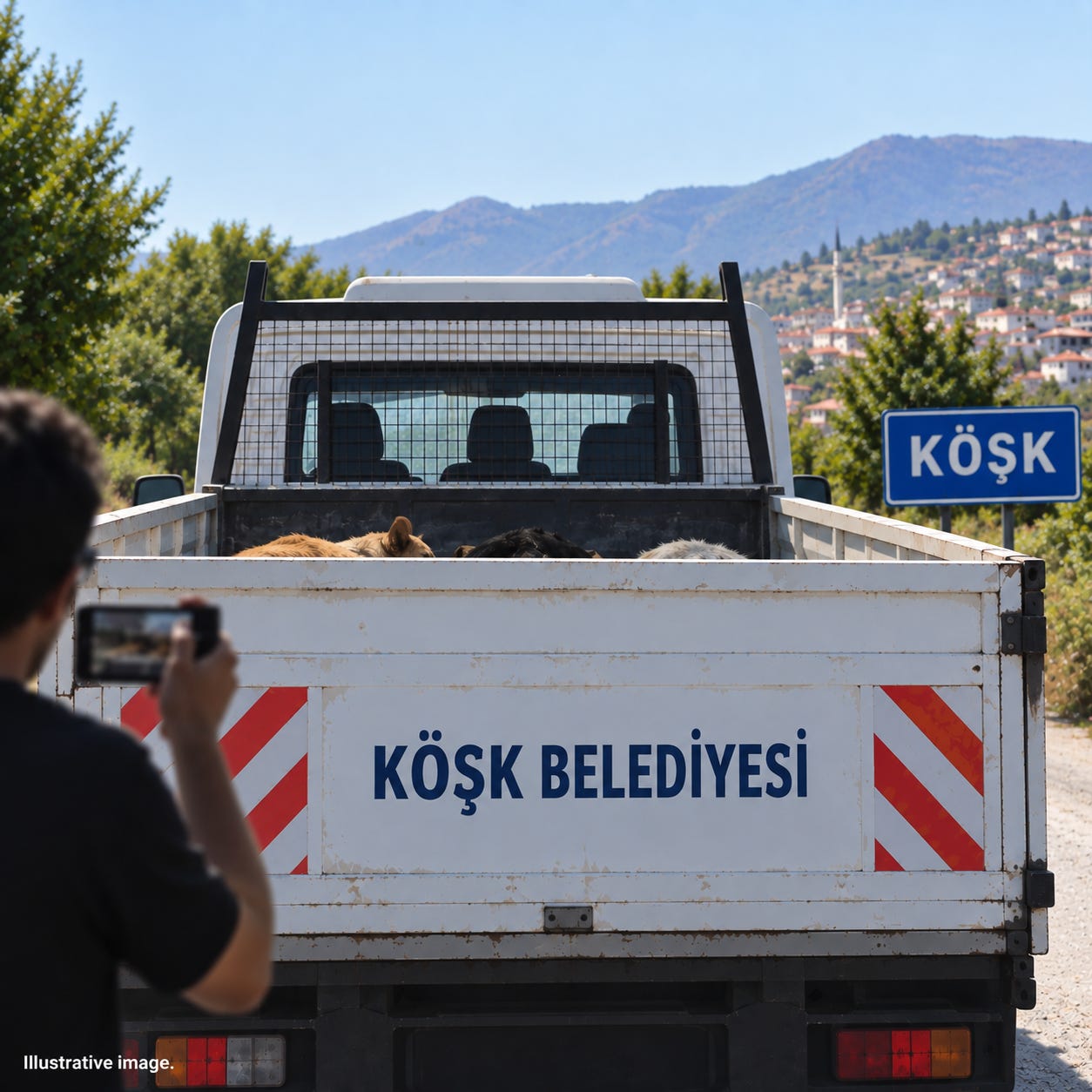
There are images that demand an explanation, and the footage that emerged from Köşk in Aydın this week is one of them. Dogs lie motionless in the back of a Köşk Municipality vehicle while the person filming describes what he believes he is witnessing: some of the dogs are dead and others are dying. He alleges that the animals have been poisoned.
The account is specific. Contemporary reporting records the man filming as saying that three or four dogs were dead and another two or three were dying. The footage spread quickly and caused outrage among local animal advocates. Aydın Can Dostları Derneği responded by calling on the Aydın Governor’s Office to initiate administrative and judicial proceedings against those responsible, describing multiple dogs as having been found dead and dying in the municipal vehicle.
These were not people looking at a photograph days later and speculating about what might have happened. The original account came from someone standing beside the vehicle, filming the dogs inside it and describing what he believed he could see. His allegation of poisoning has not been independently established, but neither should his account of the condition of those dogs be quietly rewritten because the municipality subsequently disputed it.
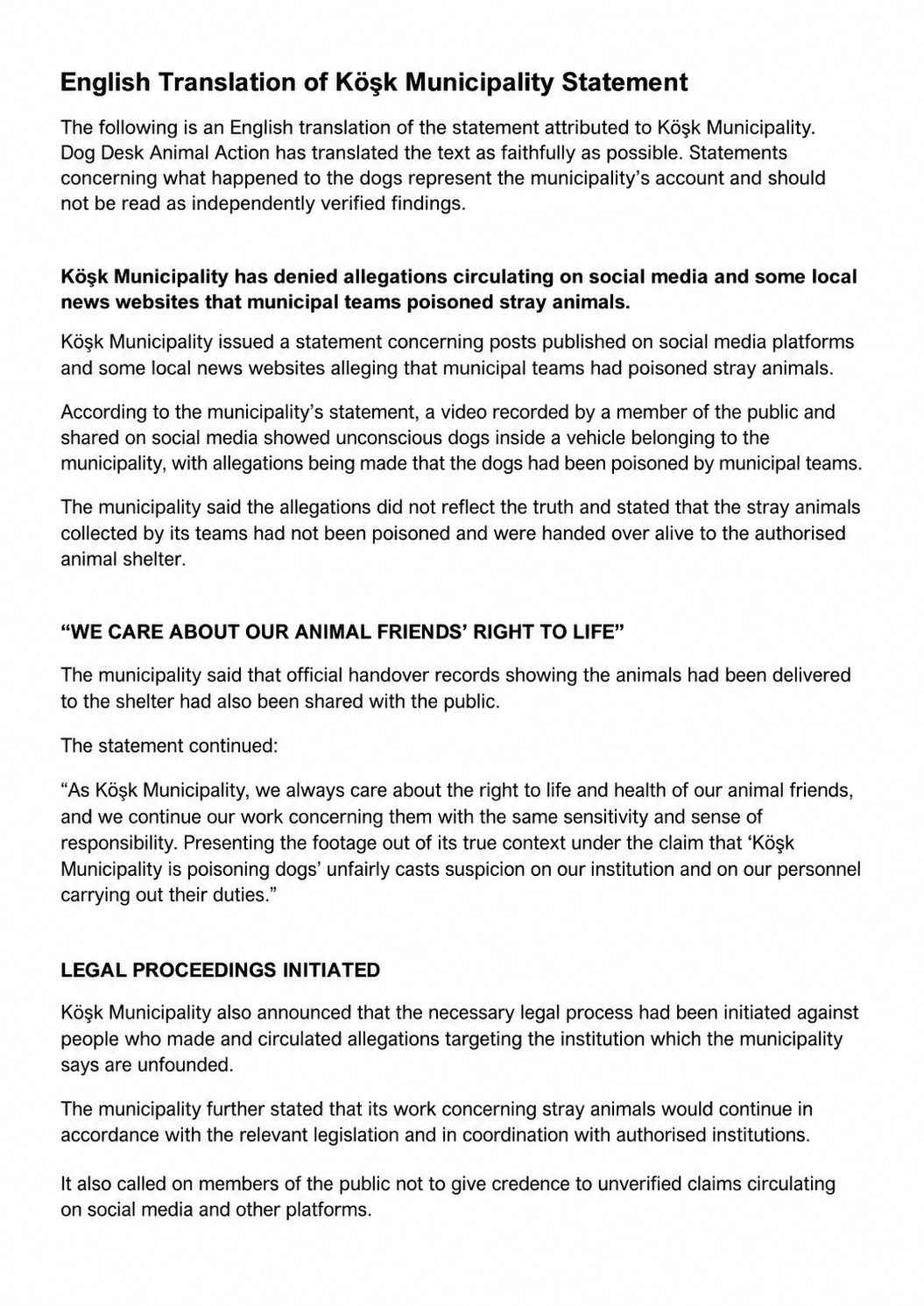
Köşk Municipality issued a strong denial. It says its personnel did not poison the dogs and describes the animals seen in the vehicle as “baygın durumdaki köpekler” - unconscious dogs. According to the municipality, the animals collected by its teams were handed over alive to the authorised animal shelter, and official handover records have been shared publicly.
That is the municipality’s account. It is not an explanation of what people saw.
The difference between the two accounts is huge. At the vehicle, dogs were reported dead and dying. In the subsequent official response, those same animals become unconscious dogs who were later delivered alive. Somewhere between those two versions is what actually happened to the animals in vehicle 09 FY 299.
There is an obvious documentary trail capable of shedding considerably more light on this. Municipal dogs do not simply pass anonymously through a system. There should be a record of the animals collected, a record of their transport and a record of their reception at the facility to which Köşk Municipality says they were delivered. If veterinary intervention took place, that should create further records. If an animal died, that death should also exist somewhere within the system.
The handover documents published by the municipality are therefore important, but they need to establish more than the fact that dogs were delivered to a shelter. The critical question is whether the dogs leaving the collection point can be reconciled with the dogs recorded as arriving alive. If the person filming was wrong and every animal in that vehicle survived, a complete record should be capable of demonstrating that.
There is another question that the municipal statement leaves hanging. Even on Köşk Municipality’s own version of events, several dogs were unconscious in its vehicle. It does not appear to explain what caused that condition.
There may be a legitimate explanation. Chemical restraint is used in the capture and handling of dogs, particularly animals who are frightened or difficult to catch. But Dog Desk Animal Action has not established that these dogs were sedated, and we will not insert an explanation that the available evidence does not provide. If sedation was involved, that becomes relevant to understanding their condition. If it was not, then the presence of several unconscious dogs requires another explanation.
This is not a minor distinction. Dogs have previously died following chemical restraint during municipal handling in Türkiye. An incapacitated dog is also extraordinarily vulnerable during handling and transportation. The animal cannot escape, protect itself or respond normally when something is going wrong. Whatever caused the Köşk dogs to be lying motionless, their condition deserved scrutiny rather than assumption.
But there is another part of the municipality’s response that concerns us greatly.
Köşk Municipality says it has initiated legal proceedings against people who made and circulated allegations that it describes as unfounded.
Think about what happened here. A member of the public encountered a municipal vehicle containing multiple motionless dogs. He took out his phone and recorded what he saw. He believed dogs were dead and dying and said so. The footage became public. An animal welfare organisation saw it and called for the Governor’s Office to intervene. The municipality denied the allegation and then announced legal proceedings against those it says made and spread the claims.
That has consequences far beyond this particular vehicle.
People are often the only witnesses animals have. A dog cannot photograph the inside of a municipal vehicle. A dog cannot upload footage of its treatment. A dog cannot contact a journalist, approach a governor’s office or ask why another dog beside it is no longer moving. When something happens away from public view, accountability can depend entirely upon somebody being prepared to take out a phone and record it.
There is a legitimate distinction between deliberately spreading information known to be false and a member of the public documenting something deeply concerning and reporting what they believe they are witnessing. When authorities respond to allegations of animal mistreatment with threats of legal proceedings, that distinction becomes extremely important.
The danger is obvious. The next person who sees something concerning may hesitate before filming it. Someone who records a municipal collection may think twice before publishing it. Someone who believes an animal has been harmed may decide that saying nothing is safer than risking legal consequences.
For animals who increasingly disappear from public streets into municipal systems, public witnesses are becoming more important, not less.
This is particularly relevant in Türkiye now. For two years, Dog Desk Animal Action has documented the accelerating removal of street and community dogs. As those animals leave the streets, much of what happens to them also leaves public view. Their lives become recorded through municipal collection records, shelter admissions, HAYBİS entries, veterinary records, transfers and deaths.
That makes transparency essential.
It also makes footage such as that recorded in Köşk important. Whatever the final explanation for the dogs in vehicle 09 FY 299, without somebody filming that vehicle there may never have been a public conversation about their condition at all.
Dog Desk Animal Action cannot establish from the footage alone that the dogs were poisoned. We can report that the person who filmed them alleged poisoning, that he reported dogs dead and dying, and that Aydın Can Dostları Derneği subsequently called for official action. We can also report that Köşk Municipality disputes that account, describes the dogs as unconscious, says they were handed over alive and has announced legal proceedings against those responsible for allegations it says are unfounded.
If every dog survived, the records can demonstrate that. If the animals were unconscious rather than dead, there should be an explanation for why several dogs were unconscious. If chemical restraint was used, that should be capable of being established. And if any dog did die, that animal should not disappear between a witness’s camera and a municipal handover document.
The public should be able to raise serious animal welfare concerns without the conversation immediately becoming about the people who raised them.
Because when an animal cannot speak, the person who sees what happened may be the only voice that animal has.
And in Köşk, somebody looked into vehicle 09 FY 299, saw dogs he believed were dead and dying, and refused to look away.