


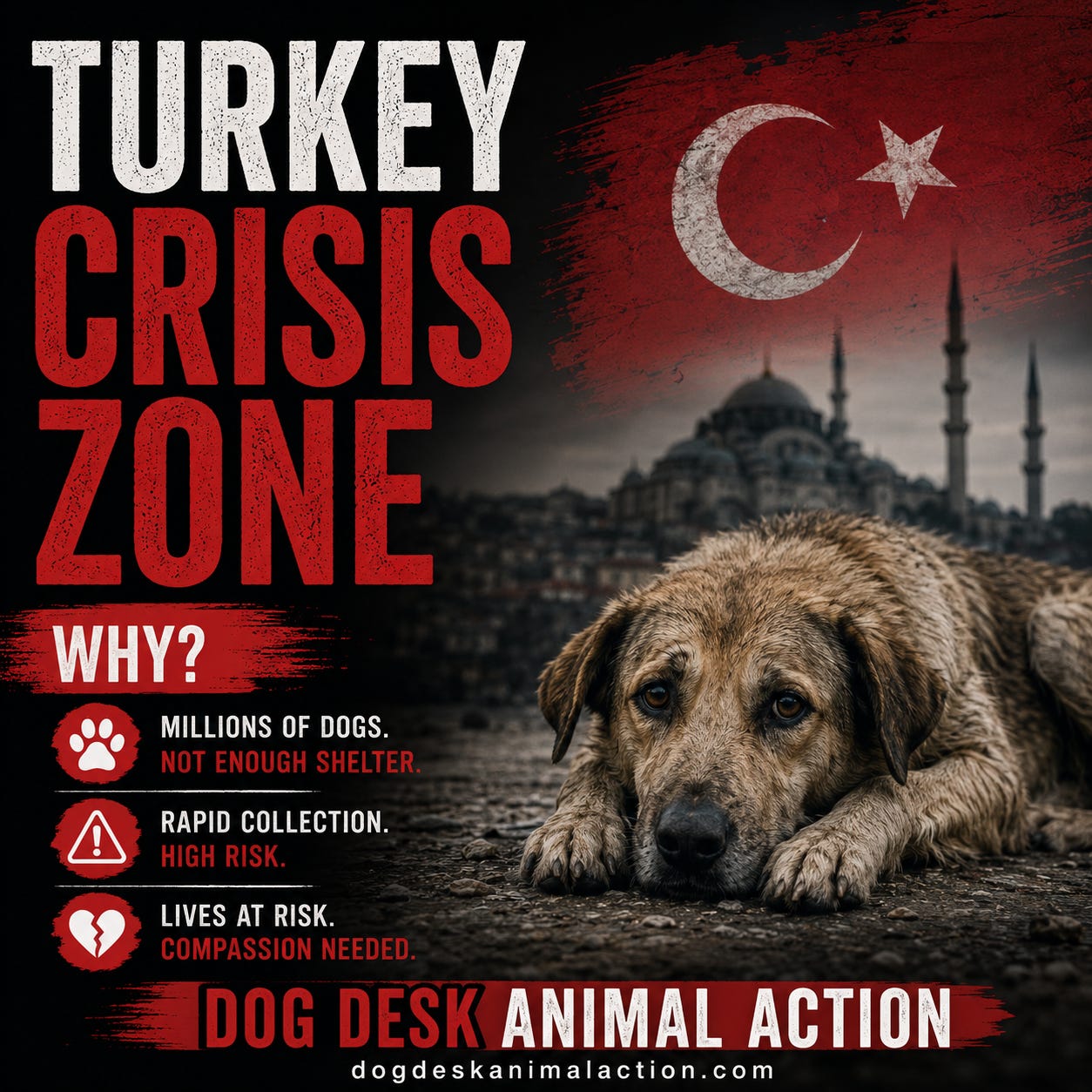
In July 2024, the Turkish government passed a controversial law requiring municipalities to remove street dogs from public spaces and place them into shelters or municipal facilities. Dogs considered aggressive, terminally ill, or posing a risk can legally be euthanised under certain provisions.
Animal welfare groups immediately warned that the country did not have the infrastructure to safely absorb the numbers involved. Türkiye itself estimates there are around four million free-roaming dogs across the country.
But official shelter capacity has repeatedly been cited at roughly 100,000–110,000 spaces nationwide. That gap is at the heart of the crisis.
What Has Changed Since 2024?
The biggest shift is that collection is no longer theoretical. Authorities are now actively pushing municipalities to accelerate removals.
In early 2025, the Interior Ministry reportedly clarified that municipalities could not wait until 2028 to begin collecting dogs, despite shelter construction timelines extending to that date. Municipalities were warned they could face penalties for failing to remove animals from the streets.
By 2026, pressure intensified further.
Istanbul Governor Davut Gül publicly stated there would eventually be not a single stray dog on the streets and warned municipalities that delays would not be tolerated.
Separate reporting this month stated Istanbul authorities ordered municipalities to speed up collections before the end of May and threatened legal consequences for failures to comply.
Why Rescuers Are Calling It A Crisis Zone
The country is now experiencing mass municipal collection campaigns, legal pressure on local authorities, growing use of confinement, shrinking tolerance for free-roaming dogs, increasing public polarisation and a widening gap between dog numbers and available infrastructure.
The concern from rescuers is not only what happens during collection. It is what happens after.
When dogs disappear into overcrowded systems without sufficient transparency, staffing, veterinary care, rehabilitation capacity, or adoption pathways, the risk moves beyond simple sheltering failure.
That is why activists and welfare organisations repeatedly warn about overcrowding, disease, neglect, and unlawful euthanasia concerns. The debate inside Türkiye has become deeply emotionally and politically charged.
Supporters of the law argue that public safety incidents, dog attacks, traffic accidents, and rabies concerns forced government intervention. Opponents argue the country is attempting to remove millions of animals without the humane infrastructure necessary to do so safely.
The Collapse Of The Old System
For years, Türkiye officially operated under a sterilise-vaccinate-return model. Street dogs were supposed to be neutered, vaccinated, treated, and returned to the areas where they lived.
Critics of the old system argue municipalities failed to implement sterilisation at sufficient scale. Critics of the new system argue the state is now responding to those failures with large-scale confinement and collection policies that the infrastructure still cannot support.
That contradiction sits at the centre of today’s crisis.
Where Türkiye Stands Today
Türkiye is no longer debating whether free-roaming dogs should exist alongside people. The state has already chosen a direction. Dogs are now being removed from public spaces at increasing speed, while municipalities face growing pressure to prove they are doing it.
That has created a new reality across the country, dogs leaving the streets faster than humane long-term solutions are being built for them.
This is why the situation has become a crisis.
Not simply because dogs are being collected but because nobody can clearly explain what happens to millions of dogs once the collections accelerate beyond the system’s capacity.