


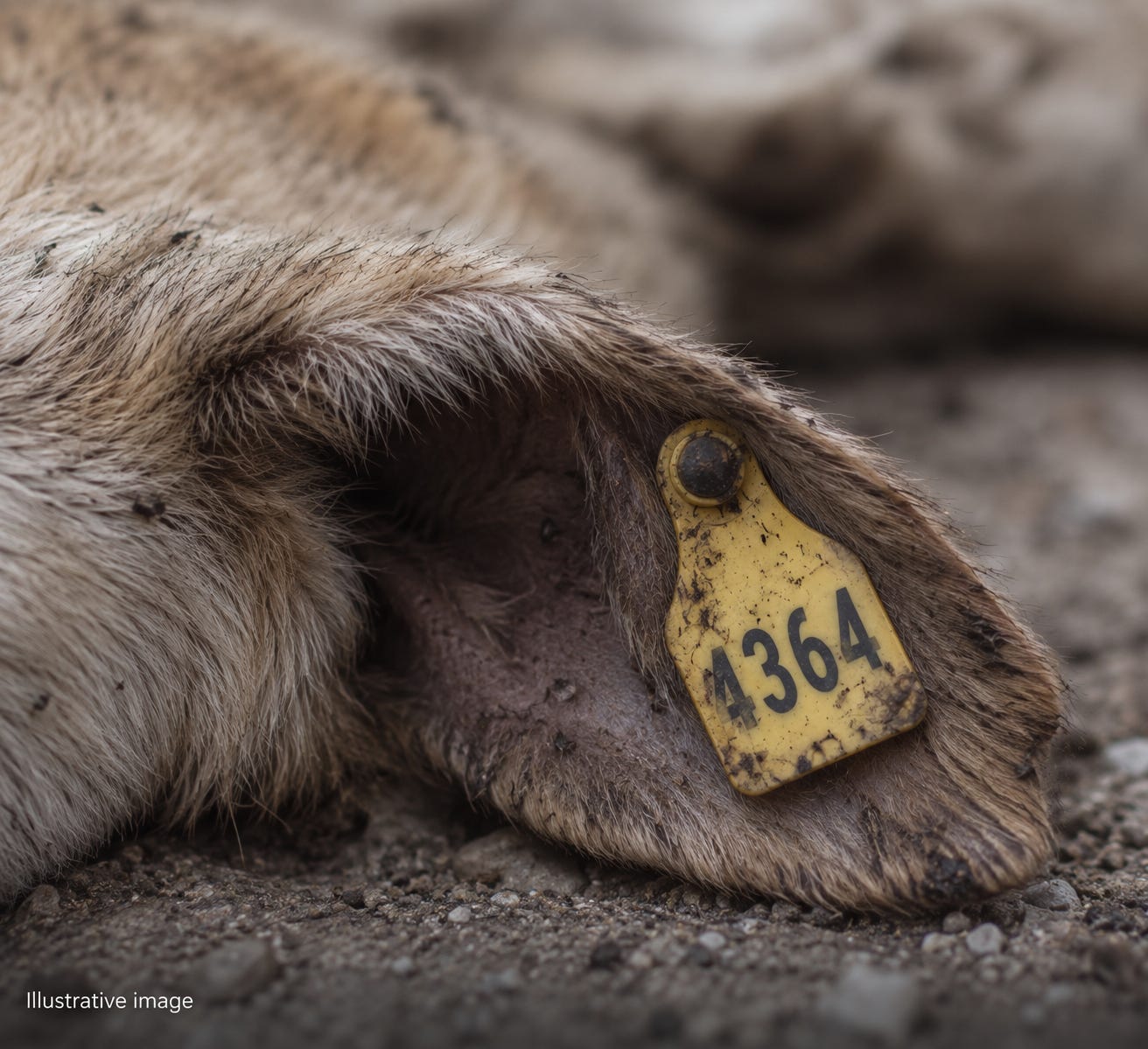
Among the dead dogs seen at Kirişçiler in Antalya, one still had a number attached to its ear: 4364. Behind it was a dog who should have a history in Türkiye’s animal recording system. There should be a record showing where the dog was collected, when the dog entered municipal care, what treatment was provided, when the dog died, the recorded cause of death and what happened to the body afterwards.
On 31 August 2026, animal advocates conducting observations around the Kirişçiler Temporary Animal Care and Rehabilitation Centre in Antalya’s Kepez district documented excavation activity and large numbers of dead dogs being brought to an area near the facility. Hayvan Hakları Platformu Türkiye has referred to approximately 300 bodies. The precise number requires official verification, but that must not be allowed to obscure the central issue. Large numbers of dead dogs have been reported and they need to be accounted for.
Applications have been made seeking examination of HAYBİS data, clinical files, shelter admission and discharge records, death records and recorded causes of death. It has also called for camera footage, vehicle and duty records and documentation relating to the transportation and burial of animals to be examined alongside those records. Dog Desk Animal Action strongly supports that scrutiny. Hundreds of dead dogs reportedly appearing during Türkiye’s mass removal of dogs from its streets should alarm anyone concerned with animal welfare.
We need to know who those dogs were, where they came from, how they died and whether their deaths were properly recorded. If the municipal system works as it should, those questions should be answerable.
Dog 4364 provides an obvious place to begin. Antalya Metropolitan Municipality says animals entering Kirişçiler are registered and that their histories can be followed through microchip or ear tag numbers. If that is the case, the number 4364 should lead to an admission record, a veterinary history and a recorded outcome. If the dog died in municipal care, there should be a date and cause of death. If the body was subsequently transported for burial or disposal, that should also leave a documentary trail.
This is what traceability is supposed to mean. A numbered tag cannot simply prove that a dog was recorded at some point and then become meaningless when that dog dies. The record should follow the animal through the system from entry to final outcome. If Kirişçiler operates the traceability system described publicly by the municipality, dog 4364 should not be a mystery.
The scale of the operation makes these questions even more important. Antalya Metropolitan Municipality says Kirişçiler has expanded from capacity for 1,300 dogs in 2023 to 5,000 dogs in 2026, alongside capacity for 700 cats. Additional natural life accommodation has been developed as municipalities respond to Türkiye’s changed policy towards unowned dogs.
Creating additional accommodation is necessary when dogs are being removed from streets on this scale, but capacity is not welfare. A municipality can build space for thousands of dogs without that figure telling us whether those dogs are safe, receiving appropriate care or surviving once they enter the system.
The same problem exists with collection figures. Government and provincial statistics increasingly tell us how much of the estimated dog population has been collected, and those percentages are being presented as measures of implementation and progress. Dog Desk Animal Action does not accept collection alone as evidence of successful animal welfare policy. Removing a dog from the street is not an animal welfare outcome. The dog being safe is the outcome & that is what we want to see.
Every collected dog should therefore remain visible in the system. A dog remaining in care is an outcome. Adoption is an outcome. Transfer is an outcome and should be separately identifiable, together with the justification for it. A system capable of counting dogs as they are collected must also be capable of showing what happens to them afterwards.
This is the question that has become increasingly difficult to ignore in Türkiye. Authorities can tell the public that a province has collected a particular percentage of its dogs. Municipalities can announce new shelters, additional land and thousands of places, yet we are not seeing equally prominent figures showing how many collected dogs remain alive in shelters and natural life areas, how many have been adopted or transferred, how many have died and how many have been euthanised.
Those figures should reconcile with the number of dogs entering the system. Without them, a dog can be counted when it is taken from a street and then effectively disappear from public view.
Large animal care facilities will experience deaths sadly. Dogs may arrive critically ill, badly injured or close to death. Some will die despite treatment, and there will be individual cases in which euthanasia is necessary to prevent unavoidable suffering. None of that removes the obligation to account for a dead animal. It makes accurate records even more important.
If hundreds of dogs died after entering municipal care, there should be hundreds of corresponding outcomes in the records. There should be identities where those dogs were registered, dates of death and recorded causes. Where euthanasia occurred, it should be identifiable as euthanasia rather than disappearing inside an unexplained mortality figure. When bodies leave a facility for burial or disposal, those movements should reconcile with the animals recorded as dead.
Hundreds of bodies require hundreds of explanations.
If dogs died from disease, the records should demonstrate it. If they arrived with fatal injuries, their clinical histories should show it. If they died despite veterinary treatment, that treatment should be documented. If they were euthanised, the records should show why and when. If dogs had been transferred from other municipalities, those movements should also be traceable. If the records cannot account for the bodies, that failure becomes a serious animal welfare and public accountability issue in its own right.
What has been reported at Kirişçiler cannot be separated from the national policy under which dogs are being removed from Türkiye’s streets. For two years, Dog Desk Animal Action has watched collection accelerate, shelter capacity expand and government attention increasingly focus on whether municipalities are removing dogs quickly enough. That scrutiny now needs to work in both directions.
It is no longer enough to ask municipalities how many dogs they have collected. We need to know what happened to those dogs afterwards. A national programme involving enormous numbers of sentient animals cannot be evaluated by counting them at the moment they disappear from streets. Those animals must remain visible in the data after collection, and every collection must eventually lead to an accountable outcome.
That brings us back to 4364.
Behind that number was a dog who lived somewhere in Antalya before becoming part of the municipal system. At some point somebody attached a numbered tag to that dog’s ear, which means the system identified the animal. The same system should now be capable of telling us what happened next.
The record should tell us where 4364 was collected, when the dog entered care, what happened there, when and why the dog died and how the body came to be where it was last seen. Once that dog has been accounted for, the same process should be possible for the others.
Dog Desk Animal Action wants those answers because the question raised at Kirişçiler reaches into the heart of Türkiye’s national dog policy. We are being told how many dogs have been collected. We now need to know how many are still alive.
Türkiye’s community dogs cannot be allowed to disappear twice: first from the streets and then from the records.