

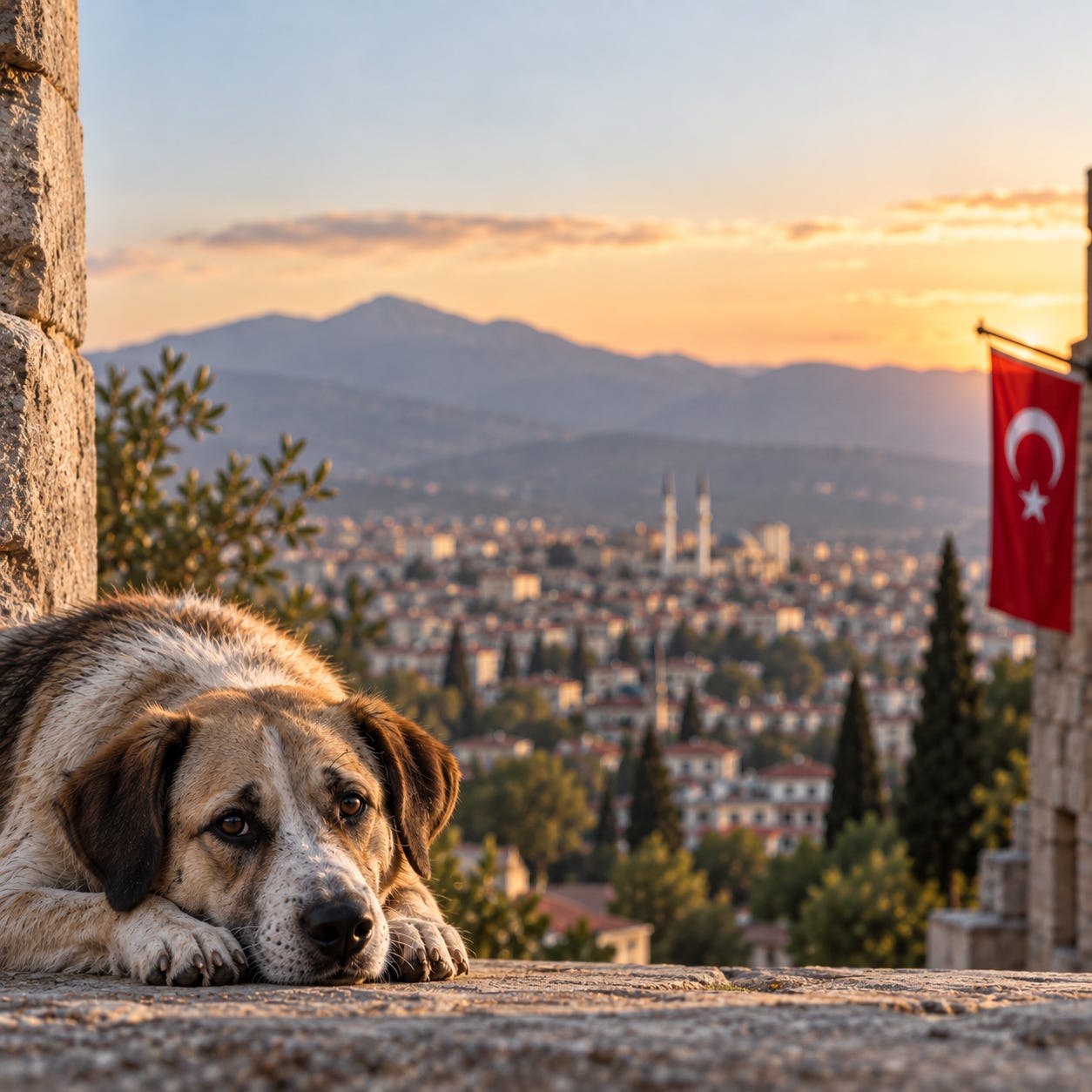
Government inspectors have been checking what is happening to stray dogs in Denizli and what they found deserves considerably more attention than another national collection percentage. Despite the enormous collection operation taking place across Türkiye, inspectors found that a significant proportion of unowned animals remain on Denizli’s streets. At the same time, nine district municipalities still have a legal obligation to establish their own animal shelters and the natural-living area established by Denizli Metropolitan Municipality still needs to complete its licensing process.
And now another collection push is beginning.
Denizli Governor Yavuz Selim Köşger has instructed the Provincial Directorate of National Education to identify stray animals around schools within three days and report them to municipalities for collection. If municipalities do not act, district governors are expected to intervene to ensure the animals are removed. Köşger has also said that the problem should be dealt with without causing suffering to animals.
We therefore have a fairly obvious question before another group of dogs disappears from public view.
Where will they go?
Inspectors Mehmet Gök from the Interior Ministry and Gazi Uzun from the Ministry of Agriculture and Forestry were examining implementation of Türkiye’s Animal Protection Law. Their findings have exposed unfinished infrastructure at the same time that collection is continuing. Nine district municipalities have shelter obligations still to fulfil, while the Metropolitan Municipality’s natural-living area has an outstanding licensing requirement.
Türkiye’s current system requires collected dogs to be taken to authorised shelters, entered into the Ministry database and kept in shelter care following rehabilitation until they are adopted. That means every additional collection creates an additional accommodation requirement somewhere.
Denizli does have substantial infrastructure. Its Metropolitan Municipality says its Street Animals Shelter and Rehabilitation Centre has capacity for 3,000 animals, with treatment facilities, operating theatres, adoption areas and digital tracking systems. During the first six months of 2026 the centre recorded 5,524 dogs as having received rehabilitation services, while 2,004 dogs were sterilised and 488 were adopted.
Those are impressive activity figures, but they don’t answer the question we need answered. How many dogs actually entered the facility?
The 5,524 rehabilitation figure cannot simply be treated as 5,524 permanent admissions because it records services and activity rather than necessarily representing a population of different dogs entering long-term accommodation. Nor can we subtract the 488 adoptions and declare that thousands of dogs are missing. The categories do not allow us to do that. That is precisely the problem.
What we need is a dog population account. How many dogs were physically inside the facility on 1 January 2026? How many new dogs were admitted? How many were adopted? How many were returned to owners? How many were transferred elsewhere? How many died? How many were euthanised? And how many were physically inside the facility at the end of the reporting period? Those numbers should reconcile.
If Denizli’s digital tracking system is following animals through the facility, the underlying information should exist. The municipality itself says dogs entering shelters are registered in the Ministry database. This is exactly the outcome information we have repeatedly found missing while monitoring Türkiye’s national collection programme.
We are frequently told how many dogs have been collected, how many treatments have been performed, how many sterilisation procedures have taken place and how many animals have been adopted. Those figures tell us what municipalities are doing. They don’t necessarily allow us to follow the individual dogs through the system.
And a collected dog is not an outcome, it is the beginning of another responsibility.
Once a dog has been removed from a street, somebody has to accommodate it. Somebody has to feed it. Somebody has to provide veterinary care. If it isn’t adopted, that responsibility can continue for years.
That makes the nine district municipalities identified during the Denizli inspection particularly important. If those municipalities are legally required to establish their own shelters but have not yet done so, where are the dogs they are currently collecting being taken? Which authorised facilities are receiving them? How many dogs has each district collected during 2026 and how many remain in municipal care? We also need to know which nine municipalities they are.
The inspection findings reported publicly tell us nine exist but do not name them. That prevents the public from examining each municipality’s collection figures, infrastructure, spending and outcomes individually.
There is a financial trail to follow as well. Municipalities were reminded during the inspection process that 0.5% of their finalised budgets must be allocated to animal shelters and natural-living areas. That money cannot simply be diverted elsewhere. Improper use can become an issue during inspection and unused funds are to be returned to the Treasury at the end of the year.
So for every municipality required to build a shelter, there should be another set of figures. How much money was required to be allocated? How much was actually allocated? How much has been spent? What has been built with it? When will the facility open and what will its dog capacity be?
Those aren’t peripheral questions when collection is mandatory. Infrastructure determines what happens to the dogs after the collection vehicle drives away.
And that brings us back to the schools. There are legitimate concerns about dogs around children and nobody needs to pretend otherwise. The interesting question for us begins after a dog has been identified for removal.
Where is that dog taken? If the answer is Denizli Metropolitan Municipality’s facility, we want to know how much spare capacity it currently has. If dogs are going to district facilities, we want to know which ones are licensed and operational. If another authorised arrangement exists, there should be records showing the transfer. Most importantly, we want to know what eventually happens to those dogs.
That is particularly important because the inspectors themselves have established that substantial numbers of animals remain outside.
The next phase could therefore involve considerably more than a handful of dogs around school gates. Every one of those animals should generate a record when it enters municipal custody and that record should not end with the word collected. It should eventually tell us whether the dog was adopted, remains alive in municipal care, was transferred, returned to an owner, died or was euthanised.
Denizli could actually provide an opportunity to demonstrate that level of transparency. The Metropolitan Municipality already says it operates digital tracking systems and publishes substantial statistics about the veterinary work taking place inside its facility.
Now we need the other half of the data, not how many procedures were performed. What happened to the dogs?
Governor Köşger has said Denizli will address its stray-animal problem without causing suffering to animals. That is a commitment worth recording. It is also one whose implementation we can follow.
The inspectors have found dogs still on the streets. They have identified unfinished municipal shelter obligations. Another targeted collection operation is beginning around schools. The dogs will now start moving.
What happens to them next should be a matter of public record.