


Türkiye’s street dog policy has reached a point that would have seemed extraordinary only two years ago. The country was estimated to have around four million stray animals, a figure that was never a census but nevertheless became the working estimate around which the national debate developed. The latest figure being reported by the authorities is that 98.69% of stray street dogs have now been collected. If the figures are broadly comparable, the transformation of public space has been enormous.
The significance of that percentage is not simply that fewer dogs remain on the streets. It marks a change in the nature of the policy itself. During the first stages of mass collection, authorities were dealing with a large, highly visible population. Dogs could be found in neighbourhoods, industrial areas, parks, markets and around businesses throughout the country. As the reported collection rate approaches 99%, the task becomes different. Attention moves towards the dogs that have not yet been removed.
A document dated 27 August 2026 from the Istanbul Directorate of Nature Conservation and National Parks gives an unusually detailed view of what that stage can look like. Its subject translates as Establishment of Teams to Detect Stray Dogs Outside Animal Shelters. It refers to instructions issued by the Ministry of Interior’s Civil Inspection Board three days earlier and sets out a short, structured operation across Istanbul.
Between 28 August and 3 September, teams made up of district governorate, municipal enforcement and law-enforcement personnel were to carry out field checks to establish whether stray animals were still present. Where animals were found, their numbers and locations were to be entered on a specific inspection form. The operation therefore went beyond a general instruction to municipalities to continue collecting dogs. It created a mechanism for identifying where the remaining animals were.
The document also required police personnel to examine footage from KGYS, Türkiye’s public security camera system. Recordings from 24 to 27 August were to be reviewed during three specified periods of the day: 06:30–08:30, 11:00–12:00 and 18:30–20:30. Particular attention was to be paid to populated areas such as squares and parks, with the numbers and locations of stray animals recorded. The footage was also to be examined for inappropriate treatment of animals and adverse incidents involving them.
This should not be extrapolated beyond the evidence. The document concerns Istanbul, and Dog Desk Animal Action has not established that every province was instructed to conduct the same KGYS exercise. The wider inspection programme is national, but the precise street search and camera review procedure described here is something we can currently evidence for Istanbul.
That distinction is important, but it does not diminish the importance of the document. Istanbul’s reported collection rate has moved rapidly. In early May, Governor Davut Gül said 46% of the city’s stray animals had been collected and made clear that the policy objective was ultimately to leave no stray dogs on the streets. By June the figure was reported at 49%. The latest figure is 88.20%. The August document therefore appears at exactly the point at which Istanbul is moving from mass collection towards identifying a much smaller remaining population.
The national picture is far less uniform than the headline figure of 98.69% suggests. Recent reporting places İzmir at 98.32%, Antalya at 94.44%, Istanbul at 88.20% and Diyarbakır at 69.08%. Those differences are noteworthy because municipalities did not enter the collection programme with the same infrastructure, resources or shelter capacity.
Diyarbakır illustrates the scale of that problem particularly well. In early 2025, the province was said to have around 25,000 stray dogs while the metropolitan municipality’s existing shelter had capacity for only around 500 and was already close to full. A much larger natural living area was subsequently developed, with planned capacity for approximately 14,000 to 15,000 dogs. Yet Diyarbakır remains well behind the national collection figure. The example demonstrates something that national percentages can conceal: collecting dogs and creating somewhere capable of receiving them are not the same administrative task, and they have not progressed at the same speed everywhere.
Other provinces provide different pieces of the picture. Şanlıurfa reported in February that 27,960 stray animals had been collected and taken to shelters, while collection continued in rural areas. Muş reported around 4,000 dogs taken into its shelter and natural living system over a year, with approximately 2,600 sterilised. These local figures are useful because they begin to connect the national collection policy with actual animals and actual facilities.
They also expose the central weakness in the national picture. Türkiye now publishes an extraordinarily precise collection percentage, but there is still no equally accessible national account showing the subsequent movement and outcomes of the animals represented by that percentage.
That does not mean millions of dogs can simply be described as missing. Such a claim would ignore natural living areas, newly built facilities, adoptions, transfers, deaths and the fact that dogs move through the system rather than occupying one shelter place permanently. Municipal shelter capacity cannot simply be subtracted from a national collection estimate and treated as an unexplained remainder.
The problem is more fundamental. The available public data do not allow the national collection figure to be reconciled with a complete national set of outcomes.
That matters because the administrative system is clearly capable of considerable detail. Istanbul municipalities have previously been instructed to conduct monthly inventories of stray dogs and submit monitoring information for entry into HAYBİS, the national animal protection information system. The August document adds field inspection forms, recorded locations, security camera reviews and fixed reporting deadlines to that picture.
At the collection end of the process, the state can produce percentages to two decimal places. It can tell officials which days of camera footage to examine and which hours of the day to inspect. It can require the location of an individual stray animal to be recorded and sent back through an administrative reporting structure. That level of precision makes the absence of a similarly clear public national outcomes picture increasingly difficult to dismiss as a simple lack of information.
There is another reason why the final stages of collection deserve particular scrutiny. The administrative category sahipsiz describes an animal without an owner, but it does not describe the dog’s social life. Türkiye has long had dogs who do not belong to one registered individual but are nevertheless known, fed and sometimes treated by communities. A dog may have lived beside the same business for years, been fed by several people and be recognised throughout a neighbourhood while remaining legally unowned.
A field inspection or security camera recording cannot capture that relationship. For the purpose of the operation described in the Istanbul document, the relevant information is much simpler: an unowned animal has been seen and this is where the animal is located. As the overall street population falls, dogs with established community relationships may increasingly form part of the smaller population still visible outside the formal system.
This is why the policy debate in Türkiye is changing. The central issue is no longer whether a nationwide removal of street dogs might occur. According to the authorities’ own figures, most of that removal has already taken place. The physical evidence that once existed openly on the streets is progressively being replaced by administrative evidence held in collection records, shelter registers, natural living area records, HAYBİS entries, veterinary records, adoption records and inspection reports.
The 27 August Istanbul document is important because it shows one part of that administrative machinery working in considerable detail. Teams were assigned, locations were checked, cameras were reviewed, animals were recorded and reports were required within days. It provides a glimpse of how a policy affecting millions eventually narrows down to the location of an individual dog.
The next phase of scrutiny therefore has to follow the same route as the dogs. Watching the streets alone is no longer enough. If Türkiye’s own figures are correct, the evidence has moved with the animals into the system that now holds responsibility for them.
For two years, the evidence was visible on Türkiye’s streets. Now, if the dogs have been removed on the scale the government claims, the next evidence must come from the records showing where they went and what happened to them.
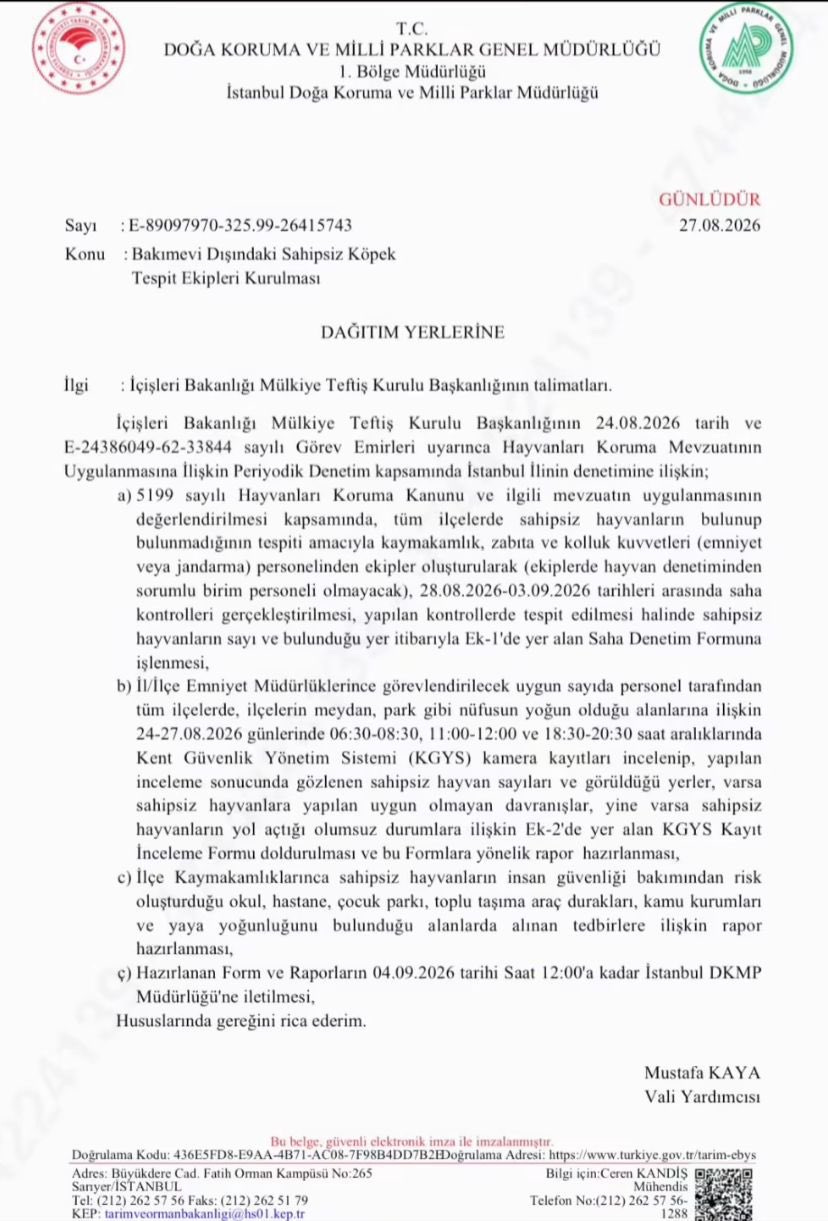
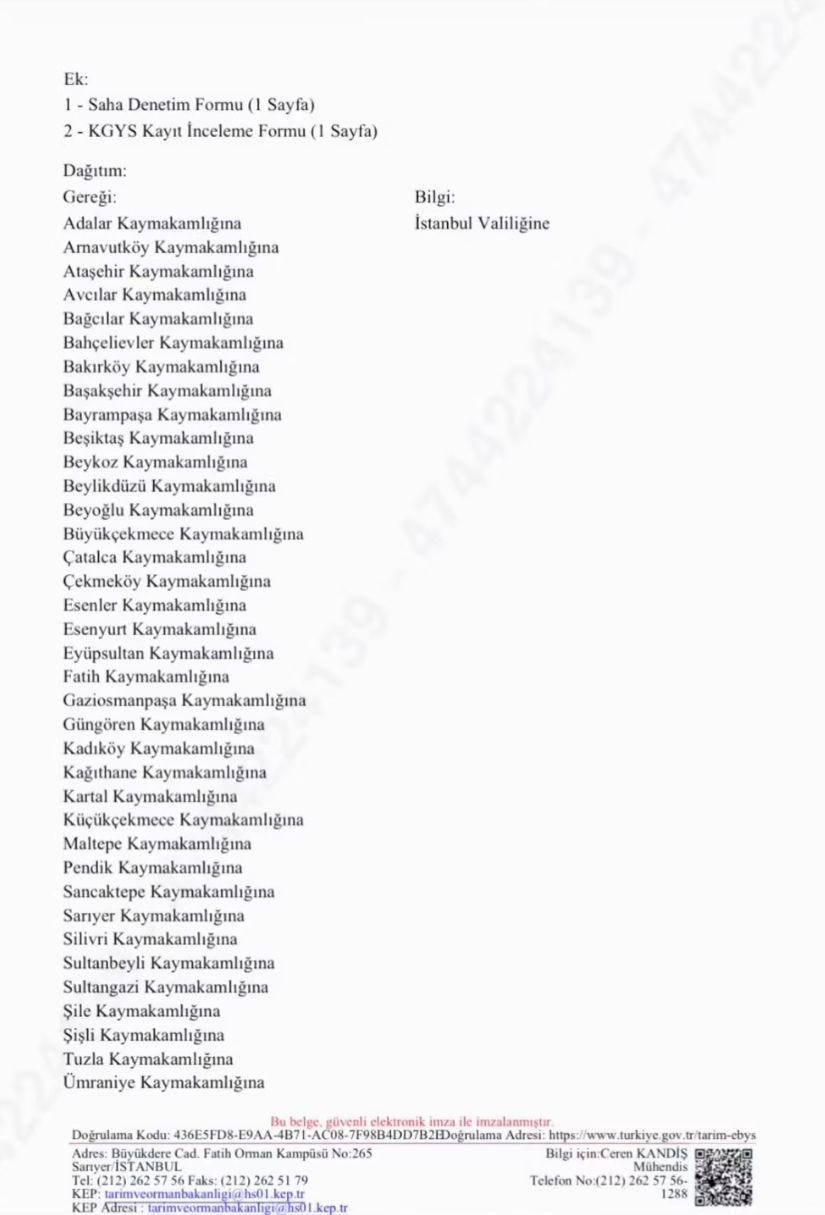
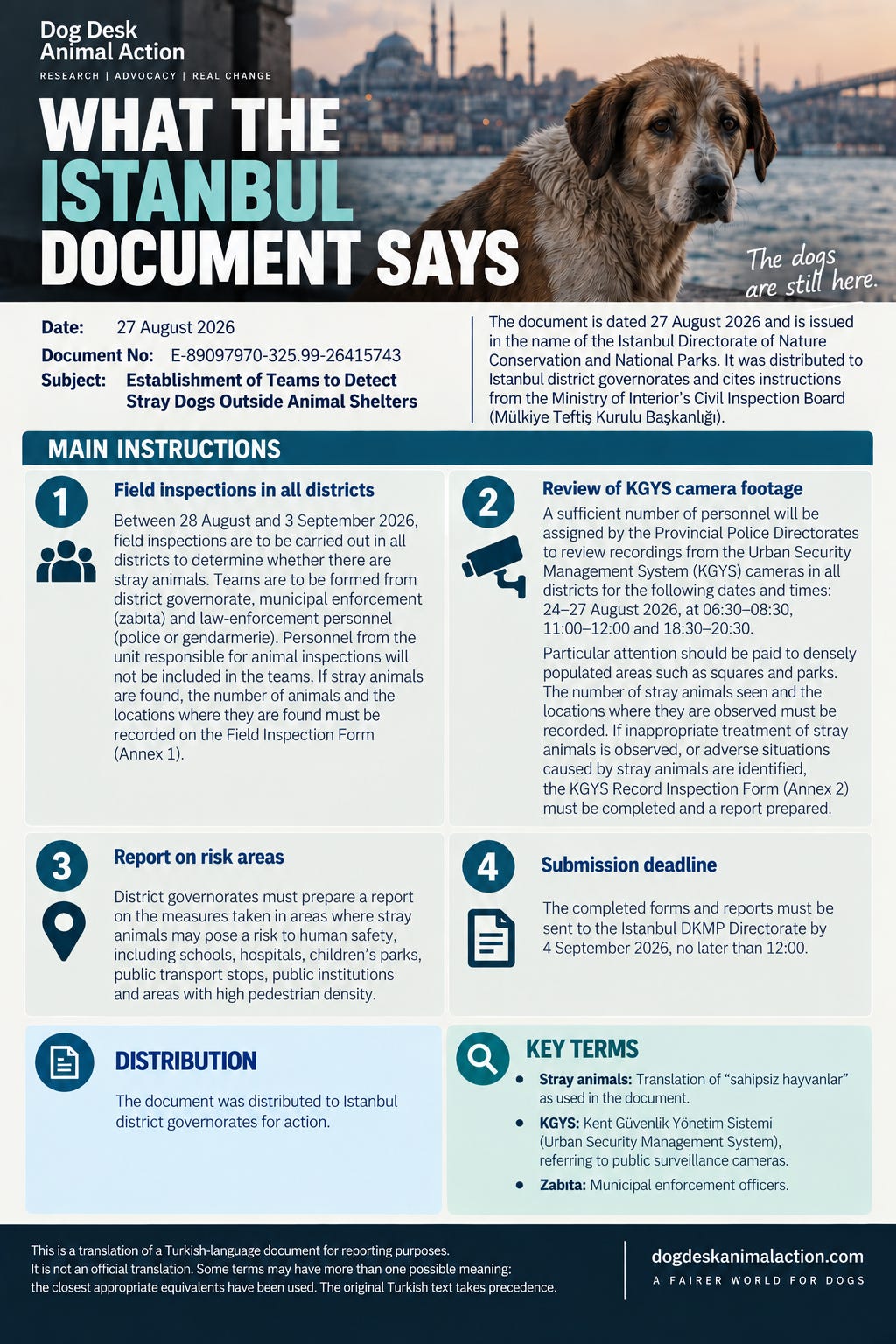
Document note: Dog Desk Animal Action has reviewed a copy of the 27 August 2026 Istanbul Directorate of Nature Conservation and National Parks document, reference E-89097970-325.99-26415743. Its institutional details, signatory and subject matter have been cross-checked against public sources and contemporary discussion of the same order. Dog Desk Animal Action has not independently retrieved the document through the Turkish Government EBYS system. The referenced 24 August Interior Ministry instruction, E-24386049-62-338444, has not yet been located publicly.