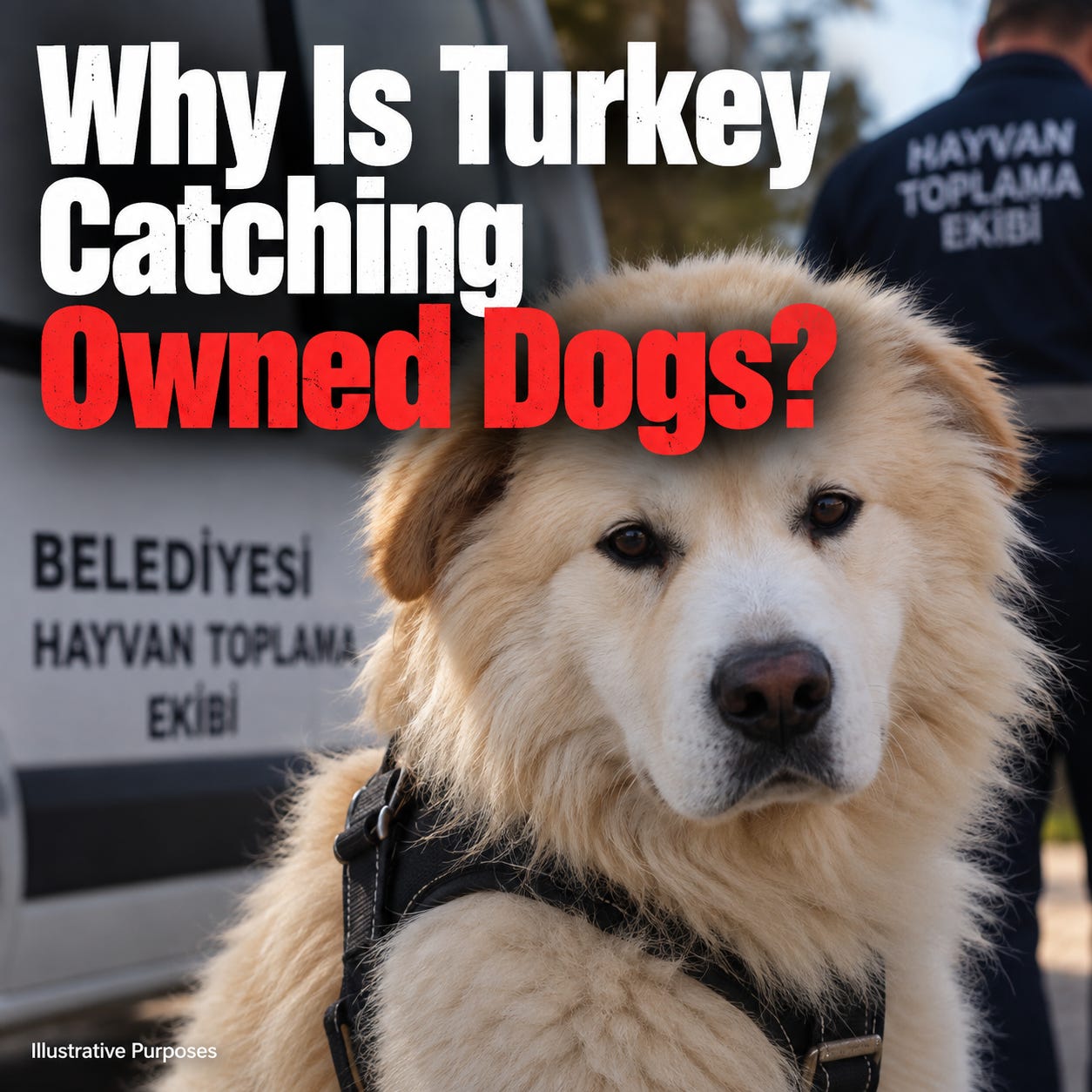
Rio was not an unidentified street dog. He was seven and a half years old, he had a family and he was microchipped. Yet on 4 September 2026, according to his owner Elanur Gürel, Rio was picked up in Çanakkale by a Kepez Municipality animal collection team, immobilised using a tranquilliser dart and taken away.
She says there was no veterinarian physically present when Rio was darted. She says she was initially told that no injection had been used, but when she eventually reached the shelter it was confirmed that an injection had been administered. She also says she was not initially told where Rio had been taken and, despite him being a microchipped owned dog, she was told that he was a stray and was not registered with the Ministry of Agriculture and Forestry.
When Rio was finally returned to her, Gürel says his harness was missing, he was brought from a dark area and he was struggling to walk. She has now filed a criminal complaint.
There are allegations here which Kepez Municipality must have an opportunity to answer, but there should also be records and those records should make establishing exactly what happened to Rio relatively straightforward.
Türkiye’s current Regulation on the Implementation of the Protection of Animals specifically deals with the capture of stray animals. Collection teams must consist of competent people who receive periodic training from the responsible veterinarian and dogs can be captured using cages, nets or catching poles. When a tranquilliser gun or blowpipe is used, however, the regulation says that capture must take place under veterinary coordination.
If chemical immobilisation was used, Kepez Municipality should be able to tell us which veterinarian coordinated it, what drug was authorised, what dose was given, who administered it and what happened to Rio afterwards. If a drug was fired into a dog whose age, weight and medical history may not have been known to the collection team, there should be a veterinary decision and a record behind it.
Then there is Rio’s microchip, because this is where the case becomes about considerably more than one dog.
Türkiye has spent years building a national identification system for owned animals. A microchip is supposed to connect an animal to the person responsible for them. More importantly, the rules governing animals entering shelters require dogs to be checked for a microchip. Where an animal is identified as owned, the relevant provincial or district Directorate of Agriculture and Forestry must be informed within 24 hours.
So what happened when Rio arrived?
Was he scanned? If he was, what did the scanner find? Was his registration checked against PETVET? If it identified his owner, what happened next? If Kepez Municipality maintains that Rio was not registered, what did its database search show? If his chip could not be read, was that recorded?
This should not come down to one person’s word against another because there should be an electronic and operational trail showing exactly what happened.
Kepez Municipality’s own published rules make this even more relevant. Its Veterinary Affairs Directorate regulations place responsibility on municipal veterinarians for the first health examination of animals arriving at the centre and require medicines used during treatment to be prescribed according to legislation. Veterinarians are also responsible for checking that information entered into the relevant animal databases is complete and accurate. Veterinary technicians can perform procedures including injections, but under veterinary control.
Somewhere, therefore, there should be a Rio file.
There should be a record of when and where he was collected, a record of his admission, a microchip check, a registration check and a veterinary examination. If chemical immobilisation was used there should be a record showing what was administered, how much was administered, who administered it and which veterinarian was responsible for coordinating or supervising that procedure. If Rio was having difficulty walking afterwards, there should be observations recording his condition following sedation and before he was returned to his owner.
Rio’s case has happened in the middle of one of the largest dog collection programmes Türkiye has ever undertaken.
Authorities have reported that 98.69% of the country’s stray dogs have now been collected. As the number of dogs remaining outside falls, the dogs left become increasingly important to identify correctly. They may include dogs that are harder to catch, dogs moving between neighbourhoods, community dogs cared for by local people and owned dogs whose status may not be immediately obvious to a collection team.
That is precisely when safeguards should become more important, not less. A microchip is one of those safeguards.
If a microchipped owned dog can be chemically immobilised, transported into the municipal collection system and allegedly described as an unregistered stray, then we need to understand where that safeguard failed. Was Rio not scanned? Was the chip not detected? Was the registration information incorrect? Was the database not checked? Or was the information available and something else went wrong?
We spend a great deal of time asking what happens to dogs after they disappear into collection systems. In Rio’s case, the dog came back out.
Dog Desk Animal Action has not found a public response from Kepez Municipality addressing Gürel’s allegations at the time of writing and the municipality has a right to reply. We would particularly like to know whether Rio was collected by its team on 4 September, whether chemical immobilisation was used, which veterinarian coordinated the procedure, what drug and dosage were administered, whether Rio was scanned for a microchip on admission, what that scan and subsequent registration check showed and why his owner says she was told that her microchipped dog was an unregistered stray.


