

Türkiye Says 97% of Its Street Animals Have Been Collected. Now It’s Time To Account For Them

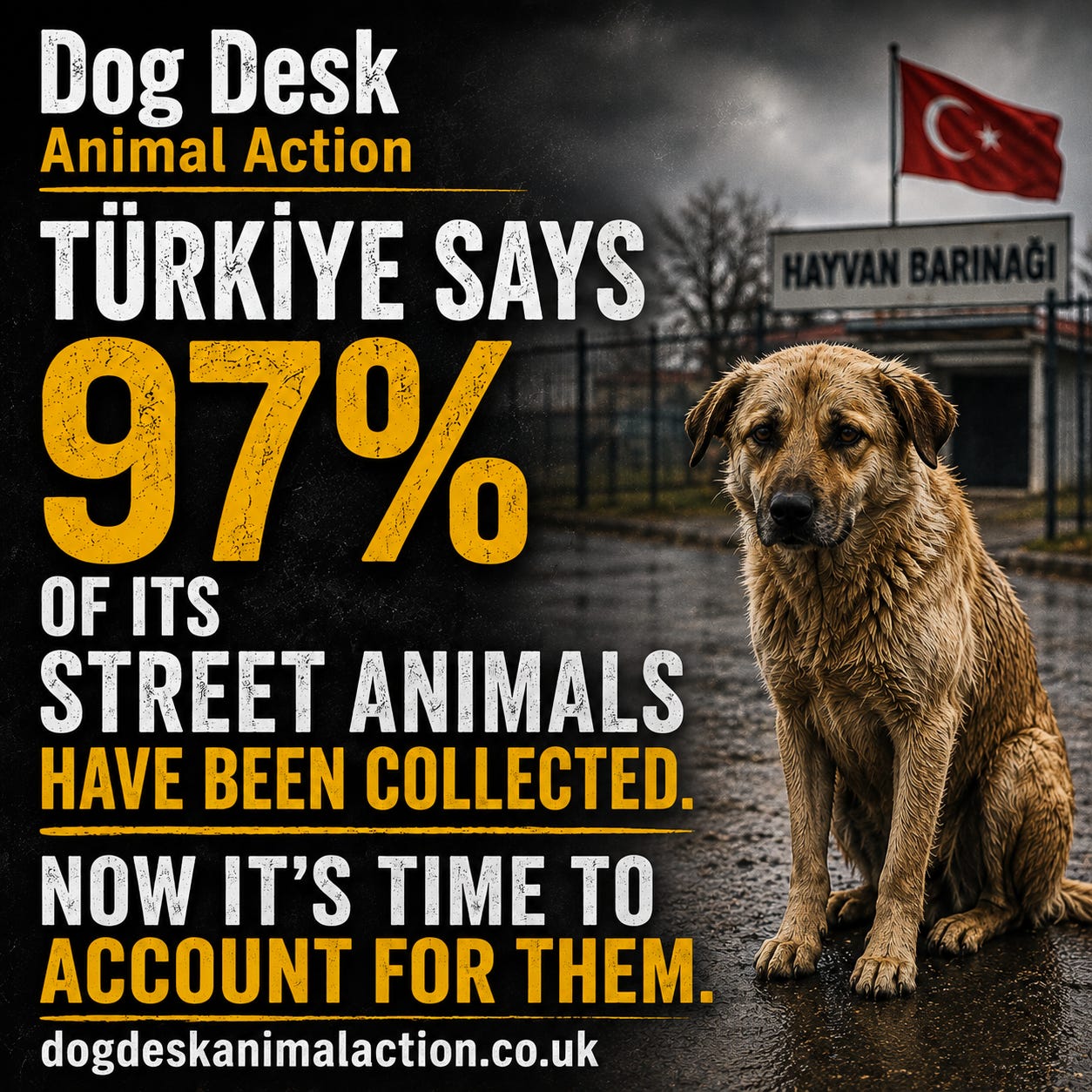
Türkiye’s Interior Minister Mustafa Çiftçi has said that 97% of the country’s unowned street animals have now been collected and that the government expects the remainder to be removed from the streets by the end of October.
It is an extraordinary claim, particularly because the government has not told us how many animals that 97% represents.
Çiftçi made the statement during an NTV broadcast on 13 August and his comments have since been published by the Interior Ministry. He explained that collected animals are taken to shelters or designated natural living areas where they are treated and sterilised, with animals offered for adoption and those that are not adopted remaining within the system.
The minister referred broadly to unowned street animals rather than specifically to dogs, which is an important distinction, although dogs have been at the centre of the enormous collection programme that followed the changes to Türkiye’s Animal Protection Law in 2024.
Türkiye has never had a particularly reliable national figure for its street animal population. Around the time the law changed, a figure of approximately four million was widely discussed, while other estimates varied considerably. Parliament was also told at the time that the country had 322 shelters with a combined capacity of around 105,000 animals.
Capacity has increased since then. Municipalities have built shelters and natural living areas and expanded existing facilities, so it would be misleading to compare today’s collection claim directly with a capacity figure from 2024. What we need instead are current figures showing how many animals have been collected, how many places are now available and how many animals are actually living within those facilities.
We also need to know what has happened to animals after collection because we know that dogs have died.
This is not speculation based on dogs disappearing from the streets. Deaths within municipal animal systems have been documented and recent reporting concerning Ankara has brought the issue into particularly sharp focus.
Ankara Governor Yakup Canbolat has said that 52,000 unowned street animals have been collected across the province, while an earlier figure put Ankara’s shelter capacity at 13,045. BBC Türkçe has subsequently reported on official records concerning animals that died after entering municipal facilities.
Those figures cannot simply be placed alongside one another and used to conclude that the difference represents dead or missing animals. Capacity may have increased, animals may have been adopted or transferred and natural living areas provide additional accommodation. But the recorded deaths demonstrate exactly why collection figures alone are not enough.
Once an animal has been collected, there should be a record of what happened next. Some will remain in shelters or natural living areas, some will be adopted or transferred and some will die. Those outcomes are what allow us to understand what a collection programme has actually meant for the animals involved.
This becomes particularly important when the government is now saying that collection has reached 97% nationally. If almost the entire population of Türkiye’s unowned street animals has entered this system, there should be enough information to reconcile the number collected with the animals currently housed and the recorded adoptions, transfers and deaths.
At the moment, that national picture has not been published alongside the claim.
Çiftçi has also announced that the Interior Ministry’s Civil Inspection Board will begin inspecting shelters across Türkiye from the end of August. Inspectors are expected to examine collection practices, sterilisation, treatment, animal welfare and compliance with the law.
Those inspections could provide an important opportunity to establish what has been happening after animals are removed from the streets. Records of animals entering facilities should be capable of being reconciled with the animals still there and with documented outcomes for those that are no longer present. Mortality records in particular matter because we already know that dogs have died within the system.
The inspections also come at an important moment. Çiftçi says the original target of completing collection by the end of the year has now been brought forward to the end of October, meaning pressure on municipalities to remove the animals that remain is likely to increase.
Before that happens, there needs to be far greater transparency about what has happened to those already collected. The government’s 97% figure sounds remarkably precise, yet without the population estimate used to calculate it and without national outcome data, we cannot properly understand what that figure represents.
Those inspections could provide an important opportunity to establish what has been happening after animals are removed from the streets, but they also need to go considerably further than checking whether the correct procedures appear to be in place.
We already know there are serious problems within parts of Türkiye’s shelter system. There have been documented deaths, allegations of mistreatment, questions about conditions and repeated concerns about what happens to dogs once they are collected. Access to some facilities is restricted, making independent scrutiny difficult, while enormous collection figures continue to be announced without the corresponding information that would allow the public to follow those animals afterwards.
Against that background, saying that animals have been taken to shelters or natural living areas cannot be treated as an answer to concerns about their welfare. A dog being removed from a street and placed behind the gates of a municipal facility tells us where responsibility for that animal has moved. It does not tell us whether the dog is safe.
That is why the inspections beginning at the end of August matter so much. They need to establish not only whether municipalities are collecting animals and completing the required paperwork, but whether the animals themselves can be accounted for and whether the conditions in which they are being kept meet the standards the government says should apply.
The timing makes this particularly urgent. Çiftçi says the original target of completing collection by the end of the year has now been brought forward to the end of October. That means the final stage of this enormous programme is being accelerated at the same time that questions remain about what has happened to animals already collected.
The government’s 97% figure sounds remarkably precise, yet we have not been given the population figure used to calculate it or the national outcome data necessary to understand what has happened to the animals behind it.
We know dogs have died. We know there have been serious concerns about conditions inside facilities. We know that in some places it is extremely difficult for the public to see what is happening behind shelter gates.
So when the government tells us that 97% of Türkiye’s unowned street animals have been collected, the fact that they have been taken off the streets is not enough.
The question now is whether Türkiye can account for them, and whether it can demonstrate that the animals still in its care are safe. We are following