

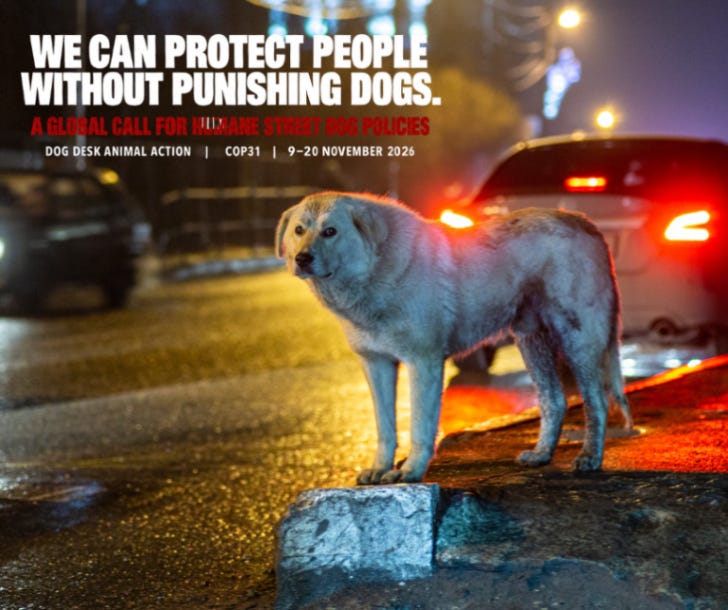
On 9 November 2026, as COP31 opened in Antalya, Dog Desk Animal Action published a message on X announcing the beginning of our 12-day global campaign.
The message was straightforward:
Across the world, street dogs are being rounded up in the name of public safety.
But we don’t have to choose between protecting people and protecting animals.
WE CAN PROTECT PEOPLE WITHOUT PUNISHING DOGS.
There was no accusation against Türkiye. No criticism of Turkish citizens. No reference to Turkish legislation. The post did not suggest that concerns about public safety were unreasonable, nor did it dismiss the suffering of people injured or killed by dogs.
It said across the world.
Antalya was mentioned because it was hosting COP31. Our campaign was international, addressing the treatment of street dogs wherever governments resort to mass collection or culling in the name of public safety.
Nevertheless, some of the responses treated our message as though it were a direct attack on Türkiye.
What followed was not simply disagreement about animal welfare. It included obscene insults, discriminatory language, degrading personal remarks and repeated demands that we take dogs to Britain.
A disagreement we had not started
One respondent demanded that we bring a child who had reportedly died following a dog attack back to life or apologise. Another dismissed our position as nonsense and accused advocates of manipulating figures. Others told us to take the dogs to England, questioned our right to speak about their country or resorted to explicitly abusive language.
Some of the responses raised concerns about dog attacks, rabies and the effectiveness of sterilisation programmes. These are legitimate subjects for serious public discussion. Governments have a responsibility to protect people from preventable harm, and nobody should minimise the consequences of dog attacks or infectious disease.
But those concerns do not explain why a statement supporting the protection of people and animals should be treated as though it opposed human safety.
Our message did not ask anyone to choose dogs over children. It explicitly rejected the idea that protecting one required abandoning the other. Yet several responses appeared to proceed from precisely that assumption.
This is an important distinction because the hostility was directed not simply at what we had written, but at positions attributed to us that our post did not express.
The demand that foreign advocates remain silent
One of the most consistent themes in the responses was the suggestion that British animal welfare advocates had no right to comment.
We were told to take the dogs to London, feed them in British streets or concern ourselves with our own country. Other replies questioned who we thought we were to involve ourselves in Türkiye’s affairs.
Similar language appeared beneath posts by British actor and animal welfare advocate Peter Egan, who was also subjected to personal insults and degrading imagery.
The repetition of these arguments is notable, although it does not establish that the accounts were acting together.
The underlying proposition was that an advocate’s nationality somehow determines whether their concerns deserve consideration.
But animal welfare is not a question of national ownership. Neither is public safety. Both are legitimate subjects of international discussion, particularly when policies affecting animals and communities are being examined across different countries.
A British organisation discussing the global treatment of street dogs is not demanding control over another country’s affairs. Nor does the nationality of an advocate invalidate an argument about humane treatment.
More importantly, our original post had not even identified Türkiye as the subject of criticism.
The respondents who insisted that we stop interfering in Türkiye had introduced that interpretation themselves.
The insults and Türkiye’s own laws
There is another dimension to this reaction that warrants closer examination. Türkiye is a country in which insulting another individual can constitute a criminal offence.
Article 125 of the Turkish Penal Code protects personal honour, dignity and reputation. It covers certain insulting statements made verbally and through written or visual communications, including online messages. Depending on the circumstances, the law provides for imprisonment or a judicial fine.
This legislation is not restricted to the President or other public officials. Ordinary individuals can also be the subjects of criminal insult complaints. And the law is actively enforced.
According to Ministry of Justice figures disclosed during parliamentary proceedings in December 2025, Turkish prosecutors opened 534,505 investigations involving online insults in 2024. Of those, 60,276 resulted in criminal charges, while courts recorded 11,161 convictions and 10,088 suspended sentences.
The figures cover different categories of insults under Article 125, including offences involving public officials. They cannot all be described as disputes between private individuals. Nevertheless, they demonstrate the substantial scale of criminal enforcement concerning online expression.
Individual cases illustrate how seriously such complaints can be treated.
In the Ethem Kut case, a Facebook comment about a bar association president led to a criminal complaint, prosecution and an initial judicial fine of 2,100 Turkish lira. The case later reached Türkiye’s Constitutional Court, which found a violation of freedom of expression and ordered a retrial.
That subsequent judgment is important. It demonstrates that the existence of an insult law does not mean every offensive statement is lawfully punishable. Freedom of expression must also be protected, and courts must distinguish unlawful personal attacks from legitimate criticism.
Nevertheless, the legal framework raises an obvious question when viewed alongside the abuse directed at animal welfare advocates.
If Türkiye considers certain forms of personal insult serious enough to justify criminal proceedings, how should we understand the extraordinary language being directed at people whose original statements were neither abusive nor personally accusatory?
What happened to the actual message?
Perhaps the most revealing feature of this exchange is how quickly the original subject disappeared.
Our post was about the possibility of protecting people and animals simultaneously. It invited consideration of humane public safety policies across the world.
Instead, parts of the discussion became arguments about Britain, accusations of foreign interference and personal attacks on advocates.
The central proposition, that public safety and animal welfare need not be mutually exclusive was largely displaced.
This is not unique to Türkiye, and we would be wrong to suggest otherwise. Hostile online exchanges occur internationally, including in Britain. Animal welfare debates can become intensely polarised wherever communities are confronting difficult questions about free-roaming dogs, public health and government responsibility.
Nor should the abusive comments of a relatively small number of social media users be presented as representative of Turkish society. They are not evidence of what an entire country thinks. But that does not make the behaviour insignificant.
When a statement is interpreted as an attack that it never made, the resulting argument can become detached from the evidence, the policy and even the words originally published.
And when personal abuse replaces discussion, opportunities to examine practical solutions are lost.
Public safety deserves better than this
We recognise that dog attacks can have devastating consequences. We recognise the fear experienced by communities where free-roaming dog populations are poorly managed. We recognise the importance of rabies prevention, responsible population management and effective public services.
These are not positions we have suddenly adopted in response to criticism. They are entirely consistent with the message we published.
Protecting people is a legitimate and essential responsibility of governments. So is ensuring that animals under human control are treated humanely.
The question is not whether people deserve protection. Of course they do. The question is whether protecting them requires avoidable cruelty towards animals, and whether governments can develop approaches that address both responsibilities.
That is a legitimate international animal welfare discussion. It should be possible to have it without being personally abused.
The evidence, and what it does not establish
Dog Desk Animal Action has retained screenshots of a number of responses directed at our account and at Peter Egan. They document examples of personal insults, discriminatory language, national exclusion and attempts to redirect discussion away from the original message.
The screenshots are a selected collection, not a representative survey of public opinion. Some comments appear in translation, and their original wording would need to be checked before being reproduced in a formal legal analysis.
We have not established organised coordination, official involvement or selective enforcement of Türkiye’s criminal insult legislation.
What the evidence does establish is narrower, but important: a global statement advocating protection for both people and dogs attracted responses that treated it as a hostile intervention in Türkiye and, in some cases, answered it with personal abuse.
We said across the world
There is a reason we are returning to the exact wording of our original post.
We said across the world because the treatment of street dogs is a global issue. We said we could protect people without punishing dogs because we reject the assumption that human safety and animal welfare must always be placed in opposition.
We did not ask anyone to disregard the suffering of children. We did not deny public health risks. We did not attack Türkiye. Yet some respondents behaved as though we had done all three.
In a country where criminal law expressly recognises the importance of protecting personal dignity from insults, the language used against advocates making a peaceful statement about animal welfare is particularly worthy of scrutiny.
We do not need to exaggerate the evidence or make accusations we cannot substantiate. The original post and the responses speak clearly enough.
We spoke about the world. Some respondents made it about Türkiye.
We spoke about protecting people and dogs. Some responded with personal abuse.
And we will continue to ask the question that began this campaign:
Why should protecting people require punishing dogs?
Sources and documentation
Turkish Penal Code, Article 125 — Ministry of Justice legislation database: https://mevzuat.adalet.gov.tr/mevzuat/103228
Ministry of Justice statistics disclosed in parliamentary proceedings, December 2025, reported by Turkish Minute: https://www.turkishminute.com/2025/12/05/turkey-opened-more-than-1-1-million-criminal-insult-investigations-in-2024/
Turkish Constitutional Court, Ethem Kut, Application No. 2022/66356, decision of 15 January 2025: https://eski--kararlarbilgibankasi.anayasa.gov.tr/BB/2022/66356
Dog Desk Animal Action’s original X post, 9 November 2026, and retained screenshots of selected responses.
The observations concerning social media responses are based on material documented by Dog Desk Animal Action. They should not be interpreted as representative of Turkish public opinion or as legal findings against individual commenters.