


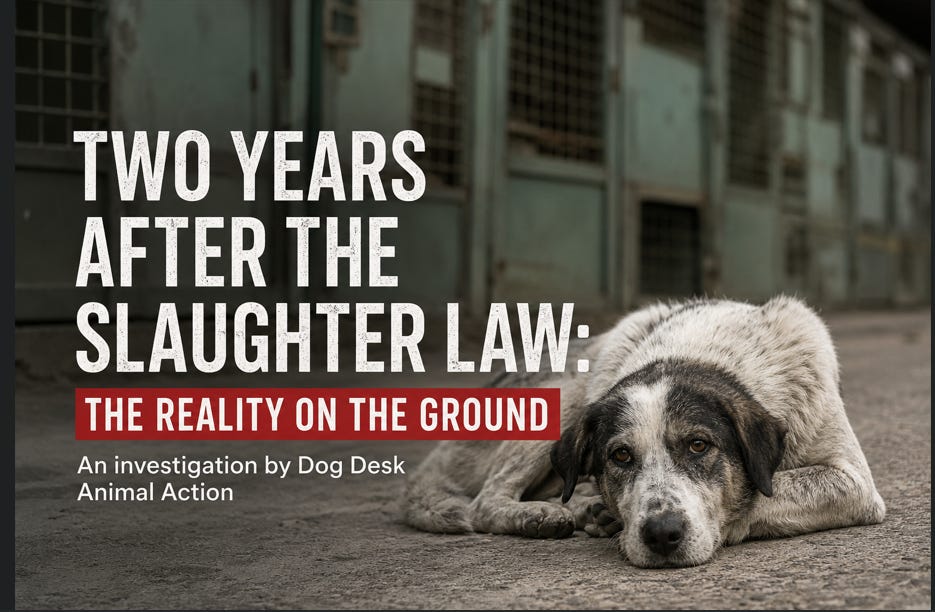
For the past two years, the Slaughter Law has dominated the discussion surrounding animal welfare in Türkiye. It has been praised as a necessary response to a growing free roaming dog population and condemned as one of the most controversial pieces of animal welfare legislation in the country’s modern history. Politicians have defended it, municipalities have been tasked with implementing it and animal welfare organisations have continued to challenge both its purpose and its consequences.
During that time, much of the debate has been driven by prediction. Before the legislation came into force, supporters argued that it would improve public safety and create a more structured approach to managing free roaming dogs. Critics warned that removing hundreds of thousands of dogs from the streets would place enormous pressure on municipal shelters, create significant welfare risks and reduce public oversight of what happened once those animals disappeared behind shelter gates.
Two years later, we no longer need to speculate.
For almost every day since the law came into force, Dog Desk Animal Action has monitored its implementation. We have followed government announcements, analysed municipal statements, reported on court proceedings, documented developments province by province and spoken to rescuers, veterinarians, volunteers and citizens living through one of the most significant changes to animal welfare policy that Türkiye has ever experienced. Two years of reporting provides something that did not exist when the legislation was first introduced, the opportunity to examine not what the law was intended to achieve, but what it has actually delivered.
That distinction is important because legislation should never be judged solely by the words written within it. Every government promises that its policies will improve the situation they seek to address. The real test comes afterwards. Do those policies achieve their objectives? Are they implemented consistently? Do they produce the outcomes that were promised? Most importantly, do they withstand scrutiny once they move beyond Parliament and into the real world?
The implementation of the Slaughter Law has been unprecedented in its scale. Government figures have reported that more than 975,000 street animals have been collected since implementation began, while municipalities across all 81 provinces have continued to expand collection programmes and develop new shelter facilities. Ministers have repeatedly emphasised progress, governors have published collection figures and local authorities have announced new so called natural life areas and expanded accommodation as evidence that implementation is moving forward.
Those figures tell us how many animals have entered the system but they tell us almost nothing about what happened to them afterwards.
This is where the conversation becomes considerably more difficult. Over the past two years, concerns have emerged from province after province regarding the practical implementation of the legislation. Videos showing the collection of frightened dogs have circulated widely. Animal welfare organisations have documented allegations relating to shelter conditions, handling methods and transparency. Citizens have organised demonstrations in response to local developments. Lawyers have challenged aspects of implementation through the courts. Journalists have investigated municipalities. Volunteers have searched shelters for dogs they had cared for for years. Each incident has generated its own headlines, but together they reveal something more significant than any single event could ever demonstrate.
They reveal the gap between policy and implementation.
That gap is not the same everywhere. Türkiye is a country of 81 provinces and hundreds of municipalities, each operating with different budgets, facilities, veterinary provision and levels of experience. Some municipalities have invested in improved infrastructure and appear to be making genuine efforts to improve standards. Others have become the subject of repeated public concern and allegations that have attracted national and international attention. A balanced assessment must recognise both realities. At the same time, it is impossible to ignore the inconsistency that has characterised implementation over the past two years. Animal welfare should never depend upon which municipality happens to collect a dog.
Perhaps the most significant issue to emerge since the legislation came into force is not simply the number of dogs collected, but the limited transparency surrounding their outcomes. Public announcements regularly tell us how many animals have been removed from the streets, yet far less information is available about what happens once those animals enter municipal facilities. Comprehensive national data on adoptions, mortality, long term shelter populations and welfare outcomes remains difficult to obtain. That absence of information makes meaningful public scrutiny considerably more challenging and leaves fundamental questions unanswered.
Transparency should not be viewed as an obstacle to implementation. It is one of the foundations of public confidence. If a programme involving hundreds of thousands of living animals is operating successfully, then the evidence should be capable of withstanding independent examination. If it cannot, legitimate questions will inevitably continue to be asked.
During the past two years, Dog Desk Animal Action has reported on municipalities that have invested in new facilities, but we have also documented allegations of poor handling during collections, reports of overcrowding, concerns surrounding shelter conditions, legal challenges, protests and repeated questions from citizens trying to locate dogs that had disappeared from the communities where they had lived for years. None of these developments should be viewed in isolation. Together, they provide a picture of implementation that is significantly more complex than either supporters or opponents of the legislation often acknowledge.
The debate surrounding the Slaughter Law has therefore reached a different stage. The question is no longer whether the legislation should have been passed. It exists, it has been implemented and its impact is already being felt across the country. The question now is whether implementation has consistently met the standards of welfare, transparency and accountability that should accompany any programme affecting such a vast number of animals.
That question cannot be answered by collection figures alone. It requires an honest examination of what happened after the dogs disappeared from the streets.
For the past two years, Dog Desk Animal Action has documented the implementation of the Slaughter Law almost daily. We have reported on government announcements, municipal decisions, court proceedings, protests, shelter developments and the experiences of rescuers, veterinarians and citizens across Türkiye. Together, those reports provide a substantial body of evidence charting how the legislation has been implemented since it came into force.
This anniversary also marks the next stage of our Global Stray Dog Crisis Map project. The map identifies countries where free roaming dogs are facing significant welfare crises and is supported by dedicated country hubs that bring together our reporting, research and policy analysis. We have already launched our Pakistan and Romania Hubs, each accompanied by a Briefing Paper No. 1. Türkiye has long been identified as one of the crisis countries on the map, and the evidence gathered over the past two years will now form the basis of our next country hub and its accompanying briefing paper.
The purpose of these hubs is not simply to document events. It is to create an evidence base that enables readers, policymakers, journalists and animal welfare organisations to understand how these crises develop, how governments respond and, most importantly, what those responses mean for the welfare of free roaming dogs. Two years after the Slaughter Law came into force, Türkiye’s story deserves that level of scrutiny.